
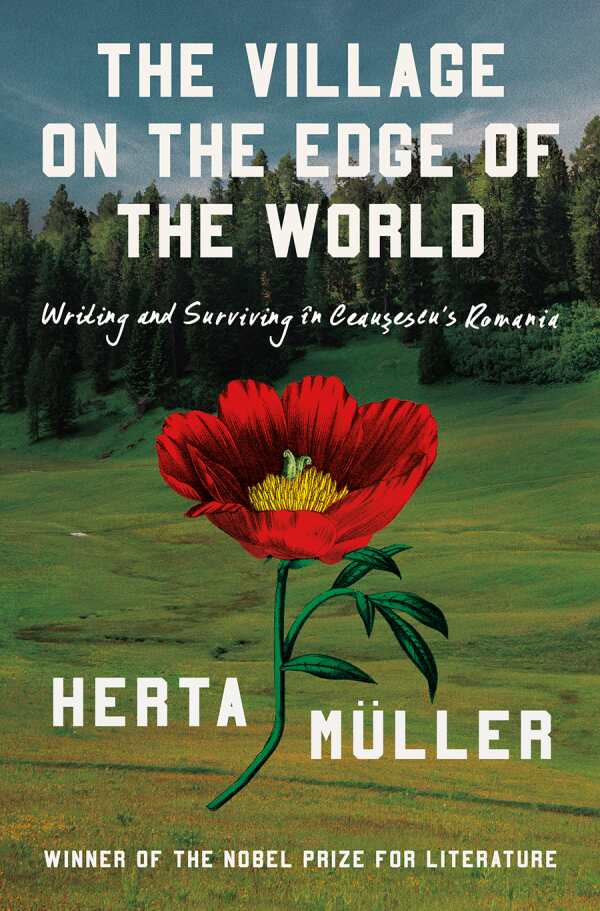

The Village on the Edge of the World
Writing and Surviving Ceausescu's Romania
A harrowing memoir about artistic integrity under state repression, The Village on the Edge of the World collects Nobel Prize-winning novelist Herta Müller’s reflections on growing into her vocation during the socialist dictatorship of Nicolae Ceaușescu.
Before she earned an international reputation for her complex, layered fiction, Müller grew up in a German-speaking Romanian household fissured by the horrors of World War II and postwar communist repression. Her father served in the Waffen-SS; her mother was one of tens of thousands deported to a Soviet labor camp as a teenager. Village life, Müller explains, was full of aching loneliness and isolation, but also sparked her first interests in language and storytelling.
In her adulthood, Müller migrated to the city and befriended like-minded artists and writers. There, she experienced the full brunt of the police state’s manufactured paranoia. Her apartment was bugged; she was tormented for declining to be an informant; her friends, including Rolf Bessert, were manipulated into madness or suicide by the secret police; and she faced brutal interrogation and near-constant psychological intimidation. Amid these soul-dampening trials, though, she cultivated inner resilience, yearning to express the truths of her experiences through art.
Because the book is a collection of Müller’s previous writings, built on conversations with her editor, Angelika Klammer, it unfolds in a nonlinear, associative manner, resulting in some missed dramatic progressions. Still, its prose strikes a winning balance between sober hindsight and raw directness. Müller’s portrayal of paranoia is a particular triumph—a horrifying portrait of the Ceaușescu regime’s efforts to stymie all forms of private dissent and expression.
The Village on the Edge of the World is a masterful memoir that meditates on art, legacy, and the endurance of the human spirit.
Reviewed by
Isaac Randel
Disclosure: This article is not an endorsement, but a review. The publisher of this book provided free copies of the book to have their book reviewed by a professional reviewer. No fee was paid by the publisher for this review. Foreword Reviews only recommends books that we love. Foreword Magazine, Inc. is disclosing this in accordance with the Federal Trade Commission’s 16 CFR, Part 255.


