

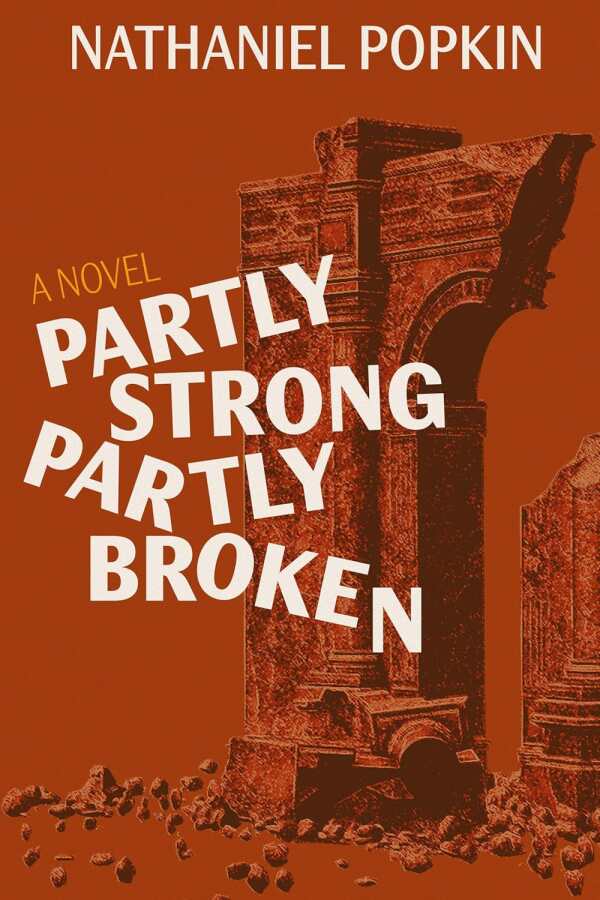
Partly Strong, Partly Broken
Set among a New Jersey synagogue’s staff and congregants in the month prior to the October 7, 2023 attacks, Nathaniel Popkin’s sobering novel Partly Strong, Partly Broken reveals the discord already roiling in liberal Jewish communities.
Adinah, an anti-Netanyahu rabbi who has “the capacity to seize on a singular light, to follow it as far as it would go,” heads Temple Beth Israel, whose story, she thinks, is quintessentially American. Among its congregants are people who believe in the necessity of Israel’s protection and those who decry the state; those who crave global Jewish connection, and those who prioritize interfaith activism in a time of increased, systemic hate. It is Rabbi Adinah’s job to navigate among and reconcile these cross-sections of opinion—in addition to handling issues like a roof collapse, a building manager’s ineptitude, and the rhythms of the Days of Awe. All is complicated further when a cherished synagogue worker and friend is the victim of a hate crime and elements of Adinah’s interfaith response go sideways.
Throughout this inquisitive and perspective-inclusive book, Adinah wrestles with what it means to be progressive while also holding Israel dear. Her own rabbinate, she knows, would not have happened without an early visit to Israel:
She hadn’t really understood what it meant to feel Jewish before [her] six weeks bathing in the mikveh waters of the eastern Mediterranean and the Galilee and drinking limonana, observing her body and mind merging toward cypress and cedar.
At the same time, she struggles to articulate this inheritance in a way that might satisfy all of her congregants’ needs and allegiances—and her own ambivalence. In this way, her struggles become a microcosmic reflection of the contradictions and vivifying forces that characterize contemporary American Judaism.
As the book continues, Adinah confronts her immediate challenges with determination, but sometimes falters. She wants to fix the pain points she sees around her, to honor her friendship with the local imam, and to repair her relationship with her Palestinian former lover, Sana, but she is tripped up by her tendencies toward romanticization over truly hearing what others need. Her rabbinate is respected, but also compromised, by her broad earnestness, as when she declares “we’re all caretakers of this inheritance, each and every one of us” while failing to intuit where internal political disagreements might make her Hebrew learning center project go awry.
Stopping short of reckoning with the attacks and their aftermath, the story ends just as news of the terrorism breaks. Nonetheless, there’s plenty to wrestle with even before these implosions, making Partly Strong, Partly Broken a novel about the nuances of contemporary Jewish theological struggles that’s worth engaging.
Reviewed by
Michelle Anne Schingler
Disclosure: This article is not an endorsement, but a review. The publisher of this book provided free copies of the book to have their book reviewed by a professional reviewer. No fee was paid by the publisher for this review. Foreword Reviews only recommends books that we love. Foreword Magazine, Inc. is disclosing this in accordance with the Federal Trade Commission’s 16 CFR, Part 255.


