

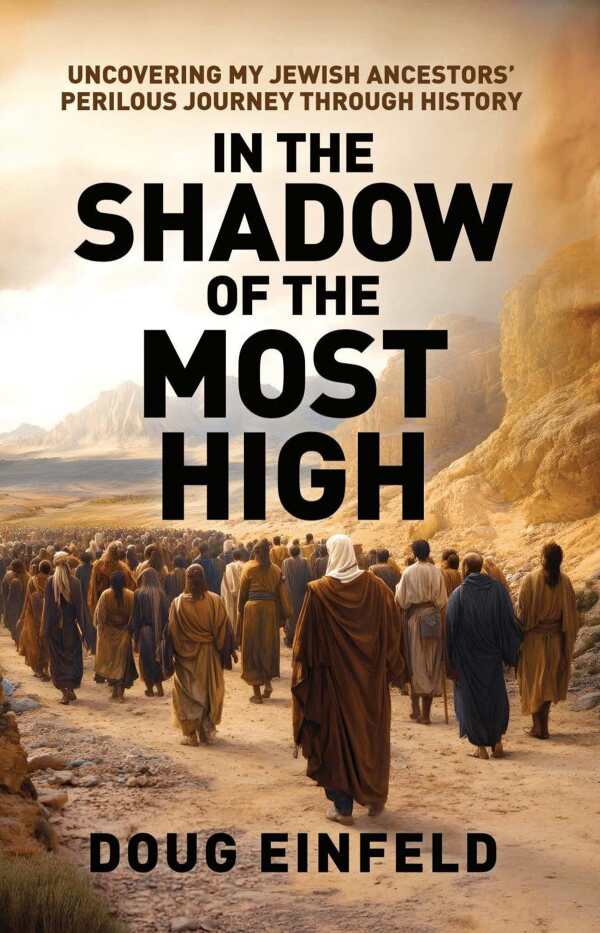
In the Shadow of the Most High
Uncovering My Jewish Ancestors' Perilous Journey Through History
Biblical history stretching from Abraham to Jesus is covered and editorialized upon in In the Shadow of the Most High, a sweeping, personalized text that also considers Jewish-Christian relations in modernity.
Spanning from biblical times to seventeenth-century Germany, retired minister and hospice chaplain Doug Einfeld’s personalized retrospective In the Shadow of the Most High places his Jewish ancestors’ spiritual persistence into historical context.
Einfeld was once surprised to learn that his great-grandfather was Jewish, as his family had longstanding ties to the Christian Reformed Church; his father was even a minister. Nonetheless, genealogical research revealed that some of his German ancestors were baptized as Lutherans while bearing the then-mandated name Juede, or “Jew.” This religious heritage inspired this history of the Jewish faith, in which Judaism’s connections to Jesus and Christianity are also explored.
Biblical history stretching from Abraham to Jesus is covered and editorialized upon in this sweeping text. Here, Moses is humanized as a “murder suspect” who, commanded to liberate the enslaved Israelites, begs “O Lord, please send someone else to do it.” Political and socioeconomic context is is included for changing dynastic kingdoms and empires, oppressive taxation, and cultural and migrational shifts throughout the Middle East. Beyond Roman domination, the “psychopathic tyranny” of Herod and his successors is indicted in the deaths of “two hundred thousand Palestinian Jews.”
The book’s coverage of Jesus is more balanced, contrasting between his messianic community of followers and Judaism’s hopes for a dynamic messiah who would “restore the nation of Israel.” As increasing numbers of Gentiles became Christians, the book asserts, zealous religiosity was used to subvert the gospels through intolerance toward Jews and forced conversions.
While early sections of the book include interspersed references to Einfeld’s Jewish ancestors in Galilee and beyond, the focus becomes more personal as the book reaches coverage of modern Europe. Here, it details the medieval persecution of Jews by German Christians, foreshadowing Nazism. It recounts how Jews were vilified, required to wear identifying attire, exiled to specific neighborhoods, beaten, and burned alive for heresy.
The book concludes with a sense of circular revelation: Einfeld’s known German Jewish relatives are introduced, along with genealogical speculation that their Lutheran conversion in the 1600s was more likely prompted by pragmatic assimilation than spiritual conversion. And while the book covers a range of historical and religious information, its commentary on the deep emotional commitment found within both Jewish and Christian faiths is less objective. A few distracting analogies also arise, as with a stilted comparison of Jesus’s life not being written about until forty years after his death to hypothetically not discussing Ronald Reagan’s presidency until decades later.
Part history, part family memoir, In the Shadow of the Most High looks back on Jewish and Christian history in an expansive and compassionate manner.
Reviewed by
Meg Nola
Disclosure: This article is not an endorsement, but a review. The publisher of this book provided free copies of the book and paid a small fee to have their book reviewed by a professional reviewer. Foreword Reviews and Clarion Reviews make no guarantee that the publisher will receive a positive review. Foreword Magazine, Inc. is disclosing this in accordance with the Federal Trade Commission’s 16 CFR, Part 255.


