

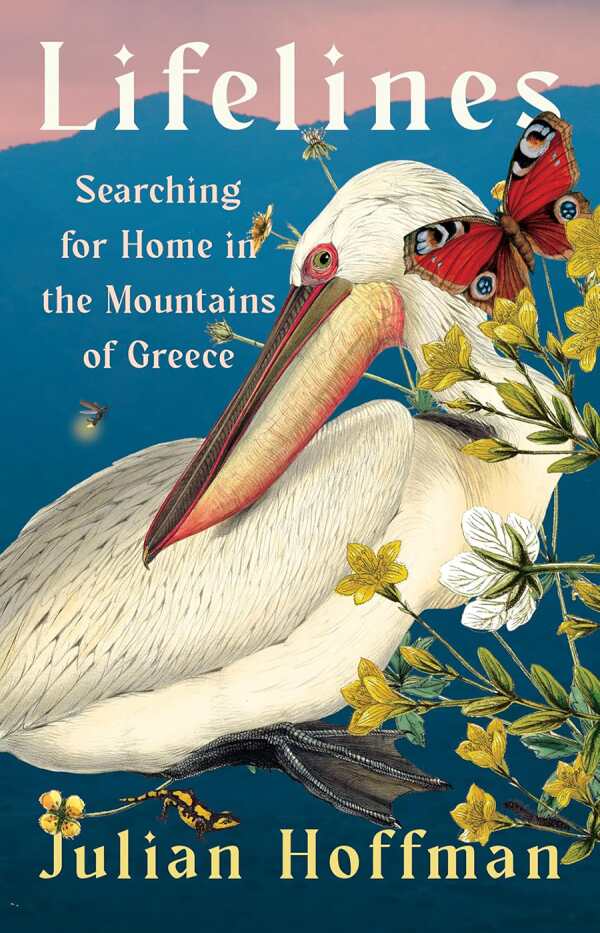
Lifelines
Searching for Home in the Mountains of Greece
Bird-watching, meditations on wildlife, and a move to Northern Greece animate Julian Hoffman’s poetic memoir Lifelines, about the varied meanings of shelter and survival on a changing planet.
Weary of commuting to hectic London, Hoffman and his partner moved to a village in the Prespa Lakes watershed to embrace a wilder rhythm. While there, Hoffman learned of COVID-19 lockdowns—a source of refuge for some; an impossibility for others. He weighed thoughts of how people must work together in tune with the “more-than-human world” to endure the future.
In this elegant series of interlinked essays, Hoffman’s nature observations pivot around the belief that home, from the familial to the ecological, “should really be thought of as a verb—something that requires action for it to become real.” Told in reverent prose with lavish descriptions of plant knowledge and biodiversity, the memoir posits that people’s lifelines depend on many histories, cultures, and factors. Likewise, fragile ecosystems are interconnected too. Indeed, through convincing and urgent examples, including a wildfire and the need to consider borders that extend beyond geopolitical ones, an appealing call for unity is developed.
Tender reflections on wrens, who wintered in an abandoned swallow’s nest, prompt thoughts about adaptability and become a recurrent motif. In one ranging essay, wonderment over junipers and outer space is juxtaposed with the Greek Civil War and the problems with silencing people’s stories. Elsewhere, uncommon permutations of the word “shelter” emerge: Language is compared to a house whose extinction is consequential, much like the loss of song is for birds. Throughout, Hoffman’s adopted village is the still point around which fascinating meanderings converge, building toward hopeful resilience.
Lifelines is an insightful, conscientious memoir about exploring a newfound home and expressing appreciation for the wilderness.
Reviewed by
Karen Rigby
Disclosure: This article is not an endorsement, but a review. The publisher of this book provided free copies of the book to have their book reviewed by a professional reviewer. No fee was paid by the publisher for this review. Foreword Reviews only recommends books that we love. Foreword Magazine, Inc. is disclosing this in accordance with the Federal Trade Commission’s 16 CFR, Part 255.


