

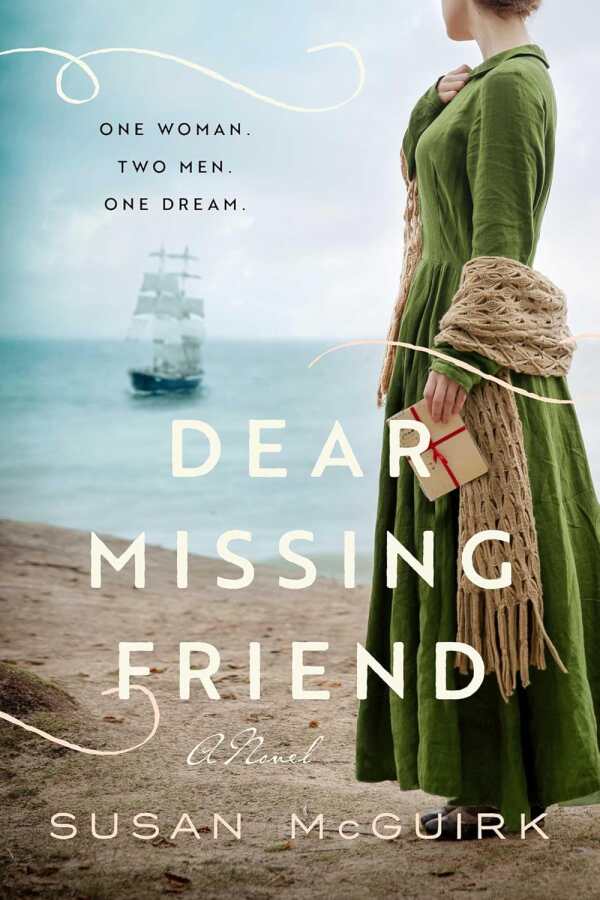
Dear Missing Friend
A Novel
An Irish immigrant yearns for freedom, revealing her most secret hopes in letters to friends and would-be lovers, in the historical novel Dear Missing Friend.
In Susan McGuirk’s epistolary novel Dear Missing Friend, letters go where the heart is meant to travel, enabling a kind of freedom that feels unattainable in daily life.
In the eighteenth century, Catherine, an Irish immigrant who dreams of being a teacher, navigates challenging social interactions, escapes famine, runs a farm, loses friends and family, and balances a lover and a pen pal. Saying “I have never had a life of my own, and I hope for that chance,” she faces three possible paths: She can stick with her unruly lover, trust the promises of an altruistic rich gentleman, or become a governess in New York City. Wherever she goes, she travels with the weight of Ireland’s fate on her shoulders.
Catherine makes note of social mores as she starts over in each new place. She marries a whaler and changes heart because of his often dangerous, roughneck lifestyle; of the whales, he writes,
They can sing, you know. I could hear the tunes on their breath a nautical mile away. The specter of their agonizing deaths plagues my dreams.
A friend, Susie, adds intermittent charm:
You seem more of a grown-up lady now that you have a sweetheart. Soon, you will be too important for the likes of me.
A neighbor who’s treated like a slave becomes Catherine’s support system in New York, and Patrick, her intriguing pen-pal sweetheart, remains in her mind through a bevy of life changes. To him, she is able to say what she wants to say and feel more free, and his letters to her are warm and romantic.
Each person’s voice is rendered with clarity, helping to suggest who people are beyond what they share in their letters. In her letters, Catherine exhibits a constant sense of discovery; this undergirds the book’s momentum. Each letter she writes or receives brings a new possibility, and some missives result in sudden turns. Her husband is a dangerous presence, so there’s some suspense about what will happen to her, though the first letter in the book, written when those immediate dangers are in the past, undercuts it somewhat.
While it is most focused on Catherine’s struggles as a woman and an immigrant, the story also intersects with those of historical figures including the Vanderbilts and Herman Melville, fleshing out the period a bit. Details about Catherine’s changing scenery also fill in some background. Through it all, Catherine’s voice remains straightforward and consistent. As the book progresses, she rises above the social limits of her times, hoping for a happy ending despite the odds.
In the historical novel Dear Missing Friend, an immigrant’s life is complicated by her relationships—and love.
Reviewed by
Gale Hemmann
Disclosure: This article is not an endorsement, but a review. The publisher of this book provided free copies of the book and paid a small fee to have their book reviewed by a professional reviewer. Foreword Reviews and Clarion Reviews make no guarantee that the publisher will receive a positive review. Foreword Magazine, Inc. is disclosing this in accordance with the Federal Trade Commission’s 16 CFR, Part 255.


