

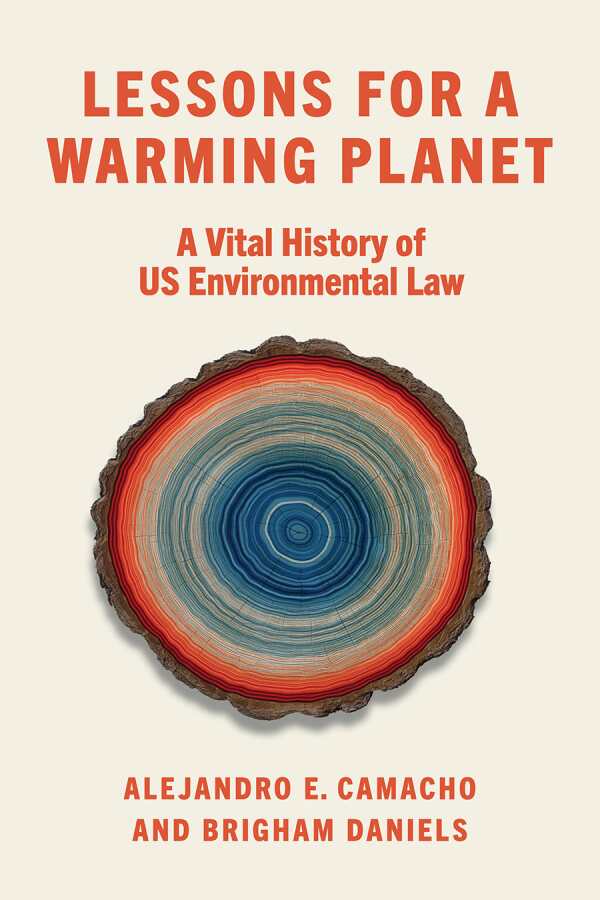
Lessons for a Warming Planet
A Vital History of US Environmental Law
In their informative book Lessons for a Warming Planet, Alejandro Camacho and Brigham Daniels trace the history of environmental regulation in the United States from the colonial period through the early twenty-first century.
“History shows that the law’s impact on the environment extends well beyond the boundaries typically assumed and discussed,” Camacho and Daniels write, and that breadth of focus distinguishes their book. It describes federal, state, and local regulations, looks at laws that damaged the environment, and considers laws passed to protect the planet. Throughout, it also shows how social movements and organizers have used the legal system and protests to shape laws across three centuries, breaking that history down into five distinct eras to indicate dramatic shifts in how the United States manages its land use and natural resources.
For example, when looking at the country’s early days, the book discusses how Native Americans’ burning practices changed the landscape, the impacts of federal westward expansion, and how common legal principles provided a basis for land disputes. When addressing the period since 1981, which the book names “the contested era,” it explains various ways the Reagan administration undermined laws already on the books, showing how lawsuits by environmental groups managed to prevent some anti-environment changes.
By connecting historical dots, the book shows how environmental rules built upon one another with sometimes unintended results, and how often the country has needed new rules to address this. In this way, the book both suggests solutions via future legislation and points out pitfalls that such lawmaking should avoid.
Addressing environmental damages caused by climate change and artificial intelligence, among other challenges, Lessons for a Warming Planet is a thorough survey of environmental legislation throughout US history.
Reviewed by
Jeff Fleischer
Disclosure: This article is not an endorsement, but a review. The publisher of this book provided free copies of the book to have their book reviewed by a professional reviewer. No fee was paid by the publisher for this review. Foreword Reviews only recommends books that we love. Foreword Magazine, Inc. is disclosing this in accordance with the Federal Trade Commission’s 16 CFR, Part 255.


