

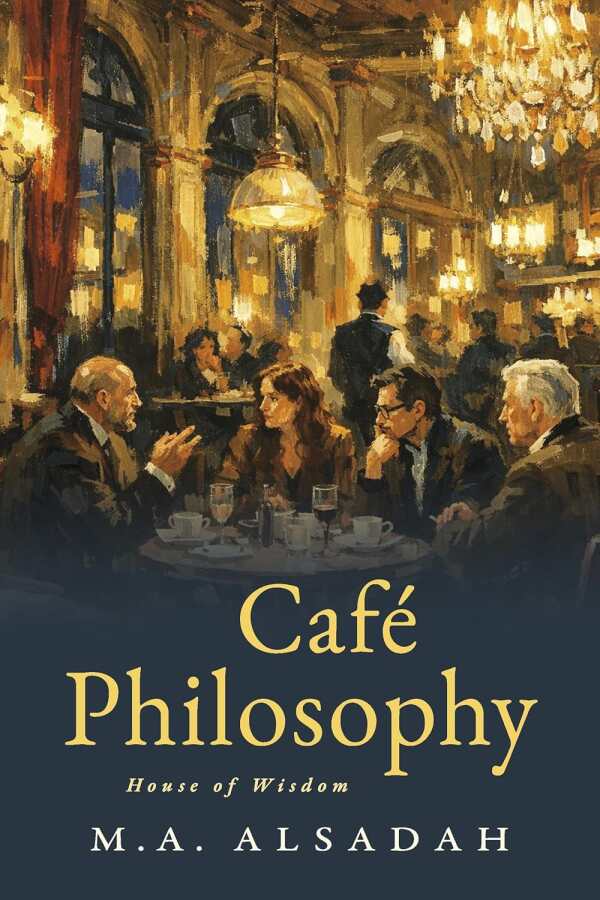
Café Philosophy
A struggling teacher is immersed in profound philosophical mysteries in the introspective novel Café Philosophy.
In M. A. Alsadah’s musing novel Café Philosophy, a precocious teacher converses with unassuming strangers at a local café about profound existential topics.
Riffing on Platonic dialogues, this story takes place within the walls of a Parisian café over the course of several weeks. It introduces Avril, a brilliant but self-conscious primary school teacher in a creative rut. She feels unable to motivate her students and is wearied by her lack of progress.
After meeting an enigmatic stranger nicknamed Plato, Avril becomes immersed in a series of conversations that pull her from her personal malaise and introduce her to profound philosophical mysteries. Over the course of several café visits, Plato introduces Avril to an ever-expanding cast of conversational sparring partners, all named after the titans of ancient and medieval philosophy. These include Avicenna, Al-Kindi, and Averroes. These characters challenge Avril to become a sharper and more confident communicator.
Much of the table talk revolves around education-adjacent subjects, including the nature of personality and the best way to teach manners. However, as the book progresses, the conversations stray farther from these topical centers, covering subjects including the origins and nature of religion and philosophy itself.
Philosophical investigations dominate, and characterizations are neglected in comparison. The story’s dramatic propulsion is reliant on universal questions, and its action is broken up only by stage directions, as with people taking sips of tea, ordering dessert, or sharing jokes. The intellectual substance of the conversations remains at the fore.
While Avril evolves in a clear manner over the course of the novel, the rest of the cast, beyond a few distinguishing quirks and tics, is not developed beyond their roles. Indeed, the characters are mere vessels for different philosophical frameworks; their personalities beyond these perspectives are not fleshed out.
Still, the book’s tone and pace makes its philosophical inquiries quite accessible, with Avril serving as a stand-in for those who are resistant to long-form debates. Her frequent confusion with the subject matter is quite out of step with her otherwise brilliant traits, though. And while some of the novel’s philosophical investigations are effective because of their intimacy (Avril’s illuminating conversations with the affable waiter Alfred, for example), others lose direction early on. One promising investigation into the limits of science, religion, and philosophy meanders into tedium after the characters insist on organizing their collective findings into groups of three, for example; this arbitrary decision leads to several “false starts” and has questionable results.
Nevertheless, the novel’s emphasis on influences from the Islamic Golden Age and obscure thinkers including Hermes Trismegistus makes its philosophical excursions feel fresh, versatile, and unpredictable. Concepts of chakras and alchemy wend into the conversations well. By the novel’s end, Avril has achieved a variety of enlightenment, enabling her to prepare for a new teaching position as a more confident version of herself as an educator.
Café Philosophy is a winding novel built on keen philosophical conversations about the natures of education, religion, and human behavior.
Reviewed by
Isaac Randel
Disclosure: This article is not an endorsement, but a review. The publisher of this book provided free copies of the book and paid a small fee to have their book reviewed by a professional reviewer. Foreword Reviews and Clarion Reviews make no guarantee that the publisher will receive a positive review. Foreword Magazine, Inc. is disclosing this in accordance with the Federal Trade Commission’s 16 CFR, Part 255.


