

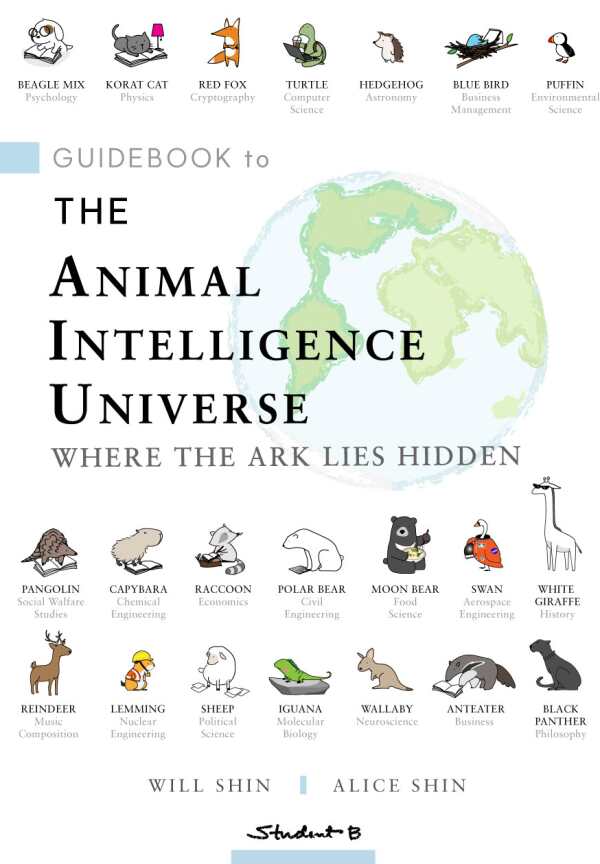
A Guidebook to the Animal Intelligence Universe
Where the Ark Lies Hidden
The Guidebook to the Animal Intelligence Universe is an imaginative exercise with serious intentions that introduces a complex, global animal society.
In Will Shin’s lighthearted introduction to an intricate world, The Guidebook to the Animal Intelligence Universe, nonhuman species have surpassed human development in secret.
An archival dossier and geographical survey of a hidden global society, this alternate reality guide is set in a world in which human beings were preoccupied with their own technological and social silos, leaving room for animals to gather knowledge and build seven distinct civilizations. The various continental headquarters of these societies are detailed here, with information about how specific regions serve specialized roles (in sub-Saharan Africa, strategy is the focus; in the Yukon, it’s information technology). Thus working as a collective, the animals work to survive ecological collapse and human shortsightedness.
The book’s structure is encyclopedic, with each chapter corresponding to a specific geographic location and its leader and reading like a site-attuned corporate brief. Complex worldbuilding is revealed, with the animals’ advancements aligning to art, science, and law. Its intricacy makes this alternate reality tangible, as do footnotes and biographical sketches of the animal leaders.
Indeed, the internal logic of this universe is detailed at length, from the architecture of animal headquarters to the social hierarchies that govern them. As it is a supporting text, the book’s focus on data and structural details is dense, containing a great volume of names, locations, and specialized roles that are somewhat overwhelming absent the connected story. Further, the colorful but rudimentary illustrations undermine the seriousness of the concept somewhat.
The prose is direct and instructional, helping elaborate concepts remain accessible. There is a touch of dry wit in the descriptions of human behavior from animals’ perspectives too. The cadence becomes repetitive, though, as the book lists the varying attributes of particular headquarters. Still, the book as a whole prompts curiosity about what pulses beyond its bounds, in the complete and self-contained world that it introduces, which challenges assumptions of human centralism in piquing ways. A sense of the living planet beyond humanity itself, which is full of sophisticated, silent neighbors emerges—though, here, they are known most in terms of the logistics of their global animal collective. Profound questions about the responsibility of intelligent beings toward other beings, and about the potential of designing a future with concern for the natural world in mind, are intimated.
An imaginative exercise with serious intent, The Guidebook to the Animal Intelligence Universe introduces an imaginary animal society in an exhaustive and inventive manner.
Reviewed by
John M. Murray
Disclosure: This article is not an endorsement, but a review. The publisher of this book provided free copies of the book and paid a small fee to have their book reviewed by a professional reviewer. Foreword Reviews and Clarion Reviews make no guarantee that the publisher will receive a positive review. Foreword Magazine, Inc. is disclosing this in accordance with the Federal Trade Commission’s 16 CFR, Part 255.


