
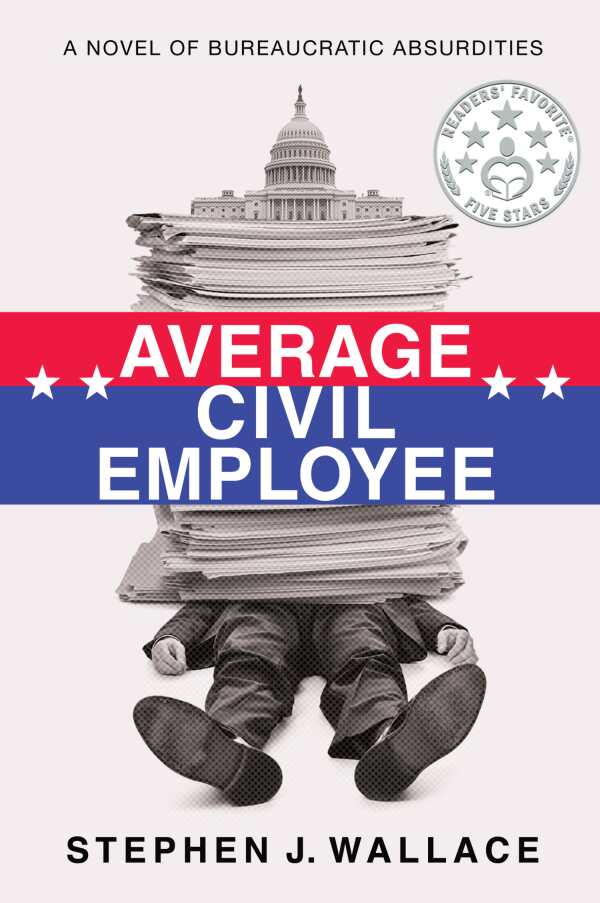
Average Civil Employee
A Novel of Bureaucratic Absurdities
Speaking at length to institutional dysfunction, Average Civil Employee is a sharp satirical novel.
In Stephen J. Wallace’s hilarious satirical novel Average Civil Employee, a reluctant man navigates institutional absurdities.
Ace, an unremarkable federal worker in Washington, DC, operates within a system that’s obsessed with efficiency, compliance, and its own self-justifying language. Within his mandated journal, he shares observations about his office life, the absurdity of the institution’s processes, and the negotiations required to survive within the bureaucratic machinery. He also sometimes speaks to life beyond his workplace, as when he writes about being a “slug for the day,” charting carpooling experiences.
An episodic novel that depends on its close, interior perspective of bureaucratic life, the book speaks at length to institutional dysfunction. Each vignette adds another layer to the absurd logic of the civil service, wherein people fixate on features like memos, approval chains, and procedural formalities at the expense of efficacy. The much-maligned BLOGE (Bureau for Logistics Optimization and General Efficiency) initiative—an efficiency-driven reform effort—functions as a scathing critique of attempts to reform the US civil service. Instead of simplifying operations, BLOGE adds extra layers of oversight, documentation, and performance rituals—a paradox at the heart of bureaucratic reform, whereby the more people try to boost efficiency, the more complicated situations become.
As both a participant and an observer, Ace is an effective conduit for the novel’s critiques of DC. At the start of the story, he’s a typical worker, but after his temporary promotion to supervisor, his perspective shifts. He begins to support the very system that he once critiqued, recognizing how difficult it is to maintain order against institutional pratfalls.
The book’s situational humor emerges from the escalation of minor administrative concerns into disproportionate crises. For instance, Ace faces a drawn-out struggle to come up with a suitable job title for a new role and a non-offensive acronym to match. Such preoccupations with acronyms also signal belonging among insiders while alienating outsiders. Some such points are belabored, though; as a result, a sense of repetitiveness sometimes sets in.
The supporting cast is present mostly to reinforce the novel’s thematic concerns. NuPol, Ace’s loophole-obsessed colleague, thrives on subverting top-down control. Mini is one of many coworkers who embody petty rivalries, dependence, and the performance of professionalism. Buzz, the office talker, is always eager to attend training courses. And interpersonal dynamics, particularly in the relationship between Negativa Diva and Mimi, are used to highlight how institutional pressures shape workflows, social hierarchies, and emotional interactions.
The novel’s narrative arc focuses on incremental shifts in perspective, charting how proximity to authority alters one’s understanding of responsibility. As Ace moves deeper into the machinery of decision-making, the focus turns to the compromises required to function within it, suggesting that complicity often emerges not through conviction but from necessity.
In the sharp satirical novel Average Civil Employee, a promoted federal employee gradually acclimates to the very system he once resisted.
Reviewed by
pine breaks
Disclosure: This article is not an endorsement, but a review. The publisher of this book provided free copies of the book and paid a small fee to have their book reviewed by a professional reviewer. Foreword Reviews and Clarion Reviews make no guarantee that the publisher will receive a positive review. Foreword Magazine, Inc. is disclosing this in accordance with the Federal Trade Commission’s 16 CFR, Part 255.


