
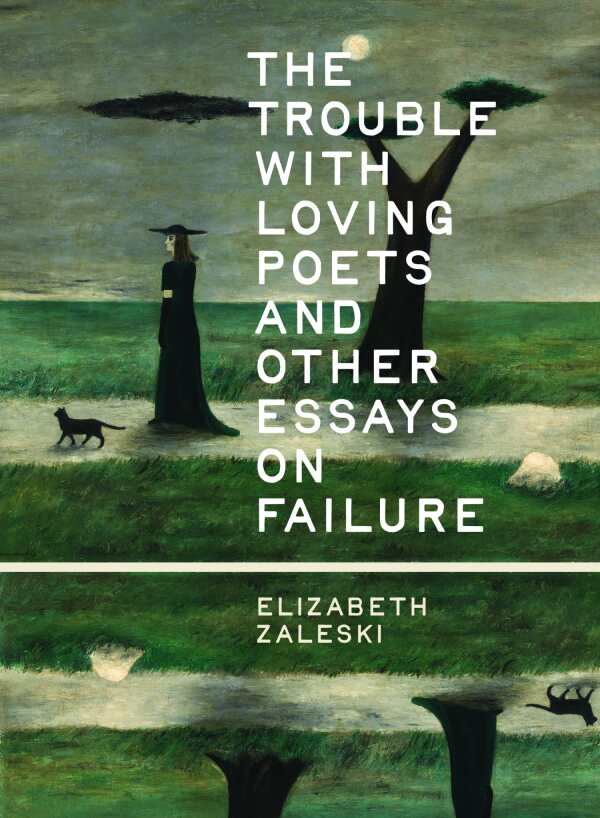
The Trouble with Loving Poets and Other Essays on Failure
In Elizabeth Zaleski’s The Trouble with Loving Poets and Other Essays on Failure, quirky anecdotes proffer insights on family, relationships, and the self.
Across five sections, the collection tackles “the trouble with” a variety of topics in Zaleski’s life, including family, meaning, and men. Its essays are rooted in personal experiences, showing how they shaped Zaleski’s perspective. “Vegetable Psychology, Lovesick Astrology” opens with Zaleski’s father asking her and her brother to get him mushrooms while visiting them at college. The essay continues on about Zaleski’s parents’ open marriage and eventual divorce, approaching the topics through a winding set of anecdotes that mimic the complex dynamic within Zaleski’s family. “Original Syntax” grapples with Zaleski’s love of grammatical conventions and her studies in linguistics, which teach her that these rules have no inherent value.
Each essay addresses its “trouble” comparably to how the Zaleski family deals with home improvement. In “Moving”:
We were too deep into the problem now to easily disengage, to simply throw up our hands and drop it.
The collection balances humor with sincerity well, even when its topics lean further in one direction. An essay about a vacuum turns into an astute analysis of Zaleski’s mother after her divorce; another essay on Zaleski’s HPV diagnosis is rife with jokes by her and by famous comedians that addressed the topic.
While the length and structure of each essay varies, the narrative voice is consistent, funny, and introspective, resulting in cohesion. Wit and intelligence shine through the prose, whether Zaleski is reflecting on high school trips or relationships in one’s thirties.
The personal essays of The Trouble with Loving Poets and Other Essays on Failure work to learn from challenges.
Reviewed by
Julia Dillman
Disclosure: This article is not an endorsement, but a review. The publisher of this book provided free copies of the book to have their book reviewed by a professional reviewer. No fee was paid by the publisher for this review. Foreword Reviews only recommends books that we love. Foreword Magazine, Inc. is disclosing this in accordance with the Federal Trade Commission’s 16 CFR, Part 255.


