
The Original Human Beings
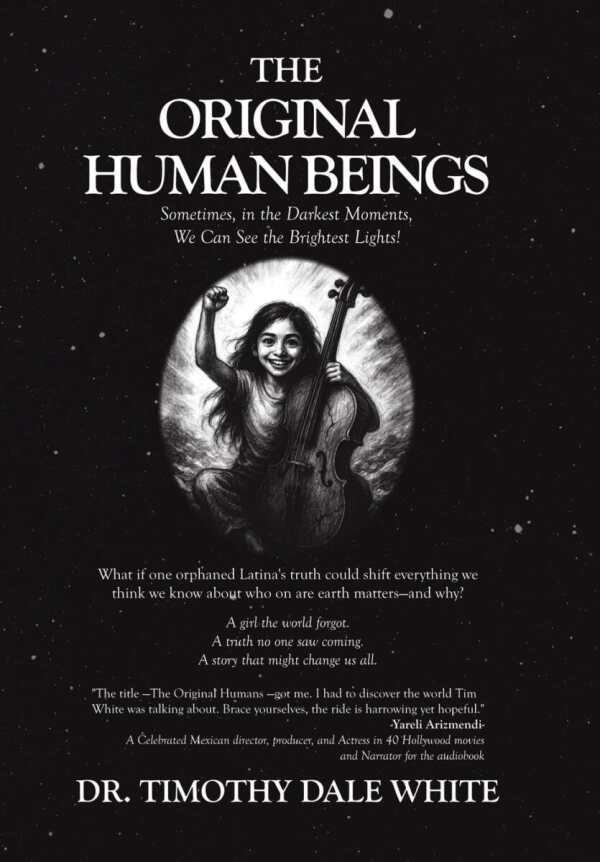
The Original Human Beings is a philosophical novel about an orphan’s physical survival, identity formation, and intimate connections.
Told through a fusion of social realism, spiritual inquiry, and mythic storytelling, Timothy Dale White’s ambitious, emotive novel The Original Human Beings is about what it means to be human.
Set most in Honduras, the novel follows Never, a Latina orphan whose childhood begins in the Tegucigalpa landfill, where violence, exploitation, and deprivation shape her earliest experiences. As the narrative progresses, Never is removed from the landfill and enters a succession of environments that expose her to new forms of control, care, and cultural displacement.
The novel unfolds in a three-part structure that moves from physical survival to identity formation and then to intimate connection, tracing Never’s development across shifting social and geographic contexts. The prose is often stark, rendering violence and deprivation in compressed, image-driven language. Scenes of brutality are presented with minimal mediation, a stylistic choice that foregrounds their impact. This approach is offset by quieter passages in which sensory details and reflective pacing allow the novel to pause before advancing.
The tone alternates between severity and restraint, though the contrast is not always well sustained. The characters are developed in terms of their backgrounds rather than their interior reflections, limiting insights into who they are beyond their circumstances. Never’s responses to shifting power structures are the primary means of narrative progression, reinforcing the novel’s emphasis on environment and survival, though limiting Never’s psychological depth in the moments her story accelerates. Secondary figures tend to function more as situational forces than as fully realized presences on their own merit, a choice that further narrows the novel’s emotional range.
Symbolism plays a prominent role in the novel’s construction, including through music. Never’s relationship to the cello is a recurring motif, marking transitions in her development and serving as a counterpoint to the instability of her surroundings. While these symbolic elements unify the novel’s thematic concerns, their repetition slows the narrative’s momentum.
The book’s extended philosophical passages also interrupt the plot’s progression, though their engagement with ethical and anthropological questions is thorough. These ideas emerge through characters’ interactions and circumstances, though their density overwhelms the narrative’s clarity at points. As the novel expands upon its themes, its layering of symbolism, social critique, and episodic action places increasing demands on its cohesion, resulting in a diffuse narrative on the whole. It moves toward an ending that is satisfying in some respects, but not in all, and that most underscores the book’s philosophical scope.
In the purposeful novel The Original Human Beings, a Honduran orphan moves from survival toward self-definition.
Reviewed by
Katherine Crucilla
Disclosure: This article is not an endorsement, but a review. The publisher of this book provided free copies of the book and paid a small fee to have their book reviewed by a professional reviewer. Foreword Reviews and Clarion Reviews make no guarantee that the publisher will receive a positive review. Foreword Magazine, Inc. is disclosing this in accordance with the Federal Trade Commission’s 16 CFR, Part 255.


