

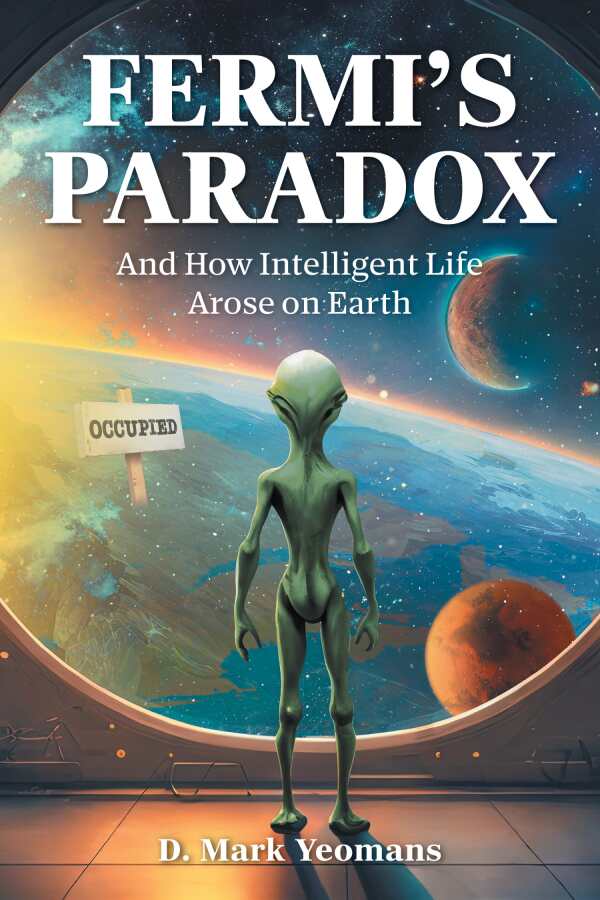
Fermi's Paradox
And How Intelligent Life Arose on Earth
Expressing awe over the wonders of life’s emergence on Earth, the intricate scientific treatise Fermi’s Paradox reframes questions about extraterrestrial intelligence.
The question of the existence of intelligent life beyond Earth is dissected in D. Mark Yeomans’s scientific treatise Fermi’s Paradox.
Extrapolating from physicist Enrico Fermi’s belief in the inevitability of intelligent life in the neighboring cosmos, this book expresses wonder over intelligent life on Earth itself. It meditates on the delicacy and uniqueness of such life, from the first single-cell organisms to multicellular life, addressing evolution and the serendipitous timing of atmospheric shifts, rising and falling seas, and continental drift that resulted in a robust, teeming ecosphere of life. Its central argument is that since such life arose on Earth, it stands to reason that it could arise elsewhere as well.
To support this argument, theoretical pins are placed in the many offshoots of species dispersal, genetic luck, and fortuitous geological phenomena that helped spur on life on Earth. Flares of contemporary humor make its sprawling scientific notions more approachable, as does the fact that academic language is reserved for asides rather than made central. Still, at times, its points are somewhat obscured by the presence of necessary scientific vernacular, as when it covers the enormity of specific eras of time in relation to genetic adaptations, extinction episodes, and rifts in hereditary trees.
The book’s extensive work is split into three parts, covering evolution in theory and in action before turning to human evolution specifically. Its divisions are helpful for breaking up its long sections of theory. Further, despite its considerable length, the book moves at a steady and reassuring pace. Even when discussing granular topics like genetic mutations and atmospheric composition, it strives to be digestible, attending to the subtle processes that enabled life on Earth with an eye toward clarity. Handy tables and drawings are also present for further elucidation of its complex topics.
The initial framing of the topic is somewhat misleading on the whole, though. While Fermi’s Paradox is concerned with where intelligent life might be in Earth’s corner of the galaxy, considering the ubiquity of life on Earth and human efforts at contact, the book’s own perspective favors terrestrial awe over stargazing, losing itself in meditations of the spidery chemical processes that led to human evolution and consciousness. Indeed, these earthbound concerns end up usurping the larger question of where other intelligent life might be lurking in the universe.
A sprawling scientific treatise, Fermi’s Paradox celebrates intelligent life on Earth in engaging terms.
Reviewed by
Ryan Prado
Disclosure: This article is not an endorsement, but a review. The publisher of this book provided free copies of the book and paid a small fee to have their book reviewed by a professional reviewer. Foreword Reviews and Clarion Reviews make no guarantee that the publisher will receive a positive review. Foreword Magazine, Inc. is disclosing this in accordance with the Federal Trade Commission’s 16 CFR, Part 255.


