

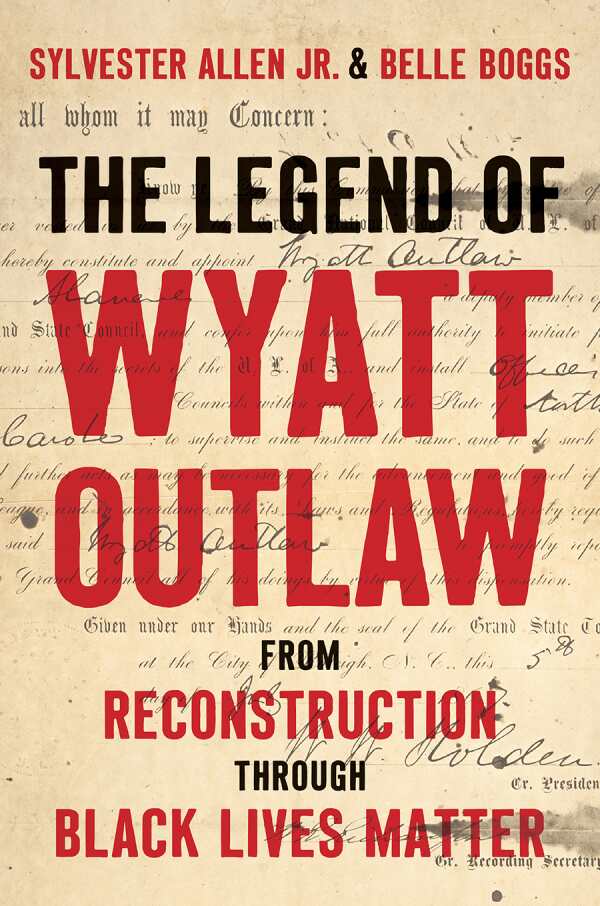
The Legend of Wyatt Outlaw
From Reconstruction through Black Lives Matter
A murder in the Reconstruction-era South is excavated in Sylvester Allen Jr. and Belle Boggs’s history book The Legend of Wyatt Outlaw.
Following the conclusion of the Civil War, small-town citizens in places like Graham, North Carolina, struggled with the expansion of human rights and success stories for its Black citizens, including Wyatt Outlaw, a business owner and the town’s first Black constable. Tensions in Graham were pressurized by rampant Ku Klux Klan activities in the years following the war’s end, which led to Outlaw’s lynching by KKK members, a historic fact that is uncommemorated by any public designation.
Having for years walked by the site of Outlaw’s death without ever hearing about it, Boggs and Allen unpack why atrocities like Outlaw’s murder are buried beneath a century and a half of misinformation and erasure. They also explore the archetypes of their Southern upbringings in an effort to reconcile their dissatisfied experiences as Black US citizens. The book covers their research processes, too, telling Outlaw’s story and explaining why it remains almost unknown.
Writing separately in some chapters and together in others, Allen and Boggs share powerful, intimate commentary on the ways that truth is obscured and how history is written and remembered. Of particular and affecting note is the story’s framing of the racial temperature of Alamance County in the Reconstruction era, drawing a line all the way from the late nineteenth century to the racial justice protests of 2020 in the wake of the murder of George Floyd, among other injustices committed against Black people.
The Legend of Wyatt Outlaw is an enlightening history book about a lynching, contemporary racism, selective memory, and institutionalized impunity in the United States.
Reviewed by
Ryan Prado
Disclosure: This article is not an endorsement, but a review. The publisher of this book provided free copies of the book to have their book reviewed by a professional reviewer. No fee was paid by the publisher for this review. Foreword Reviews only recommends books that we love. Foreword Magazine, Inc. is disclosing this in accordance with the Federal Trade Commission’s 16 CFR, Part 255.


