

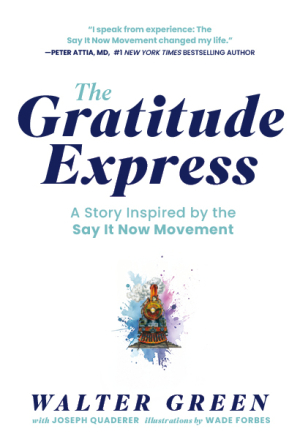
The Gratitude Express
A Story Inspired by the Say It Now Movement
The Gratitude Express is a poignant allegorical novella about human interconnectedness and expressing thanks in the moment.
Walter Green’s whimsical allegorical novella The Gratitude Express is about memory, connection, and the courage to speak one’s heartfelt truths while there is still time.
Daniel, a journalist, prepares a eulogy for his ailing grandfather. He boards a mysterious steam train, the Gratitude Express, bound for Cedarville. It takes him through current landscapes and through moments from his past. At each stop, he encounters people whose lives intersected with his in ways he forgot or never understood. Through these visits, Daniel comes to see gratitude as an active force, not a sentiment reserved for memorials.
The book’s structure is fabulistic; it progresses toward a clear moral. Daniel’s discrete encounters reveal the unseen impacts of his life choices; each vignette earns its place in Daniel’s evolving understanding. The pace is steady and deliberate, anchored by the recurring rhythm of the train’s whistle and motion. The transitions suggest time’s fluidity, with the past becoming as tangible as the present. The device is simple but effective, keeping the focus on emotion.
The atmosphere is built via sensory details. For instance, when Daniel first sees the antique locomotive, he smells “the scent of steam, coal, and oil” and feels “the heat from the engine.” Such factors have a grounding force despite the book’s otherworldly premise. Some are quite exaggerated, though: When Daniel tells the conductor he is writing a eulogy, the parrot perched on the conductor’s shoulder interrupts: “Why wait until someone dies to say nice things about them?”
Daniel’s characterization is light; he is constructed as a representative figure, standing in for anyone who postpones gratitude until it is too late. His encounters with people including Andres, the boy he once defended, and Stan, the boss who encouraged him to write, also rest on archetypal characterizations; both are present most to illustrate how small acts ripple outward. The recurring motif of exchanged objects also serves to highlight tangible notions of connection and continuity.
Watercolor pictures are interspersed throughout the novella to highlight moments from Daniel’s life. His hometown is rendered idyllic; the conductor’s parrot is colorful. Some such images, which are reflective of picture books in their style, muddy the sense of the book’s intended audience and undermine the emotional impact of the story.
The train itself is the most singular factor in the tale, though its name, the Gratitude Express, is too forceful an embodiment of the book’s ultimate message. The conductor has a pocket watch engraved “Gratitude Time” and serves as both guide and Daniel’s metaphorical conscience. The recurring imagery of steam, motion, and time results in some cohesion, as do rhythmic phrases repeated along its way, including “Making all stops!” and “Say it now.” Each recurrence of such phrases strengthens the central argument that gratitude requires consistency and effort.
Working toward a restrained ending that reflects emotional release, The Gratitude Express is an inspirational novella in which gratitude is not a destination but a journey.
Reviewed by
John M. Murray
Disclosure: This article is not an endorsement, but a review. The publisher of this book provided free copies of the book and paid a small fee to have their book reviewed by a professional reviewer. Foreword Reviews and Clarion Reviews make no guarantee that the publisher will receive a positive review. Foreword Magazine, Inc. is disclosing this in accordance with the Federal Trade Commission’s 16 CFR, Part 255.


