

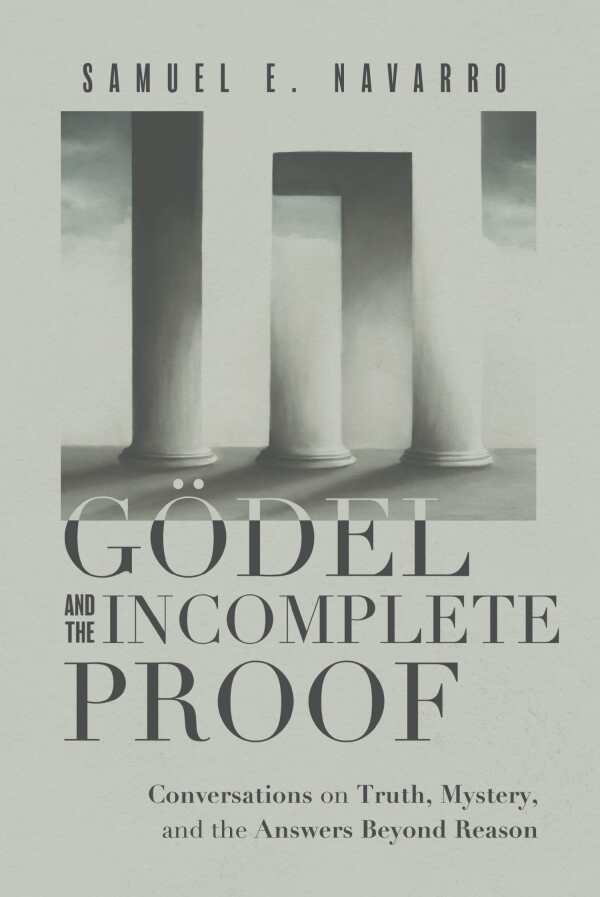
Gödel and the Incomplete Proof
Conversations on Truth, Mystery, and the Answers Beyond Reason
Truth is sought through conversations about logic, epistemology, theories of consciousness, aesthetics, and religion in Gödel and the Incomplete Proof, a musing philosophical text.
In Samuel E. Navarro’s fascinating philosophical exercise Gödel and the Incomplete Proof, a philosopher interrogates great historical thinkers on the topic of the nature of truth.
Centered by the notions that truth exceeds formal logic and that systems designed to define truth are inherently incomplete, this book is made up of imagined conversations between mathematician and philosopher Kurt Gödel and historical figures including Immanuel Kant, Erwin Schrödinger, Jackson Pollock, and Jesus. Together, they delve into subjects including logic, epistemology, theories of consciousness, aesthetics, and religion. Conversation by conversation, Gödel catches glimpses of the infinite possibilities of the meaning of truth.
The book’s conversations are clear but not chronological—a selective survey of philosophies across history. They are used to analyze each thinker’s system of thought, highlighting paradoxes within those systems, all from Gödel’s perspective. The conversations are discrete, too; each appears in its own brief chapter within a topical section. Still, the flow between the exchanges is steady, moving the book’s exploration closer to its conclusion. At the same time, it opens the book to the possibility of selective engagement, based on whichever conversation partner the audience may be interested in.
Still, as it peeks at Gödel’s work, blending his theories with a variety of philosophical questions about truth and connecting disparate ideas throughout history, the book proves intriguing. Nonetheless, the scope of Gödel’s critiques is often overextended to other disciplines, including those not based on logical systems, alluding to the possibility that universal truths about all of knowledge and reality are coming. Indeed, the application of Gödel’s incompleteness theorems to nonlogical disciplines, including the arts, strains credulity, as his theorems were limited to formal systems with clear, defined rules.
Further, the explanation of why Gödel was selected as the book’s central guide is held off until the book’s epilogue, which includes a brief note on the relevance of his incompleteness theorems. This delayed explanation, though, is ineffectual, minimizing Gödel’s importance as the protagonist too much. In addition, because the book’s narrative strategy is quite metaphorical, its overall arguments, though appealing to a general sense of mystery, end up raising more questions than they answer.
Gödel and the Incomplete Proof is a creative philosophical exercise that explores the nature and limits of truth through imagined conversations between historical figures.
Reviewed by
Corinna Underwood
Disclosure: This article is not an endorsement, but a review. The publisher of this book provided free copies of the book and paid a small fee to have their book reviewed by a professional reviewer. Foreword Reviews and Clarion Reviews make no guarantee that the publisher will receive a positive review. Foreword Magazine, Inc. is disclosing this in accordance with the Federal Trade Commission’s 16 CFR, Part 255.


