

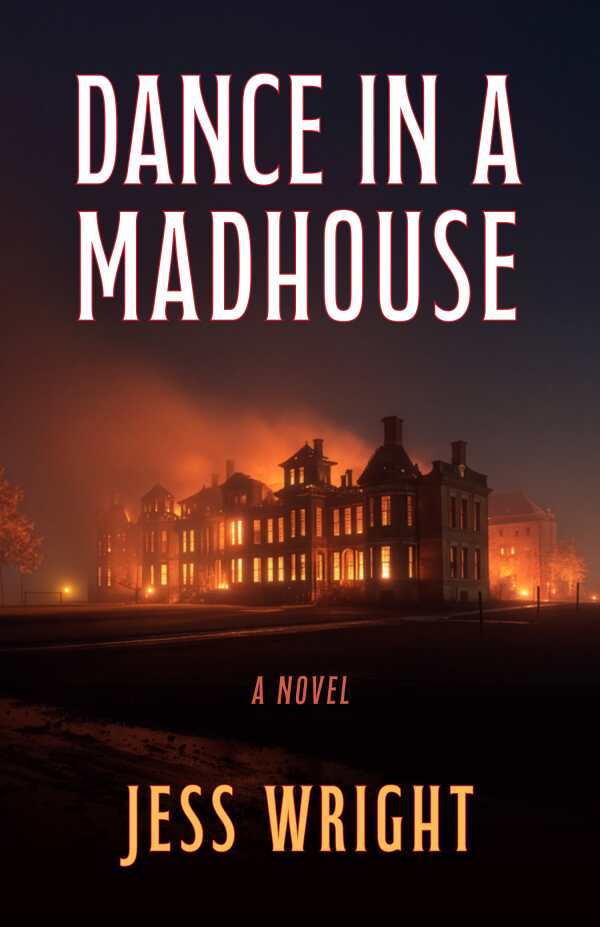
Dance in a Madhouse
A Novel
A young doctor witnesses organizational fractures at a sanatorium, whose residents handle their pain in private, in the ominous novel Dance in a Madhouse.
In Jess Wright’s macabre mystery novel Dance in a Madhouse, a man unearths an insidious plot at a sanatorium.
In the early 1900s, Owen, a recent medical school graduate, is engaged to Maude. When typhoid fever leads him to delirium, Owen lashes out in Central Park; he can’t recall the violent details after. His father, who’s running to become New York’s governor, worries about the scandal. Subsequently, Owen is diagnosed as a schizophrenic and sent to a sanatorium in Philadelphia.
Owen is a sharp hero whose keen senses alert him to underlying dangers. Indeed, his immediate exposure to the sanatorium’s ballroom—in which members of the public pay to mock the patients dancing—makes him recoil at the cruel spectacle. The dance is also a clever opportunity for Owen’s fellow patients to inform him about an ongoing plan to fight against the doctors and nurses. He goes on to meet more of the staff and patients, including a manic professor, a catatonic singer, and a suicidal novelist; their characterizations are both bombastic and limited, with people developed most in terms of their maladies.
Acts of arson and murder pull a police inspector into the cast, too. In this tense setting, the disjuncture between surface impressions and reality is mined for suspense. The hospital’s public-facing rooms, for example, resemble a comfortable manor to appease visitors, while its wings are marked by darker unrest, including poisonings.
Questions about Owen’s reliability also fuel intrigue from the outset. The prose is unnerving: At times, Owen seems lucid; at other times, there’s discordance in his thoughts. He shares nightmarish details of chimeras, flames, and carousel music, increasing doubt about his state of mind. Further, Owen suspects that Maud’s ex-fiancé, Byron, somehow instigated his exile, but he lacks proof; others think he’s paranoid.
Historical psychiatric practices are gestured at in the course of Owen’s discussions with his doctor and through mentions of his intake records, which peg him as being intelligent enough to “fake being well.” When Owen’s attempts to defend himself are taken as proof that he isn’t rational, suspense and frustration mount. Elsewhere, outdated treatments, including hydrotherapy and hypnosis, further the chilling, restrictive atmosphere.
The police investigation is used to move the novel forward, revealing instances of subterfuge. Owen is taken into the investigator’s confidence, even as he works to prove his sanity to others. However, the book’s resolutions are somewhat contrived, helped along by letter writing in the background and Byron’s ominous, but mostly off-page, presence. Further, revelations about obsessive people arrive too late in the novel to do much but complicate the situation, diminishing the satisfaction of its ending.
In the alarming mystery novel Dance in a Madhouse, a doctor in psychiatric confinement witnesses issues with his fellow patients’ treatments.
Reviewed by
Karen Rigby
Disclosure: This article is not an endorsement, but a review. The publisher of this book provided free copies of the book and paid a small fee to have their book reviewed by a professional reviewer. Foreword Reviews and Clarion Reviews make no guarantee that the publisher will receive a positive review. Foreword Magazine, Inc. is disclosing this in accordance with the Federal Trade Commission’s 16 CFR, Part 255.


