

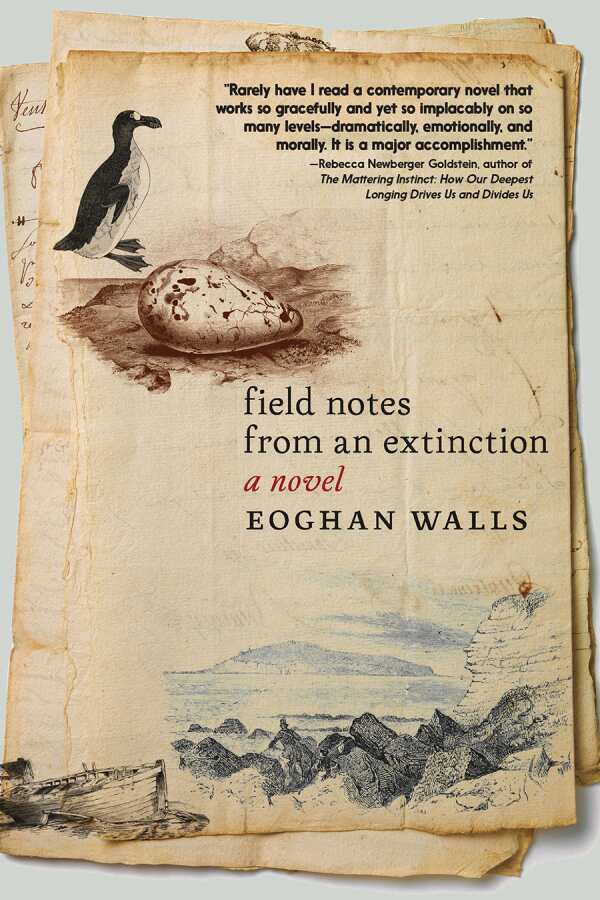
Field Notes from an Extinction
In Eoghan Walls’s wry, poignant historical novel Field Notes from an Extinction, a naturalist’s research is disrupted by the arrival of a feral child.
In 1847, Ignatius receives a royal commission to study the Great Auk. He conducts his research in a cabin near the birds’ coastal northern Ireland habitat. Though the region is blighted by famine, English Ignatius’s anti-Irish attitudes make him somewhat skeptical of the plague’s magnitude. He also regards the local residents as devious, inarticulate, and reminiscent of “sea-otters in their hirsuteness.”
At his remote location, Ignatius awaits a delivery of supplies. But his shipment arrives ransacked, missing half of its contents and instead containing a huddled and filthy child. Ignatius soon discovers that the “feral” little girl is the daughter of an Irishwoman called “The Cannibal” who claims she will return someday. For now, Ignatius must keep the child—or “it will not end well” for him.
Told from Ignatius’s prickly perspective, the novel’s interplay between emotion, empathy, and humor is deft and compelling. At first, the girl is an aggravating nuisance: Covered with lice and sores, she babbles strange sounds, relieves herself on the cabin floor, and shows little gratitude for Ignatius’s efforts to help her. But as their relationship develops, Ignatius learns that the child’s name is Bridget, and Bridget begins to call him “Ig” with possessive affection.
Ignatius’s curious connection to Bridget diffuses his scholarly arrogance. In a gradual but propulsive emergence, he is drawn into the plight of the Irish. He witnesses their starvation, oppression, and increasingly violent resistance to colonization. Through his own surge of irascible valor, Ignatius’s battle to save his beloved auks from plunderers leads to a harrowing yet hopeful conclusion.
In the affecting, sardonic historical novel Field Notes from an Extinction, English prejudices are challenged by tumult and the humanity of the Irish.
Reviewed by
Meg Nola
Disclosure: This article is not an endorsement, but a review. The publisher of this book provided free copies of the book to have their book reviewed by a professional reviewer. No fee was paid by the publisher for this review. Foreword Reviews only recommends books that we love. Foreword Magazine, Inc. is disclosing this in accordance with the Federal Trade Commission’s 16 CFR, Part 255.


