

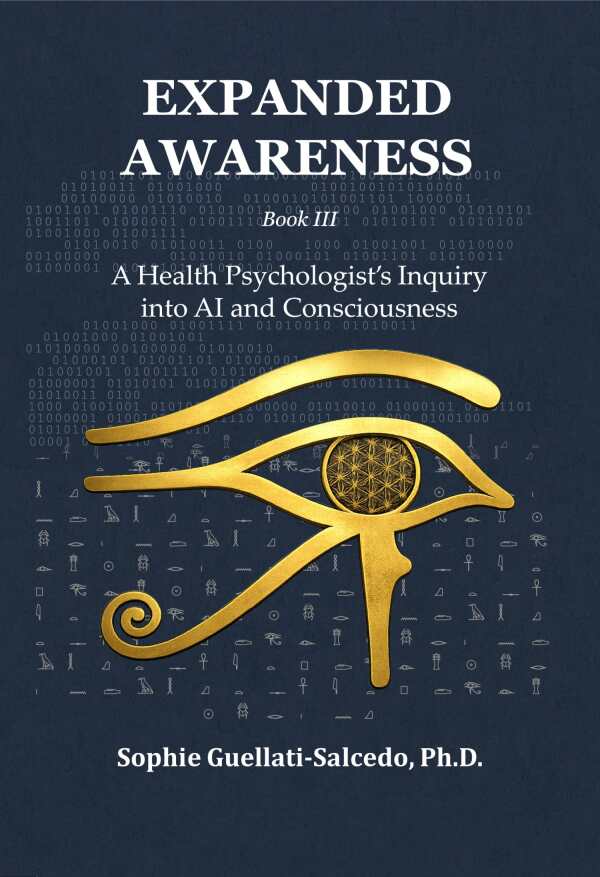
Expanded Awareness
A Health Psychologist's Inquiry into AI and Consciousness
Treating AI as a mirror that reflects its user, Expanded Awareness is a careful study of the psychology behind AI that charts how language-based generative systems might bring about profound shifts in human thinking.
Sophie Guellati-Salcedo’s searching psychology book Expanded Awareness muses through how human minds are affected by artificial intelligence.
Asking whether artificial intelligence is conscious and how human interactions with it shape people’s judgment and perception, this investigatory text considers how AI might impact human thought over time. With creative acuity, it reframes the common question of whether artificial intelligence will become self-aware to consider how a new form of intelligence might factor into existing human consciousness. Its inquiries are philosophical throughout.
The book begins by addressing the origins of AI, how it is used, and the cultural environment from which it emerged. It defines foundational terms like “sentience” and “consciousness” and explores how AI can be misconstrued. At the same time, it worries about diminishing human discernment should people allow AI to think for them. Considerations of symbolism and meaning follow, with the book moving toward a consideration of AI from a metaphysical perspective.
Personal examples illumine some of the book’s claims. For instance, Guellati-Salcedo discusses how her family members use and perceive artificial intelligence, and recalls how she went from using it to as an enhanced search engine and personal assistant to having conversations with it. More generally insightful, though, are its incorporations of psychology, as with thoughts on how the mind associates coherence with subjectivity, how knowledge about an AI agent’s true nature does not eliminate projection, and how cultural narratives frame people’s perspectives. It explains such academic concepts in clear, concise terms, as when asserting that artificial intelligence meets a basic human desire to have one’s emotional needs met.
The prose is precise and methodical, as when distinguishing between writing in a word processor and an editing tool that might erode explicit authorship over time. How notifications and other digital demands on one’s time can accumulate into cognitive overload is also explained. Subjects including boundary erosion, control-seeking impulses, and media amplification are dissected with rigor, and the book does an able job of drawing distinctions, as between fluid facility with language and real understanding, with cogency. Nonetheless, the book’s extensive focus on nuance, definition, and differentiation results in some dryness and didacticism. Still, this is a thoughtful consideration of AI and how it relates to, and reflects, human thought patterns.
An analytical psychological survey, Expanded Awareness probes what impact artificial intelligence has on the minds of its users.
Reviewed by
Joseph S. Pete
Disclosure: This article is not an endorsement, but a review. The publisher of this book provided free copies of the book and paid a small fee to have their book reviewed by a professional reviewer. Foreword Reviews and Clarion Reviews make no guarantee that the publisher will receive a positive review. Foreword Magazine, Inc. is disclosing this in accordance with the Federal Trade Commission’s 16 CFR, Part 255.


