

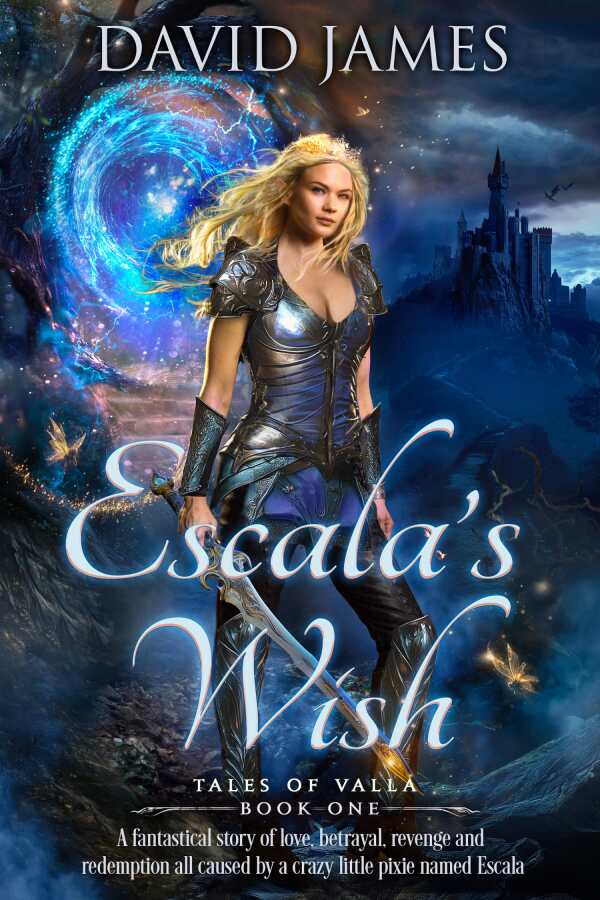
Escala's Wish
Following a consequential, cross-realm quest, Escala’s Wish is a resonant fantasy novel that celebrates group bonds and self-sacrifice.
In David James’s musing fantasy novel Escala’s Wish, a once reckless princess seeks redemption via self-sacrifice.
Following a tragic mistake, Escala, a pixie princess from the House of Winter, is transformed and banished though the fairy veil to the material plane. There, she navigates a world populated by mortals and monsters, all in order to restore the balance she disrupted by introducing “boulders” into the sacred flow of life. In the process, she faces both physical obstacles and the necessity of an internal metamorphosis toward accepting communal responsibility.
Escala’s allies in her efforts include a stoic warrior, Roedyn; sharp-witted Harper; and Sticky, who is magical and eats insects. Each plays a crucial role in the quest. Further, though Escala was once flighty and impulsive, her interactions with the group force her to reconsider her behaviors. For example, Roedyn is her initial foil, embodying loyalty and a quiet strength through his refusal to break his oaths. Their exchanges include both grand oratorical flourishes and concise, biting wittiness; further, they grow together, moving beyond their initial motivations and working together on joined, more selfless goals, founded on the knowledge that individual actions often have broader, and lasting, consequences.
The prose is constrained; each word helps to flesh out Escala’s vast adventures in intimate terms. The worldbuilding is informed by fairy perspectives, such as measuring height in “two red apples and a green grape” and in notes about the separations between worlds: “The magic of the faeries was the veil itself—the boundary that kept the planes apart—and [that] boundary was pure magic.” Elsewhere, sites like a glimmering grove are vivified with mentions of luminous indigo gowns and glowing boughs. The material world is more gritty, populated by soot-stained laborers and enlivened by alehouse chatter. And the book’s fanciful elements exist in sharp contrast to the encroaching darkness of the Void.
Story-within-a-story elements add a layer of theatricality to the novel’s progression: Wigfrith, a gnome bard, recounts Escala’s tale to a tavern audience, commenting on the nature of heroism as he goes. Wigfrith also emphasizes key moments of tension and humor in Escala’s high-stakes encounters, which include dragon battles and the infiltration of magical strongholds. Each such challenge brings the central conflict into sharp focus.
However, the book’s tension is often softened by its thematic emphasis on the team’s care and cooperation, even in the midst of dangerous moments. Indeed, Escala’s choices seem set up to affirm her morality, rather than truly challenge her. Even complicated situations resolve with seeming ease, making her team’s failure seem unlikely.
Building toward a resolution that reemphasizes the book’s established themes of sacrifice, the resonant fantasy novel Escala’s Wish follows a princess on a quest who matures as she faces tough choices.
Reviewed by
John M. Murray
Disclosure: This article is not an endorsement, but a review. The publisher of this book provided free copies of the book and paid a small fee to have their book reviewed by a professional reviewer. Foreword Reviews and Clarion Reviews make no guarantee that the publisher will receive a positive review. Foreword Magazine, Inc. is disclosing this in accordance with the Federal Trade Commission’s 16 CFR, Part 255.


