

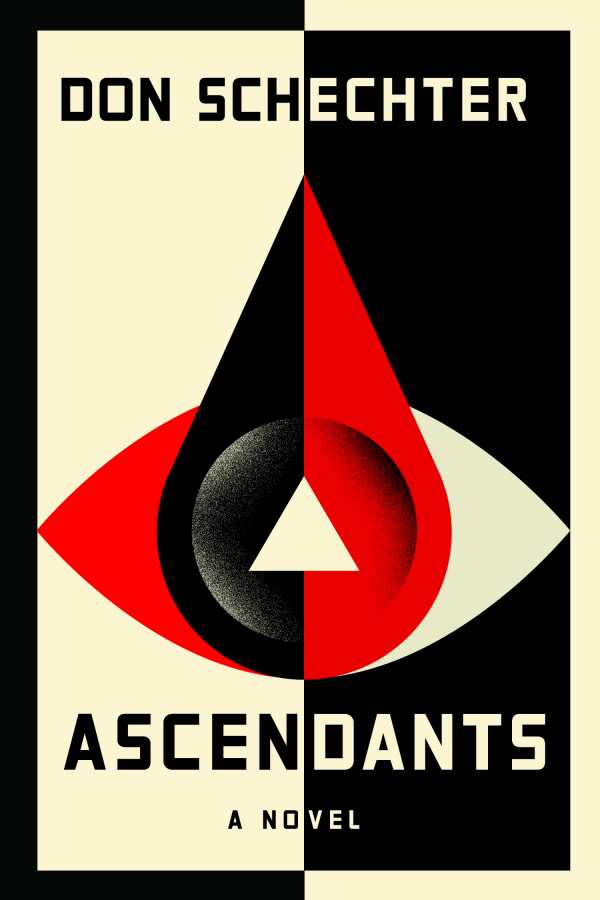
Ascendants
A Novel
An endangered family flees from brutal state forces in the exciting dystopian novel Ascendants, which is about power, faith, and transformation.
In the future of Don Schechter’s engaging science fiction novel Ascendants, society is shaped by genetic destiny, institutional power, and engineered beliefs.
In a future society dominated by the Institute, an organization that normalized the concept of Ascension—an after-death promise reserved for those deemed worthy by genetics—citizens fall into rigid categories: Ascendants, who are promised transcendence, and Biomasses, who are stripped of status and subjected to exclusion and violence. This binary forms the moral and political terrain through which the narrative moves, framing prejudice as doctrinal.
The Teller family lives in this environment. Their members include Rebecca, a trauma surgeon, who wants to shield her daughters from the chaos overtaking Boston, and Maya, marked as a Biomass, who navigates the city through underground networks, dealing with physical confrontations. Maya’s younger sister, Hannah, has a rare genetic profile that piques the Institute’s interest. The family flees, avoiding surveillance amid systemic collapse.
Scenes establishing the setting’s bigotry and brutality appear early on, including schoolyard confrontations that escalate into state-sanctioned atrocities. Maya recalls instances of mass violence captured on illicit footage too. Dark ideologies seep into people’s everyday lives, turning neighbors into enforcers and institutions into executioners. The Institute is developed in parallel sections, with glimpses into the mechanisms that sustain its control and that are used to rationalize its cruelty.
Tension emerges because of the family’s efforts to survive. The book’s action scenes focus on outcomes; within them, the family members contend with exhaustion, fear, and limited options. Maya’s role as a protector is emphasized; she has great physical skills and is somewhat volatile because of previous losses. Rebecca counterbalances her: She exhibits care and is concerned with medical ethics, and her resolve is archetypally maternal.
The prose experiments with forms, incorporating a mix of flashbacks, dream sequences, and embedded texts; interstitial computer code segments clarify the automation of the world and the wide surveillance it’s under. Quotes of in-world writings are presented as ideological artifacts too, illustrating how Ascension permeates the culture. However, in their volume, these devices tend to divert focus from the central actions. A belabored flashback to cover the Institute’s origins, including its philosophical roots and its early adherents, also impedes the momentum of the Tellers’ escape.
Further, as the novel progresses, supernatural elements surface, reframing Ascension in metaphysical ways. This introduces new questions and possibilities for the series, though they are muted in this volume. Instead, the novel closes with a consequential confrontation and revelations that put its earlier events into fresh context.
Marked by intrigue, the dystopian novel Ascendants follows an escaping family whose story exposes how some belief systems are used to justify harm.
Reviewed by
Brandon Pawlicki
Disclosure: This article is not an endorsement, but a review. The publisher of this book provided free copies of the book and paid a small fee to have their book reviewed by a professional reviewer. Foreword Reviews and Clarion Reviews make no guarantee that the publisher will receive a positive review. Foreword Magazine, Inc. is disclosing this in accordance with the Federal Trade Commission’s 16 CFR, Part 255.


