

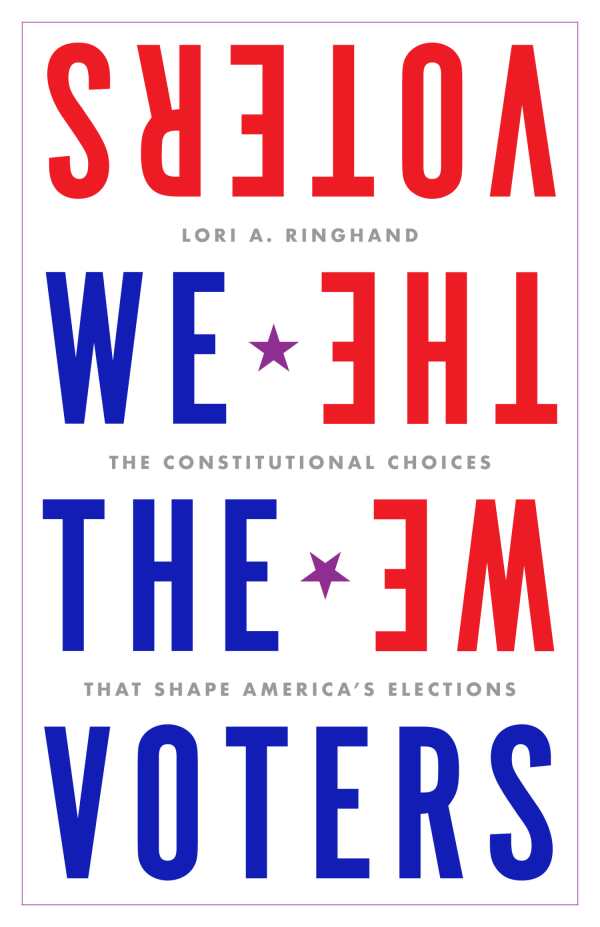
We the Voters
The Constitutional Choices That Shape America’s Elections
Lori A. Ringhand’s illuminating civic history text We the Voters combines constitutional analyses with accessible examinations of American democracy.
The book situates itself within longstanding debates about democratic health, fairness, and legitimacy. Rather than treating electoral structures as fixed, it frames voting rights and election systems as the outcomes of sustained political struggles, with access to the ballot both expanded and restricted across different periods. By centering voters alongside the institutions that regulate elections, the book presents democracy as a lived practice shaped by law, power, and collective action.
The book’s progression is clear and aided by chapter signposting. Each section outlines what it seeks to examine and how the discussion will proceed. A detailed notes section complements this work. Further, the prose is straightforward, with complex legal and constitutional issues explained through concrete examples. For instance, a discussion of at-large voting, voter cracking, and voter packing ably demonstrates how electoral design can dilute or concentrate political powers.
One of the book’s central arguments is that exclusion and inclusion have always shaped American democracy. It traces historical barriers to participation, including race, gender, and class, showing that limits on voting access were often deliberate and are still ongoing. It also examines structural unfairness embedded in democratic institutions. The Senate’s allocation of equal representation to states regardless of population, the apportionment of House seats based on total population, and the Electoral College’s privileging of swing states represent institutional compromises with measurable consequences. Elsewhere, case studies, including of the 2000 Bush v. Gore election, clarify how legal interpretations, electoral mechanics, and institutional design intersect.
Democracy, We the Voters asserts, functions through citizen engagement, so that reform movements and legal challenges can reshape democratic systems. Its examinations of these institutions and processes is assured.
Reviewed by
pine breaks
Disclosure: This article is not an endorsement, but a review. The publisher of this book provided free copies of the book to have their book reviewed by a professional reviewer. No fee was paid by the publisher for this review. Foreword Reviews only recommends books that we love. Foreword Magazine, Inc. is disclosing this in accordance with the Federal Trade Commission’s 16 CFR, Part 255.


