

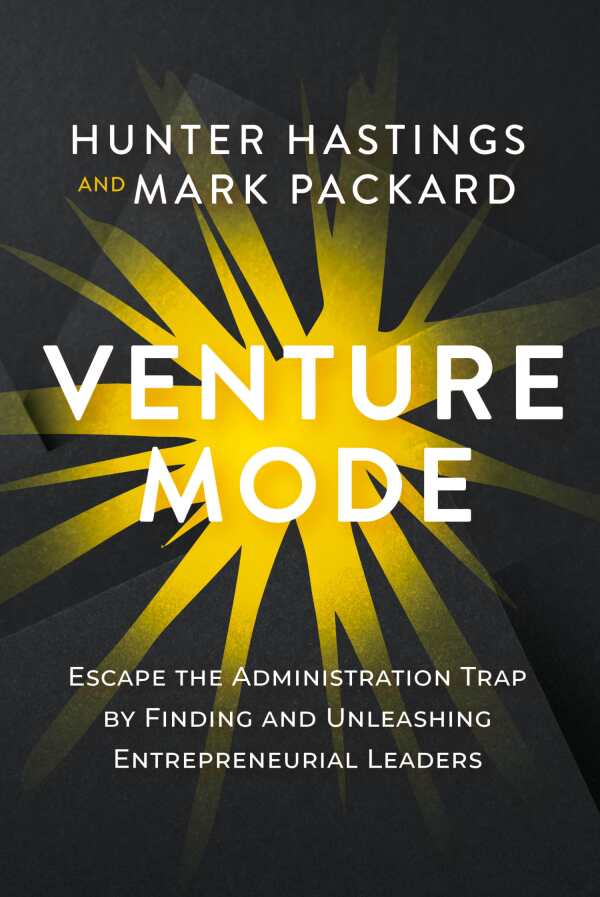
Venture Mode
Escape the Administration Trap by Finding and Unleashing Entrepreneurial Leaders
Designed to foster entrepreneurial spirits in prospective leaders, the ambitious business guide Venture Mode presents an alternative vision for management, based on agility, innovation, and valuing one’s customers.
Hunter Hastings and Mark Packard’s maverick business book Venture Mode is about managing with startup hunger and growing a company’s value.
Bucking the status quo, this book advises modern businesses to eschew traditional, rigid management mindsets, instead focusing on customers, innovation, and entrepreneurship. Making a case against putting administrators in business leadership roles, it proposes overhauling business education, prioritizing value creation, hands-on experience, and creativity. Indeed, it develops its theory for reform with care, promoting ambitious leadership focused on the big picture instead of bureaucracy.
Companies including Spotify, Morningstar, and Handu are used to illustrate the book’s ideas about entrepreneurial ethics, differentiation through purpose, and networks over hierarchies. Its case studies are studious and revealing, but they also lead to some sweeping generalities, as where the book argues that contemporary businesses are too dynamic for administrative mindsets and then rehashes talking points about stagnation meaning death.
Other undersupported claims include those related to job interviews, which it says do not give enough time to assessing whether a candidate is a good fit. Elsewhere, a random comment from a university president regarding employment data is used to argue that “the express aim of universities is to train their students for employment,” without sufficient support for this claim. Clichés also arise—for instance, where the book works to characterize what takes place in university classrooms—as well as familiar examples, as with that of Kodak failing, which it credits to administrative flaws, not a pure failure to adapt to the digital market.
Still, the book’s tone is persuasive on the whole. It works to support its central thesis at length, lionizing entrepreneurship and crediting that spirit with the app development boom and work to scale up multibillion-dollar ecommerce empires. That it takes the time to explain familiar business concepts, including fintech and kaizen, makes it quite accessible to a broad audience. Indeed, it is effective as a spirited manifesto for rethinking business education and management, presenting its ideas with conviction, vigor, and copious research. Its practical blueprint for creating a Master of Business Entrepreneurship is convincing, undergirded by an itemized curriculum, detailed course outlines, and a clear call to action.
A bold business book that’s narrated with unflagging conviction, Venture Mode urges business leaders to maintain their early entrepreneurial drives and to avoid the stagnation encouraged by MBA prescriptions and related management models.
Reviewed by
Joseph S. Pete
Disclosure: This article is not an endorsement, but a review. The publisher of this book provided free copies of the book and paid a small fee to have their book reviewed by a professional reviewer. Foreword Reviews and Clarion Reviews make no guarantee that the publisher will receive a positive review. Foreword Magazine, Inc. is disclosing this in accordance with the Federal Trade Commission’s 16 CFR, Part 255.


