
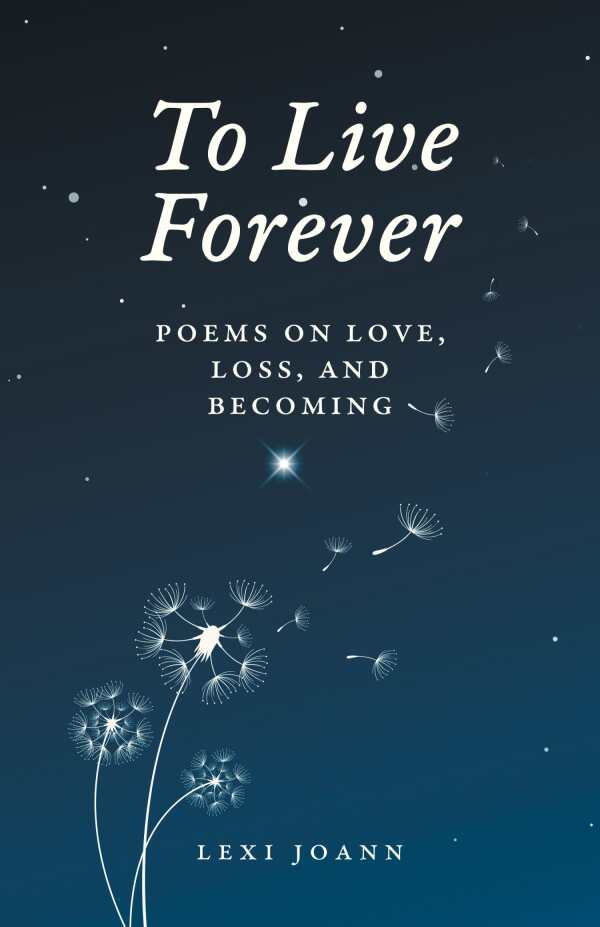
To Live Forever
Poems on Love, Loss, and Becoming
About everyday sources of confusion and comfort, To Live Forever is a deeply felt poetry collection.
Lexi Joann’s form-experimental poetry collection To Live Forever is about heartbreak, new love, and the ways people grow through both.
Moving through the stages of grief and healing to observe cycles of renewal, the poems begin amid heartbreak and end up affirming the complications and joys of life. All are anchored by this clear narrative throughline, whose stages are further pronounced by the book’s sectioning. The speaker embraces change and the chance for another relationship, coming of age in the wake of her sadness. Different formats are used to cover her growth, ranging from one-sentence entries to long poems that repeat certain phrases.
The inherent complications of heartbreak and life are well honored in this collection. Framed as part of settling into adulthood, such experiences are occasionally contrasted with earlier, easier times. Reflecting the alienation of loss through various piquing images, as of a trapped firefly and a ship unused to steady waters, the poems tap into the strangeness of particular experiences well:
my eyes fill watering cans
aiding flowers to grow
in the scars of my despair
Indeed, the book establishes a sense of intrigue about the speaker’s ongoing evolution by tackling messy topics with aplomb. However, its second half is less nuanced and exploratory than its first, though remaining earnest in tone. The process of healing is handled with the least variety, with the lines devoted to it proving quite straightforward and unsurprising, undermining the book’s pronounced interest in exploring recovery in depth.
Instances of awkward imagery and repetitive language further undermine the collection, as do its occasional breaks in voice, interrupting its otherwise straightforward focus on a single person’s experience. However, the collection regains strength in its final stretch, returning to evocative personal poems and reflecting on self-image and self-doubt with clarity:
I need to see the world
to escape this ghost town
this place that people keep saying is where
I should settle down
but I don’t see it
and if they knew that I seek
beyond their wildest dreams
would they still tell me
this is where I should be?
Further, the collection ends, not on a new love, but by examining the speaker’s desires and anxieties as a young creative. It’s a complex ending for a collection that troubles familiar concerns of growing up, in which love for another person is treated as less important than the love of one’s self and the honest pursuit of personal interests.
About art, life, loss, and love in early adulthood, To Live Forever is an emotive poetry collection.
Reviewed by
Katherine Woods
Disclosure: This article is not an endorsement, but a review. The publisher of this book provided free copies of the book and paid a small fee to have their book reviewed by a professional reviewer. Foreword Reviews and Clarion Reviews make no guarantee that the publisher will receive a positive review. Foreword Magazine, Inc. is disclosing this in accordance with the Federal Trade Commission’s 16 CFR, Part 255.


