
The Unravelling of Ou
A first-time grandmother reckons with the ways she retreated from herself in Hollay Ghadery’s melancholy but hopeful novel The Unraveling of Ou.
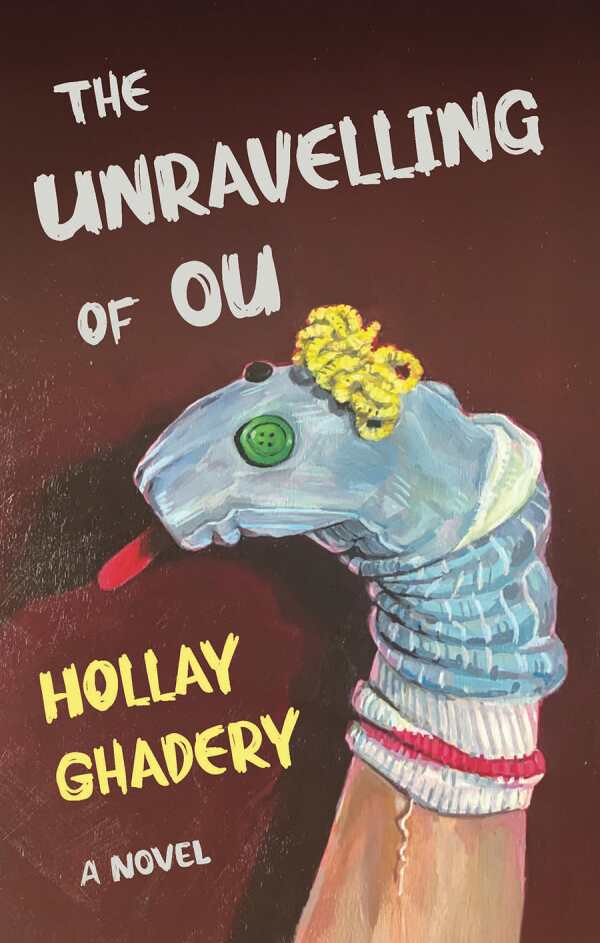
Minoo’s strict, conservative mother ingrained in her the belief that she was shameful, in body and mind. After being exiled to live in Canada with a relative, attending university, and getting married and raising her daughter, Minoo remains separate from herself, expressing herself through homemade sock puppets. When Ecology Paul, Minoo’s first puppet, accompanies Minoo to the maternity ward to meet her grandchild, Minoo’s daughter banishes them. On the drive from the hospital, Ecology Paul helps Minoo pore over her life and consider taking control of it at last.
“Ou” is a genderless Farsi pronoun that Ecology Paul uses to describe themselves. In poetic and lyrical language, Ecology Paul traces Minoo’s life from childhood to present, revealing her vulnerabilities with an unflinching yet empathetic eye. Through Ecology Paul, Minoo’s relationships with her mother figures are rendered with startling clarity. She neither assigns blame nor grants absolution, but illustrates the ways in which they failed, enabled, and tried to encourage her.
Farsi words pepper the narrative, which loops upon itself as Minoo, through her puppet, reflects on how she arrived at this moment. Even as she uses the puppet to avoid her identity struggles, she uses them to process her emotions and communicate through dissociative periods. Ecology Paul is proof of Minoo’s distrust of herself and disengagement with her body. The book’s subtle reveals of her repeating patterns and of Minoo’s fragmented self-image solidify into a portrait of a woman on the brink of either total emotional collapse or complete transformation.
The Unraveling of Ou is an insightful novel about personhood, emotional well-being, and the often fraught relationships between mothers and daughters.
Reviewed by
Dontaná McPherson-Joseph
Disclosure: This article is not an endorsement, but a review. The publisher of this book provided free copies of the book to have their book reviewed by a professional reviewer. No fee was paid by the publisher for this review. Foreword Reviews only recommends books that we love. Foreword Magazine, Inc. is disclosing this in accordance with the Federal Trade Commission’s 16 CFR, Part 255.


