

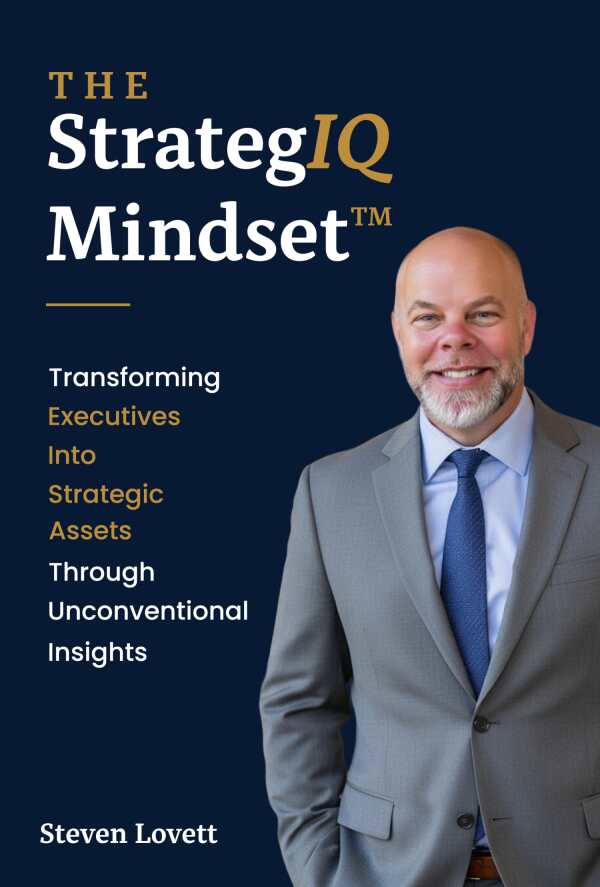
The StrategIQ Mindset
Unlocking Executive Transformation through Unconventional Insight
Aiming to translate strategic clarity into sustained financial success for those in senior roles, The StrategIQ Mindset is a compelling leadership guide.
Steven Lovett’s leadership guide The StrategIQ Mindset pushes for a shift in executive cognition to replace operational habits with strategic dominance.
Introducing a framework for executive evolution that moves beyond the mundane tasks of organizational maintenance toward the creation of a distinct market position, the book posits that many leadership failures occur due to a lack of strategic orientation and reliance on incremental gains rather than systemic change. Through a series of conceptual shifts, the book suggests replacing reactive management with proactivity and treating market ambiguity as a means of competitive advantage. It aims to translate strategic clarity into sustained financial success for those in senior roles.
Organized to mirror the first hundred days of a high-stakes leadership transition, the book’s chapters serve as a roadmap, beginning with the internal reconfiguration of a leader’s mental model and expanding to cover modes of external execution. Historical case studies involving figures including Winston Churchill and Abraham Lincoln provide a bedrock for its arguments, illustrating how strategic intelligence functions during times of extreme uncertainty. These examples anchor the book’s theoretical components well, providing a sense of gravity and historical precedent for its recommended actions.
The 100-Day Plan structure ensures that the shift from operational to strategic focus is grounded in practical steps. Its flow is consistent and focused on distinguishing between maintenance and momentum. Its conceptual divide highlights a common trap wherein executives mistake efficient administration for strategic progress.
Tools including Key Accountability Indicators are shared to measure organizational transformation; they focus on outcomes rather than the inputs that sustain the status quo. However, the heavy reliance on military and wartime metaphors results in some internal rigidity, and while the historical parallels are edifying, they frame business leadership as a series of battlefield maneuvers, emphasizing competition over collaborative dynamics. This aggressive posture obscures the book’s focus on sustainable growth at times, as does its pointed but narrow focus on attaining “absolute victory.”
Still, the prose is lean, authoritative, and insistent. Its sentences are often short and declarative, and their tone is consistent throughout, maintaining professional distance while acting as a firm guide through the “crucible of conviction.” One passage notes that “transformative leadership isn’t a position you occupy or a title you possess,” showcasing the book’s focus on evolution. The lack of jargon makes its ideas accessible, though the book’s relentless pace also leaves little room for reflection between its major points.
The book provides a sense of closure by connecting the initial mindset shift to the ultimate goal of building a legacy that survives individual leaders. There is a clear sense of purpose in the way the final chapters tie back to the original premise of strategic intelligence. The conclusion includes a compelling call to action, too, leaving the audience with a sense of confidence in their potential for effecting organizational change.
The StrategIQ Mindset is a demanding leadership guide that introduces a disciplined system for executive transformation.
Reviewed by
John M. Murray
Disclosure: This article is not an endorsement, but a review. The publisher of this book provided free copies of the book and paid a small fee to have their book reviewed by a professional reviewer. Foreword Reviews and Clarion Reviews make no guarantee that the publisher will receive a positive review. Foreword Magazine, Inc. is disclosing this in accordance with the Federal Trade Commission’s 16 CFR, Part 255.


