

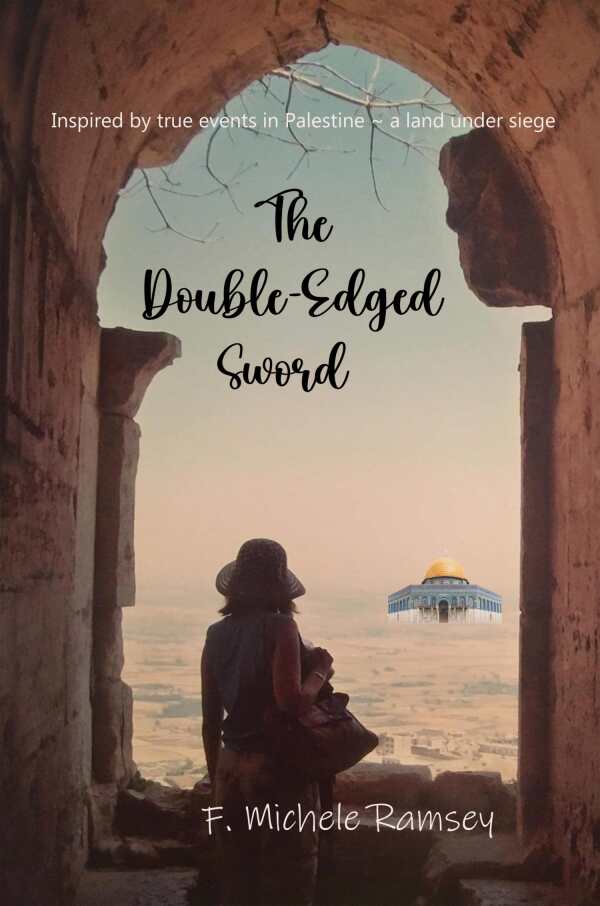
The Double-Edged Sword
Inspired by True Events in Palestine---a Land Under Siege
The lives of people of multiple faiths intersect to edifying effect in the heady novel The Double-Edged Sword.
In F. Michele Ramsey’s illuminating historical novel The Double-Edged Sword, a tenacious woman experiences romance against the backdrop of national strife.
In the 1980s, Farah, a French Egyptian woman, anticipates marrying Justin, her American fiancé. Instead, Justin disappears without explanation. Brokenhearted, Farah seeks independence in Paris, working at an airline’s VIP lounge. There, she meets Gus, a wealthy Muslim man whose romantic pursuit of her is shadowed by the traumas he experienced in Lebanon. Meanwhile, in Israel, Moshe worries about mounting unrest while caring for his Jewish family.
The multipart novel advances by drawing stark contrasts between the various countries and the characters’ alternating views. Its focus is uneven, though. Justin is rendered incidental to the central plot, with his storyline abandoned for too long. Moshe’s storyline—which includes brushes with violence, involves an edifying friendship with a Palestinian man, and is used to speak to stark differences between people’s experiences of privilege––is also somewhat neglected; his ultimate connections to the others are not well set up.
More space is devoted to detailing Farah and Gus’s dates in Paris. Gus is an alluring, decisive lover, while Farah is both excited and uncertain. They have an electric connection, though Farah’s comparisons of it to a fairy tale are strained. However, Gus is cagey about the nature of his work, and Farah has her doubts about him. Her Christian family’s disapproval of interfaith relationships also complicates their bond. Such conflicts are explored in clear terms, with the couple’s personalities making their struggles feel more urgent.
The passage of time is also inconsistent throughout. A plane crash launches Farah into a teaching job in Jordan; this storyline is rushed through. In comparison, developments are handled in a more lingering manner. Further, some chapters skip across months, leaving minor plotlines unresolved.
Then, in the 1990s, Farah’s priorities mature, leading to narrative jumps that are fueled in part by her volunteer work with Palestinian refugees. While these experiences are purported to rekindle her interest in faith, mentions of religion are quite glancing, all but brushed aside. Better handled are people’s cultural traditions, which are explored via family conversations and intricate social celebrations. The Middle Eastern settings are covered in terms of Arabic music, rich interiors, and biblical sites, with occasional arresting images, as of olive trees, proving poignant.
The book’s later sections are also too busy. They include shifts in locale and contrived thrills, including the reemergence of a character thought to be dead. Indeed, as dramatic betrayals compound, the novel’s conclusion unravels: Farah’s late curiosity about Jesus and desire “to find her own truth” insert semi-redemptive shifts that were ill foreshadowed and remain unconvincing.
In the multiperspective novel The Double-Edged Sword, a woman pursues personal growth in a variety of settings.
Reviewed by
Karen Rigby
Disclosure: This article is not an endorsement, but a review. The publisher of this book provided free copies of the book and paid a small fee to have their book reviewed by a professional reviewer. Foreword Reviews and Clarion Reviews make no guarantee that the publisher will receive a positive review. Foreword Magazine, Inc. is disclosing this in accordance with the Federal Trade Commission’s 16 CFR, Part 255.


