

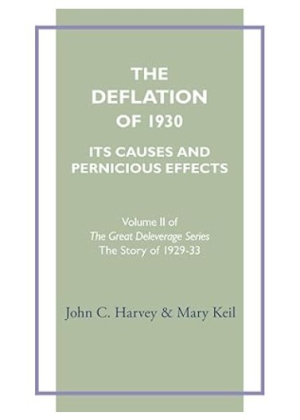
The Deflation of 1930: Its Causes and Pernicious Effects
Volume II of The Great Deleverage Series
Breaking down what happened during the Great Depression and deriving lessons from it, The Deflation of 1930 is an edifying historical text.
John C. Harvey and Mary Keil’s analytical economic history book The Deflation of 1930 is about the monetary contraction that upended life for everyday Americans during the Great Depression.
In 1930, deflation wiped out wealth, including by crashing real estate values, gutting demand, and devastating consumer spending as skittish people paid down their debts. Herein, ample economic data is proffered to explain how and why the money supply shrank, what repercussions this had, and why so little attempted federal intervention took place.
Surveying various academic theories, the book begins by spelling out a theory about overindebtedness. It then outlines the problems that deflation caused and chronicles what happened to the US economy between 1929 and 1931. Each quarter of economic activity is covered in depth, via insightful theories and extensive economic data to contextualize what occurred and to cover the misconceptions that economists or historians may have had about the root causes of the Great Depression.
The book’s arguments are supported by a wealth of data, including tax returns, New York Stock Exchange loans, and commercial bank loans. Drawing from the federal government and other authoritative sources, it cites price indexes, yield curves, and other broad sets of economic data to provide as much background and understanding as possible. The information on display is exhaustive, with the book even drilling down to an individual farmer’s balance sheet.
Quotes from academic works and memoirs are also among the book’s judicious selection of sources. It often challenges the validity of previous assertions and received wisdom, as with the notion that a wave of bank failures triggered a national banking crisis in 1930. It also mulls over contentions like that the banking crisis was regional in scope since bank failures only took place in five cities, observing that banks nationwide suffered as people and businesses stopped availing themselves of credit and started paying down debt.
The book’s conclusions are well supported, as when it differentiates between the speculators and long-term investors who suffered when the stock market crashed. Different economic metrics are also considered for balance and range, as with the observation that brokerages selling bonds and stocks opened the highest number of branch offices ever at the beginning of 1930 but started to contract by September. The scope of information about different industries, unemployment, and federal government activities is exhaustive.
The prose is accessible and clear despite being stuffed with statistics, figures, and economic jargon. Topics including the distress selling of mortgaged properties are covered in a technical and precise fashion, with the book distinguishing between the three categories of mortgages to provide contextualized working knowledge. Some of its coverage of outside work feels rushed, though. Nonetheless, its general thoughts on the phenomenon of deflation have contemporary applications, making for an edifying read on the whole.
A rigorous economic history, The Deflation of 1930 explores the monetary crisis that roiled the economy during the Great Depression.
Reviewed by
Joseph S. Pete
Disclosure: This article is not an endorsement, but a review. The publisher of this book provided free copies of the book and paid a small fee to have their book reviewed by a professional reviewer. Foreword Reviews and Clarion Reviews make no guarantee that the publisher will receive a positive review. Foreword Magazine, Inc. is disclosing this in accordance with the Federal Trade Commission’s 16 CFR, Part 255.


