

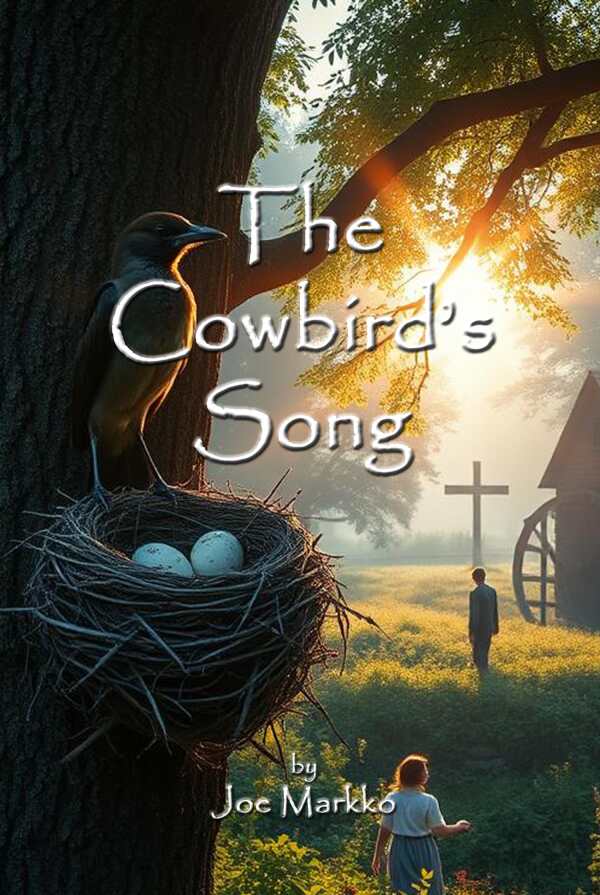
The Cowbird's Song
Centering a Methodist religious settlement along the Guyandotte River in West Virginia, The Cowbird’s Song is a detailed historical novel.
In Joe Markko’s expansive historical novel The Cowbird’s Song, multiple lives and timelines, stemming from the formation of a religious frontier community, weave together.
The novel opens in late eighteenth-century England, then moves to the American frontier and, later, to the 1960s. It follows a wide cast of characters whose individual stories intersect in both direct and oblique ways. Shiloh Mills, a Methodist religious settlement along the Guyandotte River in West Virginia, is a centering force throughout. It is animated by the convergence of multiple perspectives across time.
The book’s introduction, which is narrated by the river itself, is fluid, lyrical, and engaging, fleshing out the landscape that backdrops the life of the settlement. The character-centered chapters that follow capture three generations in the Embry family via discrete people and moments in time. It’s a broad but fragmentary storytelling approach that is undermined by its abrupt transitions, though.
Indeed, the book’s individual portraits are not made to connect well. Each has its own narrative thread and historical context. Further, some chapters are flush with details that have limited impact on the overarching narrative, as where the Gregory boys are the focus; elsewhere, Shakespeare Webb is introduced using ample personal details, though his significance to the narrative is not established for several pages. How each thread fits into the larger narrative is too often unclear.
Themes of faith, intercultural exchanges with Native Americans, and the tension between idealism and reality are addressed with greater continuity. There is also a recurring emphasis on the importance of the land, both as a resource and as a spiritual space. The relationships between the settlers and Indigenous people add a layer of moral complexity, albeit one that is underdeveloped.
In this sprawling text, the large cast of characters, coupled with uneven pacing and delayed narrative integration, results in a too-disjointed sensibility. In addition, as the novel progresses, its language shifts, becoming clipped and overreliant on metaphors; its layered comparisons are distracting. Though it seeks to capture the complexity of the religious settlement through an array of voices and perspectives, its structural sprawl and stylistic inconsistencies are too much of an impediment to its ultimate delivery. Indeed, the book often seems more concerned with highlighting historical moments than with telling a cohesive story: Prefacing its narrative are a QR code and an accompanying link that direct attention to supplementary materials, including historical documents and character illustrations, to reinforce the novel’s historical ambitions.
An intricate historical novel, The Cowbird’s Song is a character-driven look at what binds religious communities together.
Reviewed by
pine breaks
Disclosure: This article is not an endorsement, but a review. The publisher of this book provided free copies of the book and paid a small fee to have their book reviewed by a professional reviewer. Foreword Reviews and Clarion Reviews make no guarantee that the publisher will receive a positive review. Foreword Magazine, Inc. is disclosing this in accordance with the Federal Trade Commission’s 16 CFR, Part 255.


