

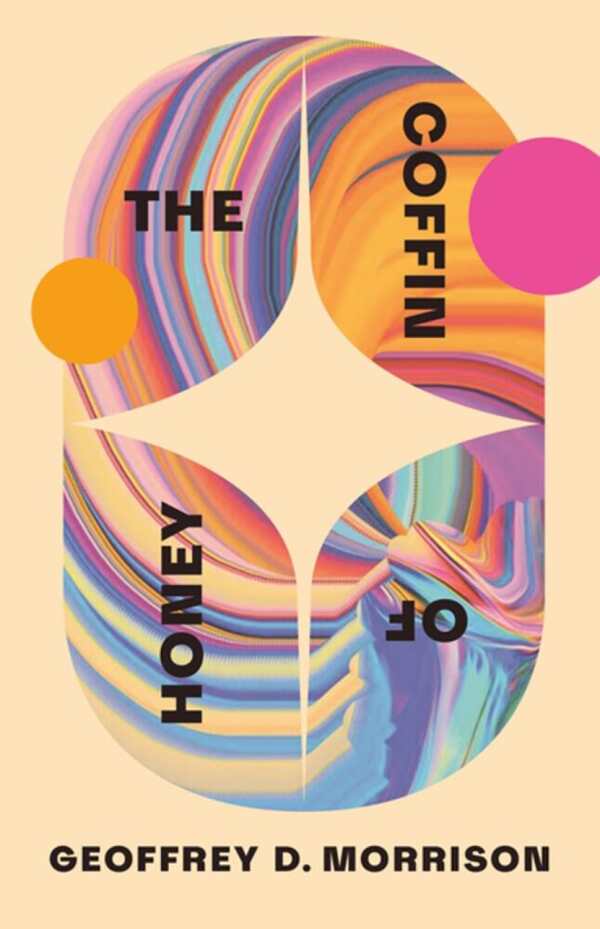
The Coffin of Honey
What is sweet can also immobilize you in Geoffrey D. Morrison’s alarming, wondrous speculative novel The Coffin of Honey, a searing indictment of capitalist destruction wrapped in the pleasures of a first contact tale.
Amid the uneasy peace following a global war between capitalists and communards, interplanetary transport orbs appear. They open themselves to “the ambivalent and the unexpecting” who yearn, inside, for fairer worlds—who have some innate sense of the better realms just beyond the veil. Stepping into their opened doors, these people become visitors in alien settings, walking among giant geode shards or singing under pink and yellow moons. It’s a transformative experience for each––and something that the jealous hordes on Earth want to either experience for themselves or control. Indeed, those in power seek ways to exploit the distant planets for profit.
Narrated through official, redacted reports and academic responses sprinkled among particular observations, the story is centered by three people: the swimmers’ first guest, a distant poet witness, and a surfer spy for “a garrison state premised on spite.” The spy, who moves “through the world smelling cold steel and spilled blood,” is ill-aware of his own flailing villainy. The poet—depleted; worried that poetry is “graveyards, dead princesses, ossified records of lost time”—finds reason to hope. And the first guest, as was always his truest ambition, comes to represent all who desire equanimity and want to move beyond.
The prose is elegant, philosophical, and introspective, though also pocked with reminders of human corruption. Indeed, as righteous vigor is expressed by those on all sides in reaction to the silent messengers from beyond, it is filtered through varying perspectives with skill: Many remain cynical; some nurture fresh dreams.
In the troubled future, a select few humans are given glimpses of interplanetary existence in the stimulating speculative novel The Coffin of Honey.
Reviewed by
Michelle Anne Schingler
Disclosure: This article is not an endorsement, but a review. The publisher of this book provided free copies of the book to have their book reviewed by a professional reviewer. No fee was paid by the publisher for this review. Foreword Reviews only recommends books that we love. Foreword Magazine, Inc. is disclosing this in accordance with the Federal Trade Commission’s 16 CFR, Part 255.


