

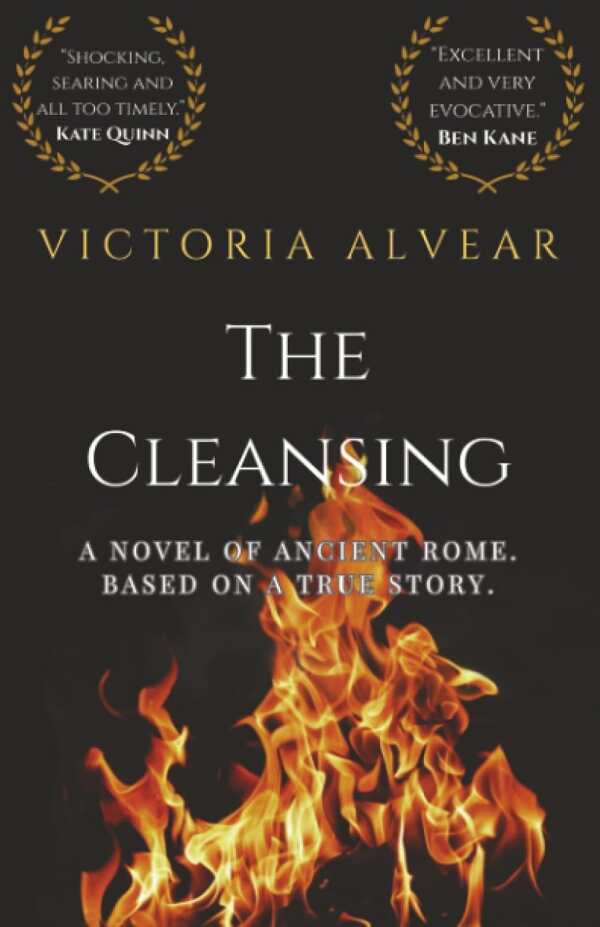
The Cleansing
A Vestal virgin defends her honor to save her life in Victoria Alvear’s The Cleansing, a riveting novel set in an ancient Rome.
At a time when the “truth no longer matters” and misogyny, violence, and superstition reign, Six-year-old Mia is chosen to serve Vesta for thirty years. Though she chafes under the cruelty of the head priestess, whose “mastery of the power of religious theater [is] unmatched,” she takes comfort in believing that her sacrifices ensure the safety of Rome. Respite is also found in her cherished friendships with Prisca, who assures Mia that “We are not meant to live without love [or] touch,” and with Attius: “the heart of my childhood joys and the source of all of my fantasies of an alternate life.”
But in the sixteenth year of Mia’s service, after Hannibal’s vicious campaigns leave the Roman army depleted, the people seek someone to blame. The ruling men of the city formulate a plan: put two Vestals on trial to appease the people, “as a distraction from [their] endless grief and panic.” With only her wits to defend her, Mia seeks to prove her innocence against powerful forces that care little about the truth.
A gripping historical account of men’s impunity and irrepressible feminine rage, The Cleansing takes Mia’s trial as its core, but also moves back through time to consider how the elements of her doom fell into place. It shows her cherishing play in the countryside, recognizing the circularity of reasoning surrounding the gods, and remaining chaste despite her desire for Attius. Though righteous and desirous of freedom, she also resists the wisdom of the Sibyl of Cumae, who argues that women’s divine places in the human story are being systematically erased.
Asking “Why [does] it always take a miracle for a woman to be believed?”, the novel’s indictments of institutionalized misogyny are clear and keen, as are its critiques of uneven power dynamics. Mia reflects that “Self-blame … was the purvey of the powerless. [It] gave them the illusion of control” and points out that men, not gods, interpret the signs that dictate the course of people’s lives. She advocates for Ketet, her freedwoman attendant, and speaks on behalf of a Vestal who is raped. Despite the wild odds against her, her righteous fury carries the novel through to its thrilling, hopeful end.
Reviewed by
Michelle Anne Schingler
Disclosure: This article is not an endorsement, but a review. The publisher of this book provided free copies of the book to have their book reviewed by a professional reviewer. No fee was paid by the publisher for this review. Foreword Reviews only recommends books that we love. Foreword Magazine, Inc. is disclosing this in accordance with the Federal Trade Commission’s 16 CFR, Part 255.


