

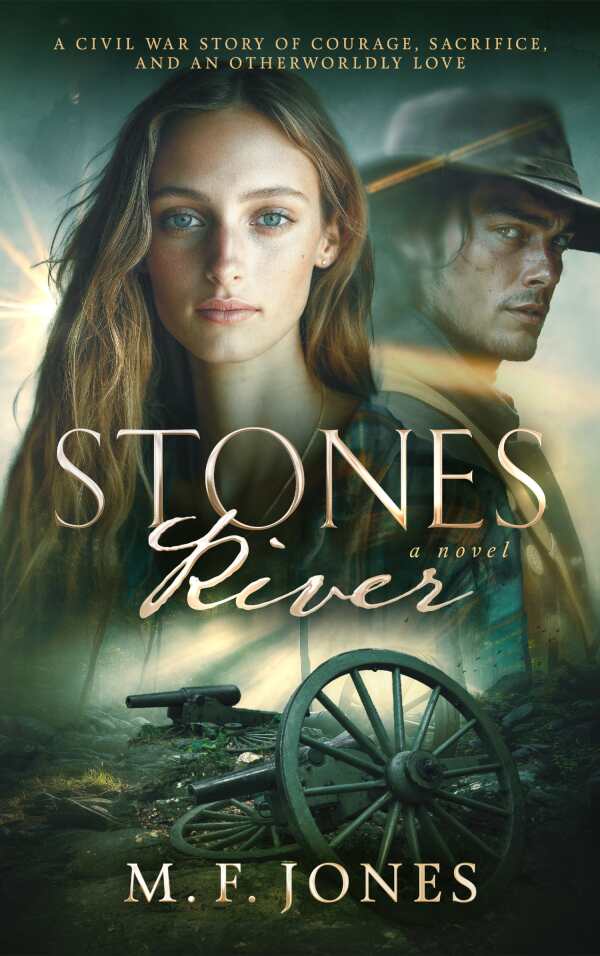
Stones River
A Civil War Story of Courage, Sacrifice, and an Otherworldly Love
A lonely woman enters into a paranormal relationship in the exciting romance novel Stones River.
In M. F. Jones’s riveting romance novel Stones River, a woman encounters a Civil War ghost; together, they search for solace.
Jessie, a shy elementary school music teacher and church organist, is also a member of a Civil War reenactment troupe. Her role within the group is to cook and sing. Near the 144th anniversary of the Battle of Gettysburg, she meets Lemuel. She mistakes him for a handsome fellow actor; in fact, he is the ghost of a Confederate soldier. Yearning for excitement, Jessie agrees to search for his family members in order to free him from standing sentinel as a ghost.
Advancing through secretive meetings with Lemuel, coverage of his wartime experiences, and Jessie’s search for his family members, the multipart novel sketches Jessie in terms of her competing emotions: She desires intimacy but is astute enough to know that her star-crossed connection to Lemuel exists in a “heightened, unstable state.” The question of how she will respond to her inevitable heartbreak is intriguing.
In contrast, Lemuel, whose supernatural limitations prevent him from being affected by the tangible world, is developed most in terms of his capabilities and determination. When he’s relaying his past, his voice is taut and visceral, focused on details like the privations the soldiers experienced, as well as their shared fears and personal confessions. Battlefield settings are fleshed out in immersive terms, with mentions of detritus, including scattered photographs, that underscore the ordinary lives of those involved.
Less lively are the book’s meticulous details about the troupe’s battle reenactments, which cover the lengths that the actors go to in imitating authentic mannerisms, speech, and clothing. However, tough correlating topics, as with the fringe groups who fight for a “lost cause” in contemporary times, are sidestepped; instead of grappling with these weighty subjects, the book focuses on Jessie’s warm friendships within the group. Lemuel’s Confederate alignment is also explained away in terms of geography, with references made to the fact that his Tennessee family held no enslaved people; his decision to defend his hometown is not explored with nuance.
Christian themes of reuniting with loved ones in eternity are hinted at, as Jessie’s pastor advises her to let Lemuel go. Her attachment to him is underdrawn, though. Because the novel condenses weeks’ worth of their off-page meetings, their confessions of love are underwhelming. Further, an ambiguous dreamy sequence related to the afterlife proves quite fanciful and jarring in relation to Jessie’s other encounters with the spiritual realm.
In addition, the book’s resolutions to Lemuel and Jessie’s search are too convenient, enabled by vague suggestions of divine help. Because faith is more of a background current than a lived reality for most of the story, though, this feels out of place. The somewhat late introduction of minor characters also dilutes the story’s focus.
About honoring soldiers, their traumas, and the descendants who carry their stories forward, Stones River is a sweet historical romance novel.
Reviewed by
Karen Rigby
Disclosure: This article is not an endorsement, but a review. The publisher of this book provided free copies of the book and paid a small fee to have their book reviewed by a professional reviewer. Foreword Reviews and Clarion Reviews make no guarantee that the publisher will receive a positive review. Foreword Magazine, Inc. is disclosing this in accordance with the Federal Trade Commission’s 16 CFR, Part 255.


