

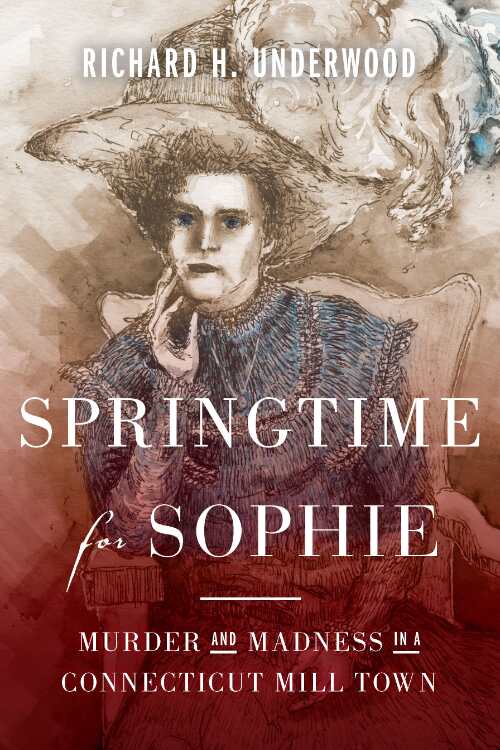
Springtime for Sophie
Murder and Madness in a Connecticut Mill Town
Utilizing archival records, court transcripts, newspaper accounts, and other historical sources, the engrossing true crime book Springtime for Sophie delves into a violent murder and the subsequent trial.
Richard H. Underwood’s gripping true crime book Springtime for Sophie is about a brutal early twentieth-century murder and the sensationalized court trial that followed.
In September of 1909, Bronislaw Kulvinskas was found in a wooded area with multiple gunshot wounds and a slashed throat. He survived long enough to identify his assailants: His close acquaintance and romantic interest, Sophie Kritchman, lured him to a secluded spot where their mutual friend, Joe Mitchell, waited. This deathbed statement became a pivotal piece of evidence.
Utilizing archival records, court transcripts, newspaper accounts, and other historical sources, the book delves into the circumstances surrounding Kulvinskas’s death and the trial of those he accused of his murder. It establishes its historical backdrop well, fleshing out Waterbury and Naugatuck, Connecticut, in the early 1900s in terms of the region’s close-knit Eastern European community. Photographs, maps, and reproductions of press articles and court documents are included; one newspaper item features a picture of Kritchman with the headline “Is This Pretty Girl a Human or a Demon?”
Citing various press interviews and Kritchman’s observed behavior at trial, the book depicts Kritchman as a somewhat impulsive, self-centered woman who was prone to displays of laughter or tears. She is said to have reacted with shock upon being given a twelve-to-fifteen-year manslaughter prison term, not seeming to appreciate that she had avoided the death penalty. Despite having an alibi, Kritchman’s codefendant, Mitchell, received a life sentence.
The book includes revealing commentary on the intense press and public scrutiny toward Kritchman, from in-depth descriptions of her wardrobe to commentary on her facial expressions and actions. Souvenir trial postcards bearing her image were printed, it notes; crowds of courtroom spectators regarded her with both hostility and empathetic approval. She garnered “mixed reviews” of her looks; in contrast, Joe Mitchell’s appearance seemed of minimal importance. Some seem to think she was incapable of committing a murder, the book notes; it implies that she may have received a lesser sentence because she was a woman.
Despite its inclusion of such in-depth explorations, the book is quite compact. It also includes fourteen pages of quoted transcripts. Still, its account of the murder and trial reads as comprehensive and accessible, even extending to coverage of Mitchell’s appeal. Occasional first-person commentary shifts the book’s perspective to distracting effect, though.
An engrossing true crime book, Springtime for Sophie is about betrayal, legal machinations, and the media fervor surrounding a turn-of-the-century New England murder.
Reviewed by
Meg Nola
Disclosure: This article is not an endorsement, but a review. The publisher of this book provided free copies of the book and paid a small fee to have their book reviewed by a professional reviewer. Foreword Reviews and Clarion Reviews make no guarantee that the publisher will receive a positive review. Foreword Magazine, Inc. is disclosing this in accordance with the Federal Trade Commission’s 16 CFR, Part 255.


