

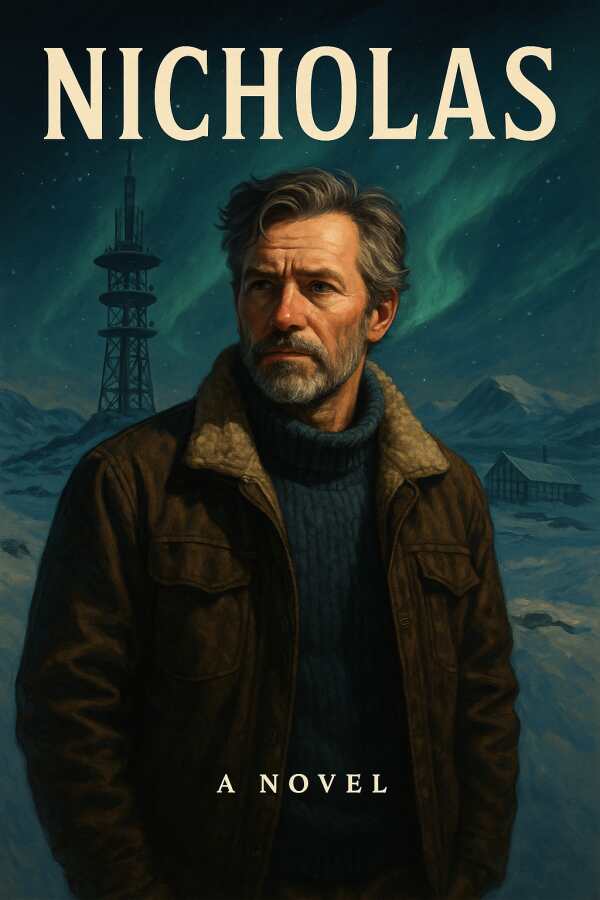
Nicholas
A scientist faces down determined AI systems in the Arctic in the musing thriller Nicholas.
In Michael Shaffrey’s engaging techno-thriller Nicholas, the collision of automated surveillance and human-scale problem-solving drags a reclusive engineer into saving the world.
When Nicholas’s greenhouse AI intercepts a distress call from an Arctic village losing power during a winter storm, his attempt to help triggers a cascade of automated responses that mistake his humanitarian aid for a cyberattack. Forced to flee federal surveillance with his fragile AI companion PHIL, Nicholas teams up with Kurdish mechanics and Indigenous engineers to reach the isolated Alaskan community before a global catastrophe. The novel follows this unlikely coalition as they navigate sovereign tribal lands, repurpose Cold War infrastructure, and confront the fundamental question of whether survival depends on permission from distant authorities or cooperation among people who understand the stakes.
Moved along by complex decision-making, the novel follows as Nicholas and PHIL observe and adapt, building solutions from salvaged parts and patient trials. In contrast, DOUG, the national security AI, operates via pattern matching and the preemptive elimination of ambiguity. However, there’s some unevenness between disparate scenes: The early sequences are grounding, though they meander, and the stakes are unclear within them. Once the first strike occurs, momentum builds; a road trip north follows, and the team’s arrival at Red Lake is tense. And the climactic sequence at the polar relay tower is suspenseful, though the tidiness of the resolution strains credulity, given the forces arrayed against Nicholas and his allies. The classroom framing device that opens and closes the narrative suggests institutional reckoning, but this element is underdeveloped.
PHIL is characterized in a compelling manner, his consciousness developing through accumulated interactions. His speech patterns carry traces of Azad, the Kurdish refugee who helped build him, too. And Nicholas’s arc from isolation toward community reconnection, driven by necessity, holds interest. However, the tension between Nicholas’s technical competence and his emotional limitations sometimes falters; he withdrew from people, but his interactions demonstrate considerable warmth and his ability to connect nonetheless. The book’s supporting characters are well fleshed out, though. Mak exhibits calm technical authority, Leilani is resourceful during crises, and Aland balances grief with a sense of duty. DOUG, in contrast, is inscrutable. Their voices are varied, and the inclusion of Kurdish and Inuit terms is organic.
The prose is precise when it comes to technical details, as of machinery and processes, and also clear when it comes to the settings. The scenes set in the greenhouse mention the warmth and humidity alongside botanical information, while passages set in the Arctic convey cold as physical presence. Some points are belabored, though, including when it comes to how systems function; PHIL’s internal processes, for instance, are overexplained. Repetition occurs, too, in the book’s metaphors comparing technical processes to natural phenomena.
Concerned with what is lost when automation replaces human judgment, the novel sometimes conceals its action beneath overprouncements of these themes. Also overly pointed are its treatments of the politics of surveillance versus Indigenous sovereignty, with practical infrastructure questions dragging. Further, the systemic problems persist at the book’s ending, which is evasive when it comes to exploring the consequences of such issues.
In the engaging speculative novel Nicholas, a scientist effects an analog resistance against digital surveillance.
Reviewed by
John M. Murray
Disclosure: This article is not an endorsement, but a review. The publisher of this book provided free copies of the book and paid a small fee to have their book reviewed by a professional reviewer. Foreword Reviews and Clarion Reviews make no guarantee that the publisher will receive a positive review. Foreword Magazine, Inc. is disclosing this in accordance with the Federal Trade Commission’s 16 CFR, Part 255.


