

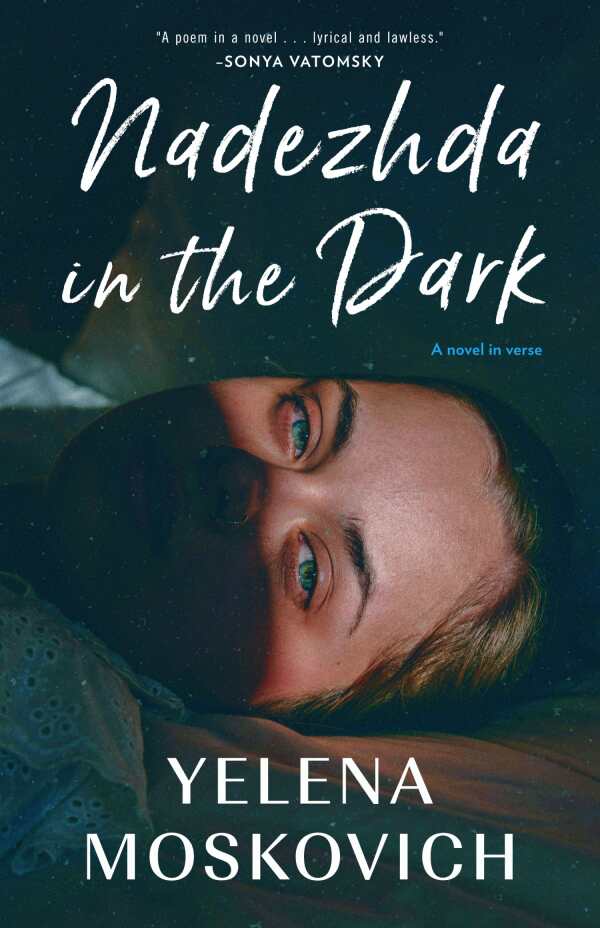

Nadezhda in the Dark
A Novel in Verse
A passionate couple from different sides of the Soviet divide avoids discussing their inevitable rifts in Yelena Moskovich’s sultry, wrenching novel-in-verse, Nadezhda in the Dark.
During a “black-milk,” mournful winter, as Russia invades Ukraine, the Ukrainian Jewish narrator and her Russian beloved, Nadya, trouble the night away, side by side. Both carry wounds from their Soviet childhoods; both have lost friends to homophobia, war, and sadness. Their love, while at times fractious, is a ferocious counter to ingrained hatred. Still, “it’s hard to dance / when there are guns / in the air.”
In some ways, Nadya and the narrator understand each other intimately, in a manner that transcends national and cultural divides; between them are “centuries of Slavic love / and death.” But they also have difficulty making their “childhood pain compatible.” Indeed, there are elements of herself that the narrator cannot share with Nadya, including the particulars of her intergenerational trauma, which she’s sure that those raised on Soviet antisemitism cannot fully understand.
Thus, to reckon with the parts of her that are lonely, even beside the one she loves, the narrator sifts through poems, music, and literary references, including a version of Cinderella that incorporates Baba Yaga lore, letting these snippets of her culture feed and center her. A nonbeliever, she clings to her Jewishness, too:
a grudge like mine could be
a way of believing …
my eyes still hold
fossil tears,
pebbles of the promise
and the hum of winds over a seamless oceanic void
Weaving together blistering revelations, historical indictments, and evidence of entrenched defiance, the novel’s blunt and lovely verses encapsulate the internal warring that occurs throughout its one determinative night. There’s a sense of inexorability to its movements, which are at the same time underlain by the certainty that love itself, even when it is fleeting, is a life-giving force in a world at perpetual war with its most vulnerable people.
Reviewed by
Michelle Anne Schingler
Disclosure: This article is not an endorsement, but a review. The publisher of this book provided free copies of the book to have their book reviewed by a professional reviewer. No fee was paid by the publisher for this review. Foreword Reviews only recommends books that we love. Foreword Magazine, Inc. is disclosing this in accordance with the Federal Trade Commission’s 16 CFR, Part 255.


