

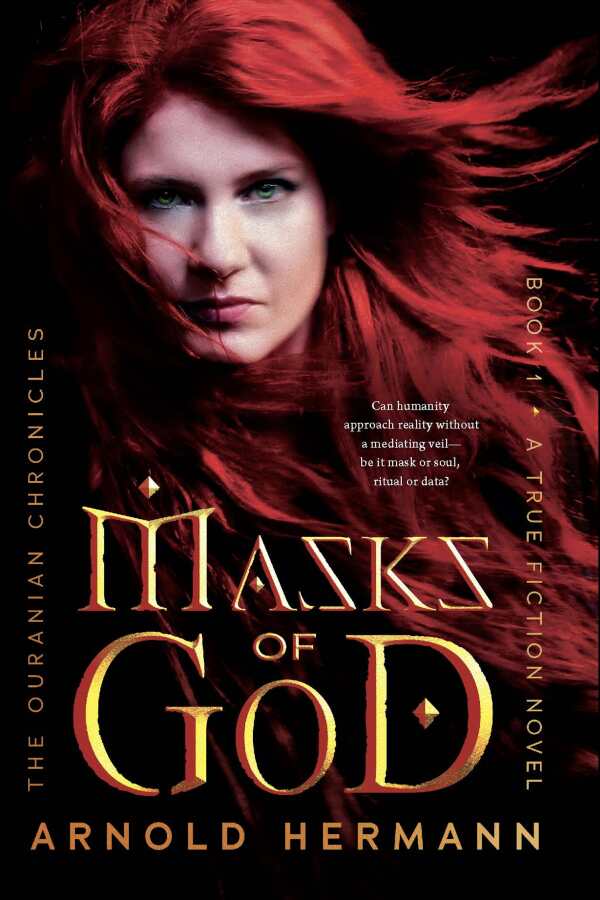
Masks of God
Book One: The Ouranian Chronicles Series
Questions of identity and historical continuity dominate in Masks of God, an intricate historical fantasy novel.
Set in the fourteenth century, Arnold Hermann’s grounded fantasy novel Masks of God concerns supernatural beings, reincarnation, and metaphysical forces that shape memory and human history.
Kayin is a wanderer who is guided by unseen, supernatural Chronologers. His mission unfolds amid the Mongol siege of Kaffa and the approaching devastation of the Black Death. As he moves through war-torn regions, he encounters Aušrinė, a warrior associated with the militant Masks of God, and Setenay, a leader tied to a secret order opposing slavery and political violence. Their paths also intersect with historical figures including Janibeg, the Golden Horde ruler whose campaign drives the siege.
The opening chapters introduce the Chronologer’s temporal framework alongside siege logistics, changing identities, and metaphysical hierarchies, using shifting timelines and recovered memories to reveal connections across multiple lives. However, because this dense conceptual information appears before the book’s characterizations are well established, emotional grounding is delayed. Indeed, early orientation within the novel is challenging.
Still, as the book continues, its story moves from the immediate dangers of warfare and captivity toward a broader struggle involving spiritual hierarchies, reincarnated identities, and attempts to influence historical outcomes. At a gradual rate, it expands from localized conflicts into a metaphysical narrative about memory, destiny, and the shaping of human history. As the chapters trade between expressions of physical danger and extended philosophical reflections, shifting alliances among steppe powers and Chronologer commentary are used to round out the layered timelines.
The depiction of the siege of Kaffa, as of Mongol forces launching plague-infected corpses into the city and the resulting collapse of civic order, have a sobering and grounding effect. The forced transport of captives following the city’s fall and encounters within contested Mediterranean port cities are also made palpable. References to steppe politics, Mediterranean trade networks, and Chronologer hierarchies flesh out the worldbuilding further.
The dense, formal narration is also punctuated by instances of philosophical exposition, though, in particular in the Chronologer sections, where abstract ideas subdue the book’s central actions. Extended explanations are also devoted to the world’s metaphysical rule and reincarnation cycles, sometimes proving interruptive to the plot’s progression. Nonetheless, all of the pieces converge in time, with later chapters bringing the once separate threads into a unified, philosophical framework. Major storylines are resolved through clarifications of reincarnation cycles and the consolidation of factional struggles. Still, the closing sections are quite compressed in their work toward cohesion.
In the intricate fantasy novel Masks of God, lives intersect during the Siege of Kaffa through matters of reincarnation and temporal influence.
Reviewed by
Katherine Crucilla
Disclosure: This article is not an endorsement, but a review. The publisher of this book provided free copies of the book and paid a small fee to have their book reviewed by a professional reviewer. Foreword Reviews and Clarion Reviews make no guarantee that the publisher will receive a positive review. Foreword Magazine, Inc. is disclosing this in accordance with the Federal Trade Commission’s 16 CFR, Part 255.


