
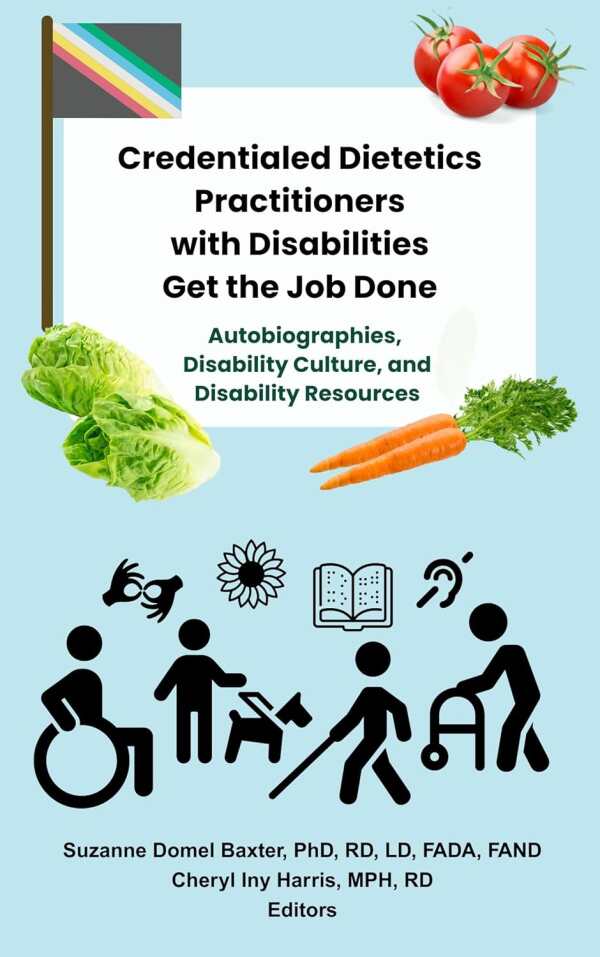
Credentialed Dietetics Practitioners with Disabilities Get the Job Done
Autobiographies, Disability Culture, and Disability Resources
Credentialed Dietetics Practitioners with Disabilities Get the Job Done is an insightful healthcare guide to broadening professional understandings of what competence looks like.
Edited by Suzanne Domel Baxter and Cheryl Iny Harris, the transformative healthcare guide Credentialed Dietetics Practitioners with Disabilities Get the Job Done challenges ableist notions that physical, sensory, or hidden differences are impediments to clinical excellence and redefines disability care in terms of specialized expertise.
Drawing on the experiences of credentialed dietetics professionals living with disabilities, this book poses questions about what it means to be a competent healthcare professional when systems are not designed with you in mind. Its personal stories cover a spectrum of visible and invisible disabilities to demonstrate that the barriers within the dietetics profession are often not the disabilities themselves but instead emanate from institutional inflexibility and the pervasive ableism of gatekeepers. The stories are further complemented by eight educational chapters that outline the programs and resources available to assist disabled practitioners in dietetics, including the Disabilities in Nutrition and Dietetics Member Interest Group, vocational rehabilitation programs, and centers for independent living.
The book does an able job of filling an underrepresented niche within healthcare literature. It is full of edifying advice for practitioners on topics including inclusivity and equity. It also encourages individuals with disabilities to enter the dietetics profession.
However, despite the book’s reference to professional pathways, credentialing bodies, and lived career trajectories, it lacks a structured pedagogy and formal academic framework. Indeed, its structural presentation is fragmented, spread across the fifteen varied autobiographical narratives. Further, for a volume that is dedicated to increasing accessibility and inclusion, it is paradoxical that the interior design eschews these principles. The chapters are text heavy, with limited visual hierarchy or infographics to anchor their complex information. This increases the cognitive effort for those with visual fatigue or processing differences and creates barriers for the very practitioners the book seeks to empower.
Still, the book’s narrative credibility is distinguishing. Its personal narratives are authentic, evocative, and illuminating. They convey moments of exclusion, adaptation, and quiet triumph well, mirroring the problem-solving nature of the dietetics profession itself. Indeed, the text is persuasive in contending that the dietetics profession cannot achieve greater equity and healthcare excellence without considering the perspectives of credentialed professionals living with disabilities. It argues with vigor that such practitioners possess invaluable knowledge of the unique physical, sensory, and systemic barriers that are embedded in everyday practice. Their lived experiences function as a form of professional expertise, one that enhances patient care while broadening the dietetics profession’s understanding of what competence looks like.
Existing at the intersection of disability and dietetics literature, the pioneering healthcare guide Credentialed Dietetics Practitioners with Disabilities Get the Job Done foregrounds the lived experiences of credentialed professionals with disabilities.
Reviewed by
Taona Ian Chirumarara
Disclosure: This article is not an endorsement, but a review. The publisher of this book provided free copies of the book and paid a small fee to have their book reviewed by a professional reviewer. Foreword Reviews and Clarion Reviews make no guarantee that the publisher will receive a positive review. Foreword Magazine, Inc. is disclosing this in accordance with the Federal Trade Commission’s 16 CFR, Part 255.


