

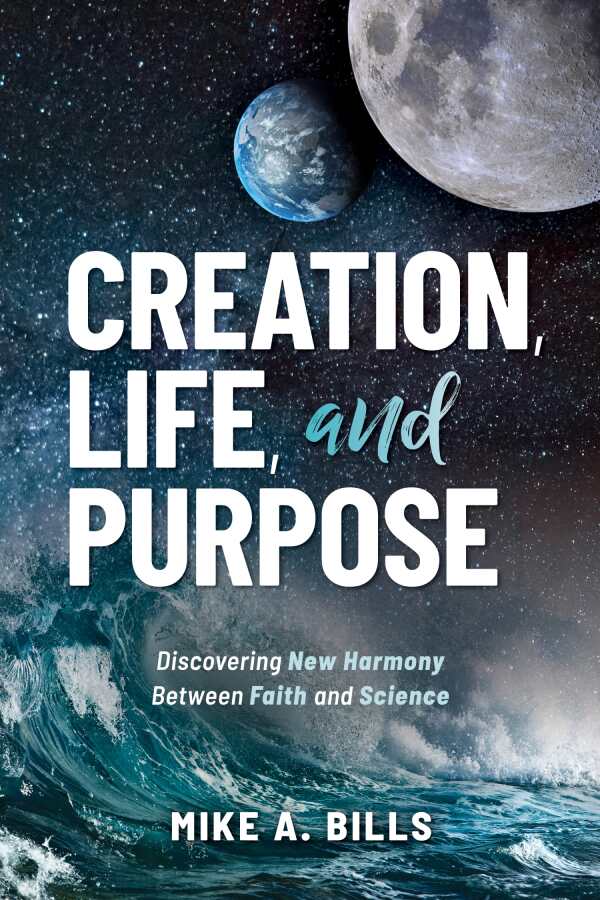
Creation, Life, and Purpose
Discovering New Harmony Between Faith and Science
The religious treatise Creation, Life, and Purpose is rigorous in its analyses of thorny biblical topics and apparent contradictions between faith and science.
Mike A. Bills’s compelling religious treatise Creation, Life, and Purpose argues that science and faith are not at odds when it comes to biblical belief and Christian living.
Written in the form of a long letter to Bills’s children, the book is rigorous in its analyses of thorny biblical topics and apparent contradictions. It treats the stories in question, which are familiar points of contention between believers and nonbelievers, from the lenses of both faith and science, with particular focus given to the creation and flood stories. Its treatments of Hebrew verses are erudite, used to pose intriguing ideas alongside considerations of archaeological research. Debates regarding evolution and intelligent design are also given attention:
For me, the sheer improbability of everything aligning so perfectly—whether in the forces that govern matter, the expansion of the universe, or the conditions that make life on Earth possible—suggests that more is at work than random, undirected processes.
More than half of the book focuses on this alignment of the biblical creation story with the scientific record, after which the book shifts to recommendations for living with faith and purpose. In its first part, it is clear and precise, asserting that how words are translated often changes the meanings of particular scriptural verses: The use of “land” is dissected to argue that the flood was not a global event, for instance, but a local catastrophe, and that Noah’s task was to “save the life-forms specific to Eden.” Such reinterpretations bring science and the Bible back into agreement.
This bracing apologetic for the comity of creation and science, built on muscular arguments that buttress the logical nature of the Bible and that treat science as an ally to proving the veracity of biblical accounts, continues with considerations of New Testament verses. For instance, the book argues that the genealogies in the New Testament are not literal, but an instance of “genealogical compression” that rests on the flexibility of the Hebrew language to uncover how the Genesis 11 events unfolded over a much longer period of time.
Such provocative theories run throughout the early, Bible-focused portions of book, whose prose revels in the thrill of discovery. However, the last third of the book changes direction to deliver advice on healthy and moral Christian living. This comes without the heady, intellectual steam of the book’s earlier portions, leading to a lackluster ending.
A faith-based treatise, Creation, Life, and Purpose argues that the most challenging Bible accounts can and do align with scientific principles.
Reviewed by
Peggy Kurkowski
Disclosure: This article is not an endorsement, but a review. The publisher of this book provided free copies of the book and paid a small fee to have their book reviewed by a professional reviewer. Foreword Reviews and Clarion Reviews make no guarantee that the publisher will receive a positive review. Foreword Magazine, Inc. is disclosing this in accordance with the Federal Trade Commission’s 16 CFR, Part 255.


