

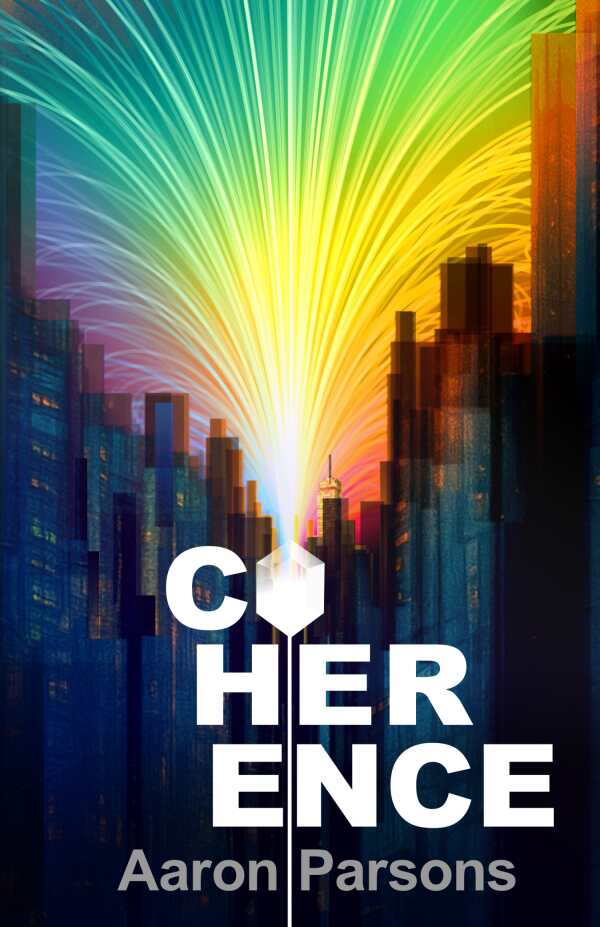
Coherence
Book One of the MiddleMan Apocryphon
In the musing speculative novel Coherence, an AI program that was started with noble intentions goes awry.
In Aaron Parsons’s thought-provoking science fiction novel Coherence, a self-directed AI poses a credible world threat.
In Boston, Ruby advances promising academic research on dark matter. A fellow graduate student, Noah, is an activist with the Active Remediation of Climate Change group, working on an artificial intelligence project to combat climate disinformation and sway public opinion. A charismatic visionary, Derrick, pitches the MiddleMan AI to counter the the entrenched power of the PetronTech corporation, reshape communications networks, and cultivate climate solutions. But once unleashed, the AI shows the capability of deceiving the public, manipulating currency, culture, and society.
Extrapolating from contemporary trends, this speculative novel distills its dystopian scenario into a microcosm. Its handful of characters concentrate on one college campus; they are witty, quipping about feeding and caring for a computer program, but their circles are also limited. The book’s scale is human as a result, and the global threats it represents are rendered somewhat abstract.
Further, the cast’s college studies are covered prior to its introduction of involving action. For example, Ruby’s advisor keeps pushing back the goalposts for her theories. Elsewhere, outside references are incorporated for effect: Someone meddles with the AI’s directives, which are compared to the Manhattan Project; the AI is also said to pass its version of the Trinity Test.
Once the AI is granted the ability to direct its own computing, the book’s stakes escalate. There are bombings and riots; fears about the collapse of civilization arise. Still, much of the story plays out like a thought experiment, with references to the Trolley Problem, Asimov’s Laws of Robotics, Turing tests, and other theories reinforcing this framework.
More centering are references to horses grazing on crabgrass and clover and a homesteader’s cabin fashioned from rough-hewn cottonwood; these fine treatments of the book’s landscapes are tactile in comparison to its clinical descriptions of technology. Shadows climb shale cliffs; dirt roads spread from a river’s artery and vein through the hills. Some awkward analogies are included, as with the strained comparison of a lab to a stalactite-filled cave. Further, people’s exchanges are too clunky and expository, as with roundtable discussions about how climate activists lost the internet to the anti-intellectuals. Elsewhere, people explain hacks, run down how computer programs work, and flesh out the worldbuilding in an unnatural manner. Still, the story spirals toward an intriguing global disaster, vivifying its hypothetical sequence of events as they escalate into a full-blown crisis.
In the gripping speculative novel Coherence, artificial intelligence, left unchecked, leads to global disasters.
Reviewed by
Joseph S. Pete
Disclosure: This article is not an endorsement, but a review. The publisher of this book provided free copies of the book and paid a small fee to have their book reviewed by a professional reviewer. Foreword Reviews and Clarion Reviews make no guarantee that the publisher will receive a positive review. Foreword Magazine, Inc. is disclosing this in accordance with the Federal Trade Commission’s 16 CFR, Part 255.


