

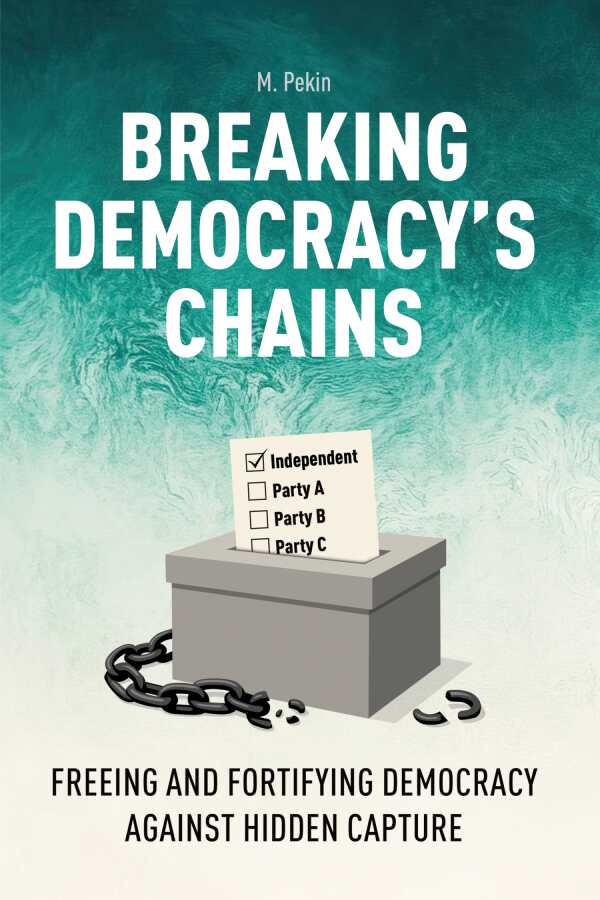
Breaking Democracy’s Chains
Freeing and Fortifying Democracy Against Hidden Capture
The assertive political manifesto Breaking Democracy’s Chains critiques the state of party politics and how elites have seized control of democratic systems.
M. Pekin’s political polemic advances a clear and urgent critique of party-based democracy.
Arguing that dismantling party dominance is the only way to restore democracy, the book draws on examples from the United States, Europe, and the UK. It asserts that party politics, at their core, stand in opposition to true representation. Its scope is expansive, incorporating thoughts on political history, media theory, campaign finance, and institutional design.
With the tone of a manifesto, the book’s thematic chapters discuss the historical origins of democracy, media influence on politics, and the need for institutional redesign. Short, punchy sentences are used to make points, resulting in a sense of urgency, though this approach also often results in repetition and some topical skimming. For instance, the idea that political parties centralize power and stifle dissent reappears throughout, often treated with similar phrasing and sans new insights.
Still, the book is compelling in arguing that political parties act more like bottlenecks than true champions of democracy. It indicts processes like filtering candidates, enforcing strict ideological rules, and allowing elites to seize control of politics. However, the context of such arguments is quite familiar, roiling around the influence of money in politics, media consolidation, and the unwillingness of institutions to change.
Further, the book’s engagement with political theory and contemporary scholarship is uneven. Its mentions of historical figures and contemporary writers have a name-dropping quality, rather than representing meaningful critical engagement. Jane Mayer’s work on dark money, for instance, is reiterated, yet the book’s coverage of this topic does not move beyond her established conclusions.
In addition, the book makes strong empirical claims without support. A notable example appears in its discussion of Israel’s alleged use of Pegasus spyware against journalists. The text asserts “This isn’t speculation—it’s documented,” but no supporting sources are included. The same rhetorical flourish is evident with its comments on media influence and foreign state broadcasters and with its analysis of the autonomy of the Russian media company RT.
Terms including “radical,” “naïve,” and “dangerous” are used without deeper exposition, and multiple references are made to Turkish President Recep Tayyip Erdoğan’s post-2016 consolidation of power. Better handled are topics including the fourth estate, wherein the book’s points about media dependence on political parties and advertisers are well developed; democracy as an evolving process; and actionable steps for laypeople, like voter refusal to support party candidates and the creation of a democracy fund.
The provocative political treatise Breaking Democracy’s Chains challenges the legitimacy of party-based democracy.
Reviewed by
pine breaks
Disclosure: This article is not an endorsement, but a review. The publisher of this book provided free copies of the book and paid a small fee to have their book reviewed by a professional reviewer. Foreword Reviews and Clarion Reviews make no guarantee that the publisher will receive a positive review. Foreword Magazine, Inc. is disclosing this in accordance with the Federal Trade Commission’s 16 CFR, Part 255.


