

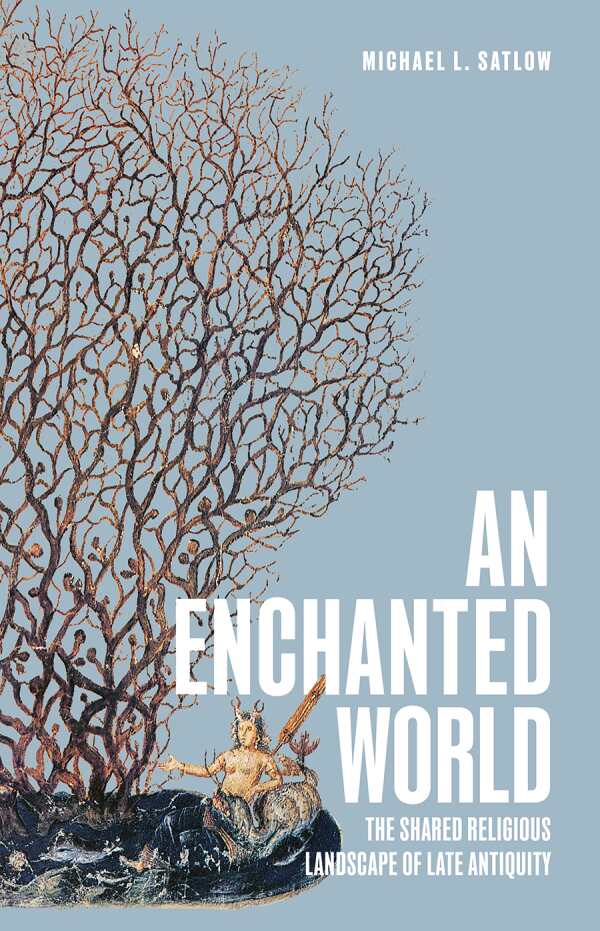
An Enchanted World
The Shared Religious Landscape of Late Antiquity
In Michael L. Satlow’s rigorous religious study, the daily practices of Late Antiquity faiths, set in a world alive with the supernatural, reveal the shared experiences of human beings negotiating the divine realm.
Focusing on Late Antiquity (200-600 CE), the book is a rich compare-and-contrast of believers’ worlds, whether they followed the Greek and Roman pantheon of gods or the Christian or Jewish traditions. Satlow’s two primary observations are that evidence of the supernatural was ubiquitous in Late Antiquity, to the extent that it was difficult to distinguish between Christians, Jews, and so-called pagans based on the ways each interacted with the invisible world. In this view, quotidian spiritual practices to maintain favorable relationships with the supernatural—sacrifices, rituals, amulets, and astrology—reveal how ancient peoples’ hopes and fears might challenge religious boundaries and rigid doctrine today.
With a cogent structure, drilling down from large categories of religion, identity, and ethnicity into the detailed landscape of individual experience, Satlow employs a thoughtful lens that shifts the frame away from groups and institutions and centers it on flesh-and-blood people. Through this refreshing approach, Satlow makes effective use of archaeological evidence and historical documents to tell the story of a world that “crackled with the energy of the supernatural.”
With fascinating detours into the spiritual practices of Christians, Jews, and the waning followers of Greek and Roman gods, Satlow also engages with the “literate elite” of Jewish rabbis and Church Fathers (St. Augustine features throughout) whose writings form the bulk of his sources. The academic-speak makes this book a good fit for specialists, and its arguments make room for more tolerance and empathy among religious people of varying faiths.
Heady and magical at once, the religious survey An Enchanted World issues an unapologetic, humanizing vision of a transformative period, showing how ancient spiritualism still has much to teach modern believers.
Reviewed by
Peggy Kurkowski
Disclosure: This article is not an endorsement, but a review. The publisher of this book provided free copies of the book to have their book reviewed by a professional reviewer. No fee was paid by the publisher for this review. Foreword Reviews only recommends books that we love. Foreword Magazine, Inc. is disclosing this in accordance with the Federal Trade Commission’s 16 CFR, Part 255.


