
Meet the Minds Behind "Quaker, Whaler, Traitor, Spy!": Author, Sarah Crabtree and Illustrator, Melissa Philley
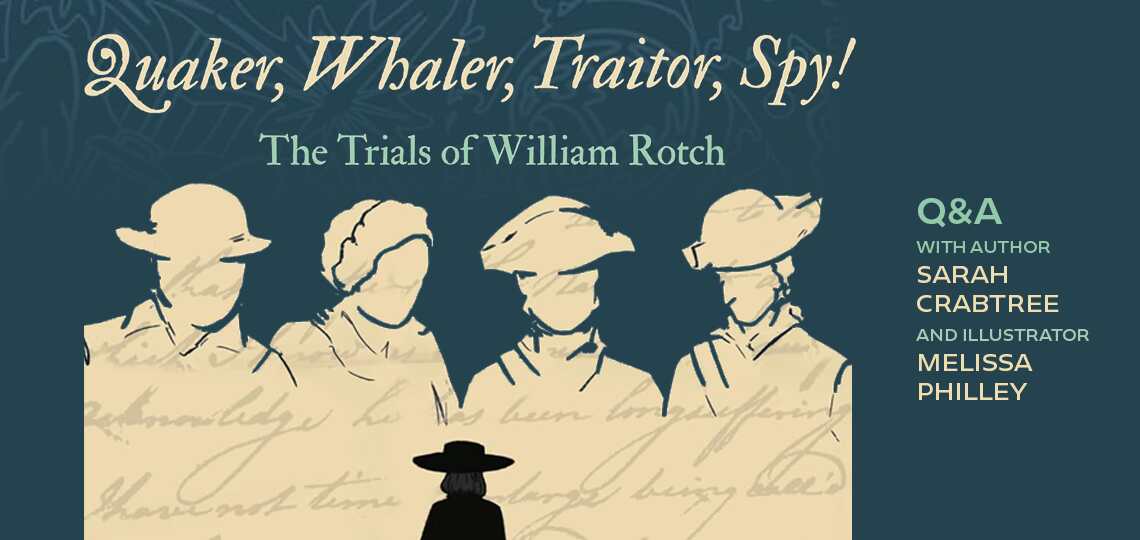
An Interview with Sarah Crabtree and Melissa Philley, Author and Illustrator of Quaker, Whaler, Traitor, Spy!: The Trials of William Rotch
Oil embargoes. False flags. Tariffs. Gunboat diplomacy. Smuggling. Religious zealotry. You might think these news items were pulled from a recent New York Times front page but no, we’re simply mentioning a few of the plotlines from this week’s featured book—a very special graphic novel about one of the most compelling and controversial figures from the American Revolutionary War. Indeed, at various times over the course of twenty years, whaler William Rotch was accused of treason by the US, Great Britain, and France. And, as a Quaker with a complicated view of patriotism, no less than John Adams had it out for Rotch. He is truly a man for the ages.
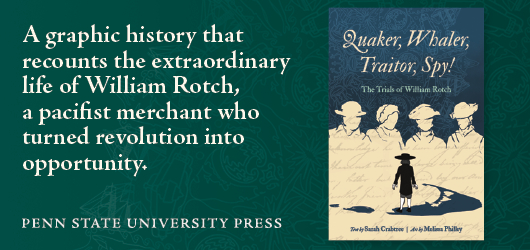
We’re with Sarah Crabtree and Melissa Philley, the author and artist behind Quaker, Whaler, Traitor, Spy!: The Trials of William Rotch. They joined us to share all manner of details about Rotch and how this project came together. The good people at Pennsylvania State University Press are pleased to offer readers 40 percent off the cover price by applying the discount code, SPY26, when ordering your copy.
The William Rotch story is fascinating and complicated—as inferred by the title—in addition to shedding light on an aspect of Revolutionary War history that will be eye-opening to many readers. As a historian, why were you convinced that this project needed to be done?
Sarah: Well, I think those of us who research the American Revolution knew there would be renewed interest during the 250th anniversary this year. And as I say in the book, William Rotch doesn’t fit into the stories from this period most people are familiar with—being accused of treason four times by three different governments in two decades is certainly unique! And so I thought using his experiences to show that people have always disagreed about how we define really fundamental ideas like patriotism and citizenship could—I hope!—offer a different perspective that would broaden and deepen our conversation about the Revolution and its legacy this year.
The US, Great Britain, and France all accused Nantucket-based, Quaker-whaler Rotch of disloyalty in the twenty years following the onset of the Revolutionary War in 1775. In order to betray a country, you need to have been in an influential position, able to do enough harm to jeopardize national security—all of which suggests Rotch was shrewd, transactional, equivocating, and slippery. In your remarkable author’s note, you admit to coming full circle in the way you view him. Please walk us through your changing opinions of Rotch.
Can I start by shifting this framing just slightly? These governments also persecuted scores of Quakers who were not wealthy or well-known in this time period. And when I explored this history in my first book, I included William Rotch’s experiences as examples of this larger conflict between church and state.
But as the first illustrated page of this book says, “This is a story about how I was wrong,” and this book is really a story of how and why I changed my mind. It started when a colleague really pushed me on exactly the point you make, telling me I couldn’t ignore Rotch’s extraordinary wealth and political influence. And when I made that shift and started to research his whaling business, a second story began to emerge. I think it really clicked when I read about the Rotches’ trade war against John Hancock and I began to understand that so many of the revolutionaries—Franklin, Jefferson, the Adamses, etc.—knew from their own personal dealings with the Rotches just how ruthless they could be.
I had to really sit with this aspect of his life for a long time, trying to figure out how it changed how I had written his experiences during the war. Did it add to that story? Complicate it? Negate it? We used the image of a kaleidoscope to depict how my thinking evolved—it wasn’t so much that I completely changed my mind but that I learned to see one person’s life in two different ways. The book ends by inviting readers to take a turn with the kaleidoscope, so hopefully they will also come to their own, different conclusions.
Why, specifically, did John Adams have it out for Rotch?
Oh, gosh, John Adams had it out for everyone! He was famously grudgey and grumpy; his wife, Abigail, was always trying to get him to cool it. But I think Rotch loomed especially large for Adams for a few reasons. Both were stubborn, principled men who had a long history of both working with and fighting against each other on a range of issues. And I think they mostly respected each other, even when they disagreed—you can really hear Rotch’s hurt in his letter to Adams after the treason charges were reprinted all those years later. But Adams never forgave Rotch for what he saw as a double betrayal—first, by not supporting the patriot cause during the war and then by moving his incredibly lucrative and strategically important business overseas after the peace—and so I think Adams resented that Rotch continued to enjoy and exercise his power and privilege after returning to the United States.
Tell us about your research? What source materials did you lean on? How long did it take you from start to finish?
Thank you for this question! Historians love to talk about our sources. The book is divided into halves—the first is dominated by Rotch’s memoir which I first encountered {whisper} almost twenty years ago. That’s freely available online, and I sometimes worry I memorized it. I corroborated many of the details using newspaper articles and government records. The second half required a lot of detective work and a steep learning curve. I’m used to working with archival records like letters and diaries, but I really had to teach myself to read different kinds of sources like account ledgers and ship manifests and to pay attention to different kinds of details like pricing, customs, and insurance. I am also forever grateful to all the researchers at whalinghistory.org whose work made it possible for me to understand the vast maritime network the Rotches relied on.
In terms of how long it took, the Rotches have more or less lived inside my head for almost two decades. Life and work sidetracked me for many years, but their story just wouldn’t let me go. I finally reached out to Melissa about two years ago. I don’t know if she would have signed on if she had known what was in store! But I am forever grateful she did, as it was ultimately her skill and guidance and commitment that got us across the finish line.
You’ve spent years studying the history of the Quakers across the Atlantic World, with a special focus on how they were persecuted. Why did they earn the ire of so many factions during this period? Was William Rotch’s experience typical or did he attract more attention because of his higher profile?
There were so few Quakers in France, but their story offers the clearest answer. French writers had admired Quakers for years—they wrote plays and philosophical treatises about them and even visited Britain and the US to meet “real” Quakers. But what I’ve always found so fascinating is that these same authors and politicians genuinely expected the Quakers to abandon their pacifism and support the Revolution. There is this very tense scene in the book where Mirabeau summoned the Rotches to the National Assembly to express his disbelief and even outrage that the Quakers weren’t supporting what is now their second Revolution. He really leans into them, saying the patriot cause is about liberty and justice and how could the Quakers possibly oppose that? And then he echoes what the Americans had warned Rotch, saying because our Revolution is by and for the people, it has to be an all-hands-on-deck affair, and your compatriots are going to really resent you if you don’t go along to get along. So I think everyone from government officials down to their neighbors felt a profound sense of betrayal, but I think if we peel that back a little, we see that it stemmed in part from a profound fear of disunity and dissent and what the Quakers’ refusal to join them meant about the righteousness and success of their cause.
Let’s not forget William’s younger brother, Francis Rotch, who proved to be crucial to your understanding of these events but also somewhat of “an enigma wrapped in a mystery,” to borrow a phrase from Winston Churchill, because he didn’t leave much of a paper trail. Tellingly, Francis wasn’t an observant Quaker like William. Please explain why Francis earned your trust as a source? Have historians treated him well?
This question is so interesting and important—I especially love thinking about whether Francis finally earned my trust by the end! Yes, as you say, Francis was initially a kind of a question mark or wild card because he didn’t preserve his private papers as opposed to William who wrote a memoir and left behind hundreds, even thousands of letters. I thought I had a good handle on William, his faith, his relationship with his family, etc., whereas all I could piece together of Francis was his business dealings. This caused me, somewhat unconsciously, to slot them into a kind of good-big-brother/bad-little-brother dichotomy with a principled-and-courageous William vs. a sneaky-and-greedy Francis. But I came to see both men—and their relationship—as much more complicated. Uncovering Francis’s story revealed how much William had withheld and what an unreliable narrator he was. This made me reflect a lot about what assumptions historians bring to the people we study and how the nature of our sources determine a lot of our assessment of their character and reliability.
Russia’s shadow fleet of oil tankers play a major role in the Ukraine-Russia War, and many countries are actively seizing those vessels in international waters. Similarly, in Quaker, Whaler, Traitor, Spy!, you detail how the Rotch brothers shifted residences to disguise allegiances, used freeports to unload whale oil, and kept multiple sets of flags on their ships to avoid detection—all to game the system and protect their investments. The brothers admitted to “pushing boundaries and making up the rules as we went.” Can you give us a better sense of the scope of this scheme and how they found it morally defensible?
Oh, that’s an interesting parallel. The Rotches hatched several schemes in the 1770s, 80s, and 90s as various wars were turning their whaling grounds and shipping routes into battle lanes and their ships and cargo into prizes of war. Francis’s first ploy is to use his Boston residence to obtain permits from the Americans and his London residence to get permits from the British. This way, he could present whichever set of papers would save him when hostile boarding parties tried to seize his ship. William denies participating during his treason trial, but Francis’s business records suggest otherwise. Then, after US independence, it appears both brothers smuggled American-caught oil onto Nova Scotian ships to avoid British tariffs.
But the biggest gamble was when they moved their operations to Dunkirk after King Louis XVI promised subsidies, loans, bonuses, etc. They were supposed to reregister their ships as French in return but instead they used it as an opportunity to acquire a second flag. They then reran Francis’s play, sailing with two sets of papers and presenting whichever was to their benefit. It was different this time, though, because now they were claiming to be citizens of two different countries. We are used to people having two passports nowadays, but dual citizenship was illegal until at least the 19th century. When their scheme was exposed, they lost over a dozen ships and nearly lost their US citizenship.
As to how it was morally defensible, I argue in my first book that Quakers didn’t really believe they were part of a nation-state—they lived in it, they lived under the thumb of its government, but they were Quakers first and foremost, not American or British or French. My research for this second book helped me see that a lot of merchants felt the same way. In fact, Jefferson complains bitterly about this, saying merchants have no country, their only allegiance is to profit. So government officials like Jefferson and Adams and Mirabeau and Robespierre saw patriotism and citizenship as moral questions, but the Rotches really didn’t.
You’re a bonafide historian, Professor of History at San Francisco State University, and author of two books now. Wearing your tricorne-shaped hat representing those areas of expertise, explain to us what the work of history is?
I use this metaphor in the book. I think many people believe the past is like a puzzle and the job of historians is to locate the missing pieces. And when we find enough pieces, we’ll have a stable, complete picture. I wanted to focus more on how we can look at the same person or the same event—even using the same set of sources—and come to different conclusions depending on our perspective. Again, this is my kaleidoscope analogy. I might turn the lens in one way so that a pattern emerges and then someone else will turn it a different way so that a different pattern becomes clearer. I don’t mean to imply that it’s all relative or that anything goes—historians use evidence to prove our arguments—more that I wanted to emphasize the work of history is ongoing and it is okay if we change our minds! We have to keep revisiting the past with new questions and more diverse perspectives to really get at these bigger and deeper questions of meaning and identity at the heart of what we do.
You tell and retell William Rotch’s story “as a way of illustrating how historians work in the present,” which allows readers to participate “in the process of making (and remaking) history for the future.” Can you unpack that statement for us, please?
I have a friend who jokes that people think you memorize 1000 facts for a BA in history, 10,000 for an MA, and 100,000 for a PhD. But that isn’t what historians do! So I wanted to shine a light on how we work, what we call our method, especially how we interpret sources and compile stories, and especially how our ideas change in light of new evidence and arguments. Then that last clause—making (and remaking)—is a way of acknowledging not only that readers absolutely can and should disagree with my interpretation of Rotch but that I will most likely continue to change my own ideas about him in the years to come. Making history is a collective endeavor and the work is never done!
What’s next for you and your talented pen?
All of my work engages questions of citizenship. Recently, I have become really interested in the role of public schools in American society, especially the changing attitude toward K-12 education and teachers. I enjoy experimenting with form and genre, so I am hoping to write it as a YA history.
What was it like to work with historian Sarah?
Melissa: I really can’t say enough about how wonderful Sarah was to work with. She came in knowing her own expertise, and trusted me to know mine, which isn’t always the case. The big fear is always a client who’s determined that they know better and demands that you make decisions that are detrimental. It’s sort of like going to a doctor, telling them you have chest pains, rejecting their suggestion to get a chest x-ray and instead insisting that they do surgery on your leg. This will not solve your chest pain issue, will cause new leg pain, and is largely a waste of everyone’s time and resources. But the customer is always right. Anyone who’s done commissions or contract work knows what I mean.
That was not the case with Sarah, and if any other comic artists get the chance to work with her in the future I highly recommend it!
What is the process of making a graphic history? How did the collaboration fit into that?
The first thing we worked on was, naturally, the script. Initially this project was conceptualized as thirty pages of comics. It’s now ninety pages. It’s very easy when you’re an expert in a subject to forget how much more casual knowledge of that subject you have compared to your average person. That was one of the main issues with the first script version. Luckily, I am not a historian, so I was a good test audience for that part.
And, like many histories, there’s a lot we didn’t have the space or time to include. Not just nuance or detail that didn’t make the cut, but incidents, actions, and decisions. So the process of reaching the final version was more a process of deciding what we could leave out. Presenting a history as a narrative is also a very different animal than a historical treatise meant for other historians, and that’s part of where my expertise comes in.
Once we settled on a script, I started working on what we call thumbnails. These are small sketches of what a final page layout might look like. They’re messy, fast, and disposable—I’m talking stick figures and rectangles that just say “ship” or “city background.” It’s a way to test visual ideas as quickly and efficiently as possible. This is also the stage where the most edits happen. By the end you should basically have a whole comic, it’s just extremely ugly and small.
After the thumbnails are mostly finalized, traditionally you would move on to pencils, and then inks. In the digital age there isn’t necessarily much difference. Then you do more edits, but smaller ones, maybe adjust some speech bubbles, trim down some narrative, swap the order of some panels.
After that it’s just finalizing and polishing the artwork and micro-edits like typos.
Who is the ideal reader?
There are some passages, mainly because of the inclusion of direct quotes from the era, that have an advanced vocabulary and more unusual sentence structures, so I think maybe thirteen years old and up—if they’re a strong reader—would be fine. The ideal reader is anyone with an interest in the topic, or who’s just looking for an interesting read. It’s not a very long read, and it’s a very digestible story if read at a surface level, but there’s plenty more there for those who want to do some deeper thinking. If you’ve ever enjoyed a forty-five minute documentary/explainer video online, this one’s for you.
Is working with fiction very different to working with nonfiction?
Nonfiction, particularly historical nonfiction, is a really interesting challenge. It makes certain parts of your story essentially inflexible. With fiction, if there’s a problem with a plot point, or a character, you change it, no problem. In nonfiction, you just don’t have that luxury.
Another big difference is an extra rigorous editing process. Usually you do the best you can, you read through carefully, get multiple sets of eyes on things, but if you draw a character wearing gloves in one panel, and magically no gloves in the next, if you’re far enough into the process, you just let it go. For a nonfiction work, there are some parts you just have to get right.
Another challenge is needing to be careful with anachronisms and visual shortcuts. There’s a panel where Francis and William high five each other. This is anachronistic enough that it’s clearly just a signal to the audience that they feel they’ve accomplished something. But there were definitely moments where I had a character doing something or placed in a room in a certain way, that Sarah asked for changes to in edits, because that simply wouldn’t have happened at the time.
What were the particular challenges of illustrating this story from this era?
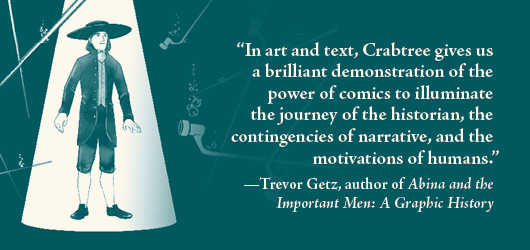
One of the first challenges we came up against with this project is the character design. Quakers had sort of a dress code at the time, which means they’re wearing very similar clothing in very similar colors. That knocks out a huge chunk of your toolset when it comes to character design, which is really important for clarity and readability. One thing I was able to use was the hats. William always appears in a hat with a flat top, his son always wears a hat with a rounded top, and Francis (William’s brother) doesn’t wear a hat at all.
There’s also a portion of the story where William and his family go to France. Ordinarily, the most straightforward way to express this to an audience is to just throw in a wide shot cityscape with the Eiffel Tower. Unfortunately, the Eiffel Tower wouldn’t exist for another several decades. I thought about instead using an image of Versailles, but I didn’t think that would be recognizable enough standing on its own as a visual cue. In the end, I think I scrapped that panel entirely and went with one depicting the voyage itself.
The last problem is visual reference. There really aren’t a lot of photographs from the time period, and by that I mean, essentially, none. Sarah mostly provided me with the visual references I asked for. Mainly portraits of the people in question, a lot of ships, interiors of rooms, and furniture styles. The architecture was very difficult, because an average looking house isn’t the sort of thing people take care to record just in case someone is going to make a comic about it a few centuries down the road. I was able to get a pretty good reference for everything except scaffolding. I couldn’t come up with anything on what scaffolding would look like at the time, and why would I? Again, who would think to go to the effort of recording what scaffolding looked like. I just went with what seemed simplest and visually clear.
Any other interesting things about the process?
We had a lot of debate about font use. We initially had the idea of both a Sarah-inspired historian narrator AND Rotch himself as narrator. We thought we’d show the difference through having different fonts. But then we had to account for Rotch having both dialogue (usually in a bubble with a tail) AND narration (usually in a rectangle), as well as accounting for indicating when text was a direct quote, which we thought maybe could be shown using embellished versions, for example, a narration rectangle that looks like a scroll at the edges. AND we had to think about accounting for some direct quotes NOT being from William Rotch, particularly in dialogue. By then we were reaching a point where we had two font choices, four bubble choices, and two quotation types—which meant audiences would have to keep track of sixteen different types of text. Needless to say, the idea was mostly scrapped.
Matt Sutherland


