
Interview with Nillin Lore, Author of Carry On: Unpacking Your Internalized Transphobic and Queerphobic Baggage
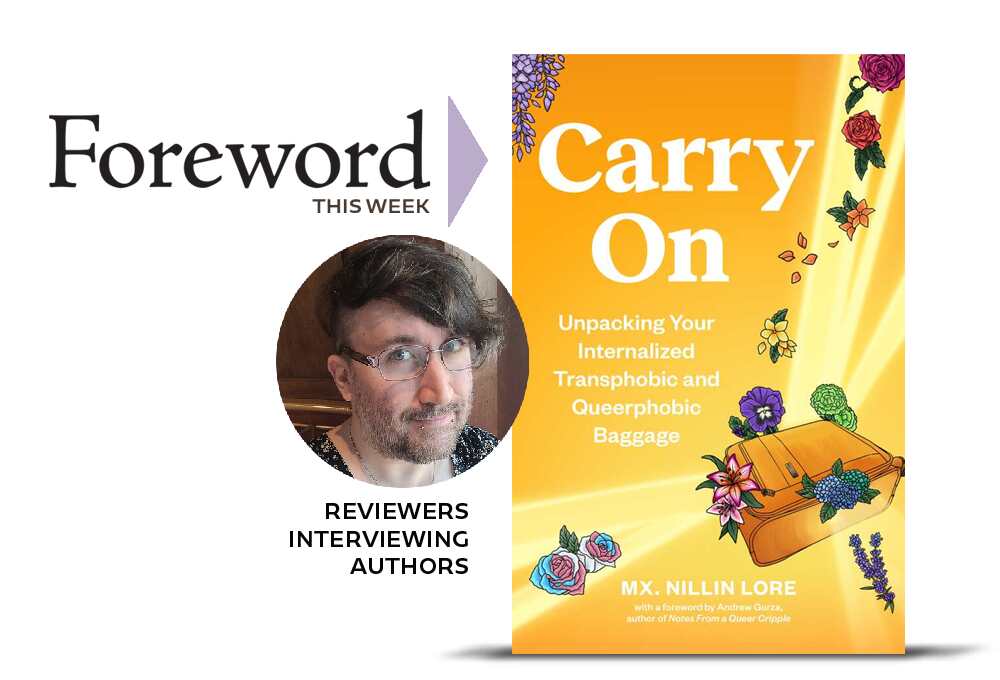
It takes a village to help an LGBTQ+ teenager come out—in addition to a robust bookshelf. Fortunately, those human and literary resources are becoming easier to find. Unfortunately, we still live in a world where condemnation and hatred run rampant, so support of all kinds is as important as ever.
When thinking about the reasons they write, today’s guest remembers “little Nillin who was so alone, scared, stressed, confused, ashamed, and filled with all of these urges and desires that the world was telling them were somehow immoral and unnatural. If I’d had access to more 2SLGBTQ+ affirming books I can’t help but wonder if I’d have still stayed in the closet for nearly thirty years.”
Likely not—Nillin’s Carry On “brims with supportive words for queer and trans people,” writes Meredith Counts in her recent Foreword review. Little Nillin would be so proud of their older self.
Your new book, Carry On, seems like it will serve as a mentor and cheerleader for readers, especially for trans non-binary readers (please correct me if I’m wrong there!). It’s a friendly guidebook that can demystify queer terms and histories, and dismantle ideas or assumptions about identity and sexuality that can be harmful. You also include statements from a bunch of other queer leaders, thinkers. activists, and artists. What a gift, for people who may not have queer role models in their day-to-day lives.
While you wrote, did you have specific readers in mind? Will you tell a little about the mission of the book?
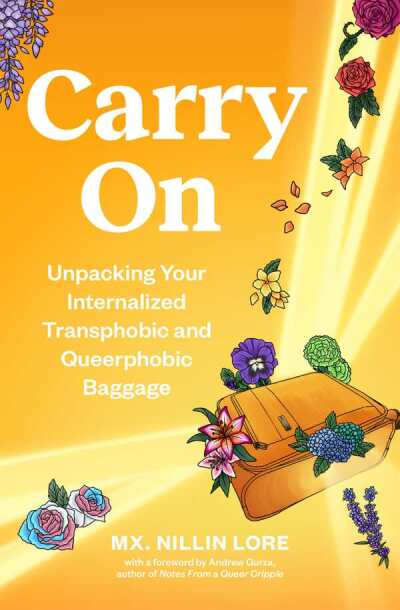
I’ve always said that a lot of what I write is to my younger self. I think back to little Nillin who was so alone, scared, stressed, confused, ashamed, and filled with all of these urges and desires that the world was telling them were somehow immoral and unnatural. If I’d had access to more 2SLGBTQ+ affirming books I can’t help but wonder if I’d have still stayed in the closet for nearly thirty years. Would I have come out earlier? Explored my gender identity with patience and self-compassion? Allowed myself to be in queer relationships with the people I was attracted to? I don’t regret anything about my life and wouldn’t change a thing because I know that would fundamentally impact the writer I am today, however, I want the books I write to reach those who really need them, just like I did.
My mission with Carry On is to encourage and empower queer, trans, gender nonconforming, neurodivergent, disabled, and marginalized people to focus inwardly on their own happiness, boundaries, and fulfillment. We can’t always change the world, and we certainly can’t make other people do what we want them to do, even if all we’re asking is for acceptance and respect, but we can unlearn all the toxicity and hate the society instills in us about ourselves. We can take control of our own narratives and forge lives for ourselves and community for each other.
One remarkable thing about the writing—the voice and tone—of Carry On, is how well it balances serious and sometimes upsetting topics with an overall upbeat tone and a commitment to joy. It works really well as a whole, even when different chapters have sections with personal stories of street harassment over one’s looks, for example, or of broad history of the Canadian Indian residential homes that took Indigenous kids from their homes and punished any behaviors that stood out.
Then in contrast, you address and encourage the reader directly in other passages, and have fun with descriptive language about clothing choices and entertainment references and some creative, emphatic slang and swearing, and celebrating the feeling of finding oneself and finding one’s communities.
Will you talk a little about balancing the good and the bad in this book?
I feel like there’s so much negative public discourse about 2SLGBTQ+ people, especially trans, nonbinary, and gender nonconforming folks, and I just really don’t want to be adding any more reasons for our community to be panicking and afraid. There’s a lot of reasons to feel depressed these days with the state of the world, and the ways in which AI and algorithms are feeding us misinformation, rage bait, and flooding us with images and videos of extreme violence, unrest, death, and war. Not that these aren’t important things to be aware of, but if that’s all the information and perspective we’re being fed day to day that’s going to have a very adverse affect on you. It’s gonna be exhausting, infuriating, stressful, and emotionally devastating.
Yet there is also so much beauty around us! So much to celebrate and be thankful for! I think it’s crucial that marginalized folks take the time to see that and let the good, positive, and loving messages out there sink in as well.
When writing about something as heavy as internalization, I wanted to instill the book with some of that beauty and wonder to remind readers that it’s not all bad. 2SLGBTQ+ people are fascinating, loving, creative, skilled, and have contributed so much to the world. As a writer it’s important to me that my work doesn’t just inform and educate, but genuinely uplifts and emboldens those who really need it.
As a follow-up about potentially emotional histories and anecdotes that are included, throughout the book, Carry On does a very conscious and caring job of letting the reader know ahead of sensitive topics.
This made me think of the idea of informed consent. Does making sure a reader is comfortable have any connection back to your roots as a sex author and blogger, where consent is so important?
Very much so! I don’t know about others, but one of the things that keeps me off social media more and more these days is the onslaught of deeply upsetting content and imagery that’s just thrown at us without any consideration for the effects that might have on somebody’s mental health and wellness. I can log in for five minutes on Facebook and in that time see several bombs dropped on a city, ICE brutalizing and kidnapping innocent civilians, a politician ranting about trans people being monsters, and a picture of a bloody body on some street somewhere, and it’s just sitting on my feed and being shared by mutuals with absolutely no consideration of the impact these things can have. No wonder we’re all so tired and depressed and irritable! There’s no off switch for it all!
I truly believe that consent extends to far more than just sex and intimacy. It also extends to emotional labour, commitment, quality time, and potentially traumatizing imagery and messaging. I don’t want to see death, destruction, and carnage every minute of every day without warning. I don’t need to wake up and immediately hear about queer hate crimes and be sent crime scene photos of trans murder victims first thing in the morning.
When people read my books I want them to be able to do so knowing that they won’t have something incredibly triggering or upsetting dropped on them without a heads up. I want readers to make their way through Carry On, and How Do I Sexy?, and any of my upcoming titles, in an informed and confident way so that they can get as much from it as possible without burning out on potentially draining topics. Consent is important!
You have several upcoming book titles coming up in the next year or two, which is exciting! Will you tell us a little about these new books, their topics and how far along they are to being completed?
You’re so right! I’ve been really hard at work researching and conducting interviews for two books actually. One of them is my fourth title with Thornapple Press, called Aro: What Aromanticism Teaches Us About Love, Affection, and Connection. It will be a deep dive into looking at how romantic love is depicted within Western society, how the social and cultural expectations around it can impact people, and what it means to exist as an aspec person, somebody who experiences very little to no romantic attraction at all, in a world that include finding your one true love as a defining life milestone. I’m a greyromantic individual myself so this one is very personal to me and I’m excited to share it. There haven’t been a lot of books centering aromantic people yet!
The second book I’m working on will be the first that I’m co-writing with my partner, Fenric Leverett! We recently signed a deal with Jessica Kingsley Publishers to write Fursonas: Finding Yourself and Exploring Queerness and Neurodivergence in the Furry Fandom. We’ll be presenting a comprehensive look at the international furry community as it exists in North America, South America, and the United Kingdom, as well as other regions of the world, with a heavy focus on how furries tends to be a tremendous draw to 2SLGBTQ+, neurodivergent, disabled, and otherwise marginalized individuals. There are already interviews lined up with artists, writers, musicians, fursuit makers, programmers, game designers, filmmakers, and even politicians, who are also furries. I think it’ll be a really great read and the first book of its kind on the fandom.
I can’t want to start sharing more about them both soon!
Meredith Grahl Counts


