
Michelle Schingler Interviews Bar Fridman-Tell, Author of Honeysuckle
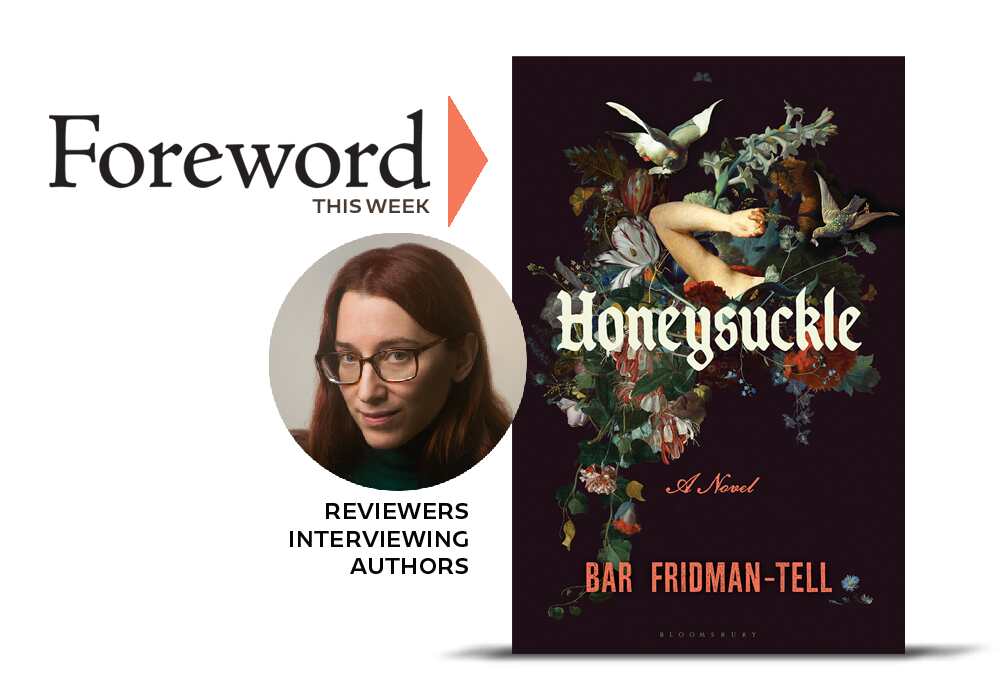
In today’s conversation, Editor-in-Chief Michelle Schingler coaxes Bar Fridman-Tell into revealing a fascinating source of anxiety, one that Bar shares with other principled writers who retell myths and folk tales while striving to stay true to the characters of the original story. To wit, What is the relationship between retelling and reimagining? Are they compatible? Why care?
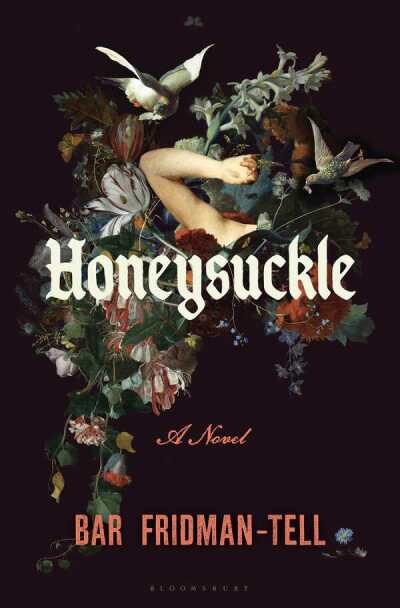
Regarding her debut novel Honeysuckle, a retelling—or did we mean reimagining?—of the Welsh myth of Blodeuwedd, Bar says she was drawn to reexamine that story of a woman created from flowers because she “never felt comfortable with how she’s framed as a villain when she’s given so little control … over her own life and body.” In other words, Bar had an axe to grind with the myth and she turned that discomfort into one of the best books Michelle (see her starred review) has seen this year.
Enjoy the conversation.
Honeysuckle is a tantalizing retelling of a classic folk tale with an additional feminist twist. Can you talk a bit about what it’s like to adopt a known story as your own—what you feel obliged to keep, what you feel moved to rewrite, et cetera?
I’ve put a lot of thought—probably too much—into what it means to retell a story, and the tension between retelling and reimagining (partly because of my thesis research, and partly because I’m a somewhat insatiable reader of myths and retellings). I think many retellings are born from dual impulses: on the one hand, loving the story you begin with; and on the other, a niggling sense of unease about some element of it—something that pushes you to unravel it.
That was very much the case with Honeysuckle. I’ve always loved the story of Blodeuwedd deeply, but never felt comfortable with how she’s framed as a villain when she’s given so little control or agency over her own life and body. Honeysuckle is my way of pulling at that thread, of asking what it means to be created for someone, to exist within a relationship where the power is entirely skewed to one side—keeping not so much the plot of the myth as the setting, relationships, and assumptions behind it.
Your descriptions of the natural world are so luscious, and the bits that make up Daye are seductively evocative. How did you choose what she’d be woven from next, and what inspired the ultimate additions to her form, beyond her yearning for escape?
I did a lot of research on seasonal flowers and plants, trying to remain as faithful as possible to the local flora Daye could be made from. At the same time, much of the inspiration came from living next to the Institute Woods in Princeton, New Jersey, and from my daily walks there.
The later additions to Daye’s form (which I’ll keep vague to avoid spoilers) draw on the original story of Blodeuwedd in Welsh mythology. They became a way of rethinking how that story ends—and, in some ways, of allowing her to reclaim it.
Would you consider Honeysuckle a love story? Why or why not?
I think Honeysuckle is not so much a love story as a story about love. It is in no way a romance, and does not follow the structure or expectations that come with one. Rather than tell a love story, in Honeysuckle I tried to ask questions about what shape love takes in a relationship with an essential imbalance of power, and about the messy interrelations between love, power, control, and agency.
Rory is both sympathetic in places (his parents’ abandonment of him and Wynne is brutal) and responsible for some reprehensible acts, his intentions aside. For you, what was interesting or necessary to explore about his creator-created, inherently power-imbalanced relationship with Daye?
I was very interested in the costs that both sides pay in a relationship like this—where one person holds all the power, but also all the responsibility—and in asking whether such a relationship could end in anything other than tragedy, even when both sides enter it with the best intentions. I wanted to show not only the toll this takes on Daye—on her autonomy and ability to consent—but also on Rory, and what it means for him to find himself holding Daye’s life quite literally in his hands.
Watching Daye come into her own is pretty magnificent, despite the tragic elements involved in that shift. What directions do you envision her choosing for her life, once she is able to choose?
Thank you! Would it be strange to say that I try not to envision her life after the book ends? As a writer, there’s a strange tension between knowing I created Daye—that everything she does is, ultimately, directed by me—and spending years essentially living with her. Because of that, I feel like allowing myself to speculate, even just to myself, would take away from the privacy and freedom she very much deserves.
You have a background that’s pretty dreamy from our perspective—you’ve worked as a translator, a bookseller, and are now pursuing an MLIS, putting you at a cross section of all of our favorite people! What do you appreciate most about these fields?
I think each of these roles—along with my years studying in the English department—has taught me something different about narratives, language, and how people engage with them. Each asks me to approach texts in a different way: as something to transmute, while preserving as much of the original as possible; as an act of matchmaking, where I try not only to distill a story to its essence, but also to try to match the right book with the right reader; and as a facilitator of access, working to ensure that the stories people need are available to them—which also means constantly questioning how I decide what is needed.
I love all three deeply, and wish I could do them all at once (while also being very aware that I love sleep quite a lot).
Michelle Anne Schingler


