
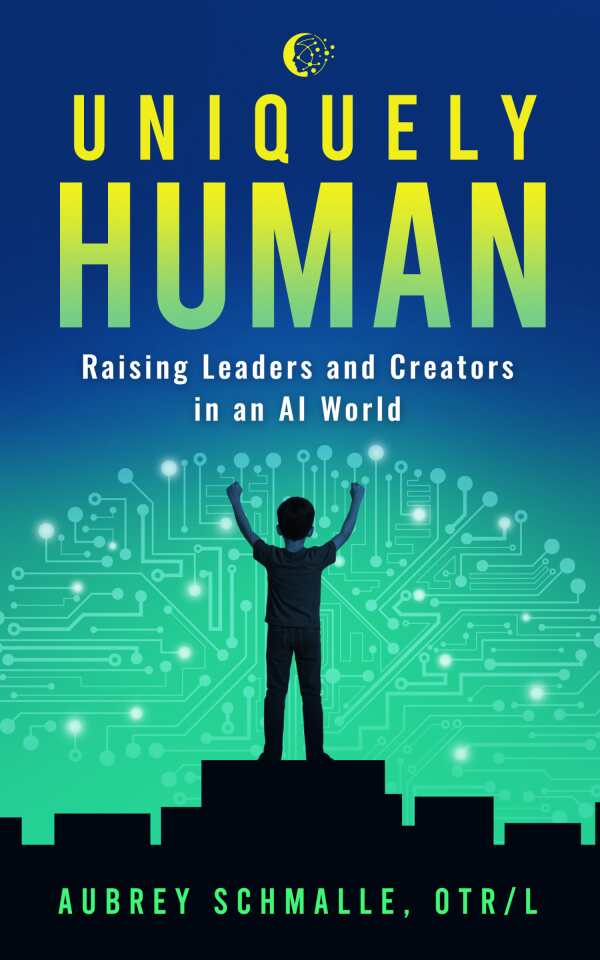
Uniquely Human
Raising Leaders and Creators in an AI World
Uniquely Human is an astute parenting guide for those looking to navigate a digitized world built for consumption rather than personal development.
Occupational therapist Aubrey Schmalle’s science-backed parenting guide Uniquely Human suggests means of evading digital overreach in childhood.
Arguing that behavioral and mental health challenges including distraction, dysregulation, social anxiety, and learning difficulties are the consequences of a digital environment built for consumption rather than development, this book draws on pediatric occupational therapy practice, peer-reviewed research, and firsthand parenting experience to make its case. Its response is five-pronged: It recommends modeling healthy technology habits as a parent, investing in face-to-face connections, prioritizing purposeful movement, cultivating multisensory learning, and building digital literacy.
The book progresses from its diagnoses to prescriptions for change well. Its problem framing draws upon developmental neuroscience, public health data, and clinical observations to explain how a screen-heavy childhood disrupts sensory integration, social skill formation, and academic learning. This scientific grounding ably validates the recommendations that follow, which are motivating on their own merit.
Each chapter opens with a stated goal and a proposed solution, a format that keeps the material action oriented and informative. The book’s recommendations are further deepened by their nuance: For instance, familiar tips related to physical activity are amplified by insights into neurophysiology, complementing recommendations for outdoor play with explanations of the mechanisms behind such advice. The book’s clinical anecdotes serve the same function, showing how its abstract principles operate in real treatment settings.
The digital safety chapter is an outlier in this mix, taking a different approach to its subjects. It covers online predators, cyberbullying, AI chatbot risks, and related legislation; each such topic is introduced and moved past in a short span. While weight is suggested behind this material with references to credible studies and news events, its scope works to its detriment, rendering it informative but underanalytical in comparison to the surrounding material.
The prose is accessible throughout, though. Technical vocabulary from occupational therapy is defined in context, and the stories drawn from Schmalle’s clinical practice, parenthood, and daily life make the material approachable. Still, some points are revisited amid the mix of personal stories without need. Further, the book’s central claim—that screen time displaces multisensory experiences—appears in near-identical terms across multiple chapters with diminishing returns. And while the book’s sense of authority wavers when its passages related to neuroscience give way to affirmations, its rigor as a scientific resource is often keen.
Making a case for protecting children from technological threats, Uniquely Human is a grounded parenting guide.
Reviewed by
John M. Murray
Disclosure: This article is not an endorsement, but a review. The publisher of this book provided free copies of the book and paid a small fee to have their book reviewed by a professional reviewer. Foreword Reviews and Clarion Reviews make no guarantee that the publisher will receive a positive review. Foreword Magazine, Inc. is disclosing this in accordance with the Federal Trade Commission’s 16 CFR, Part 255.


