

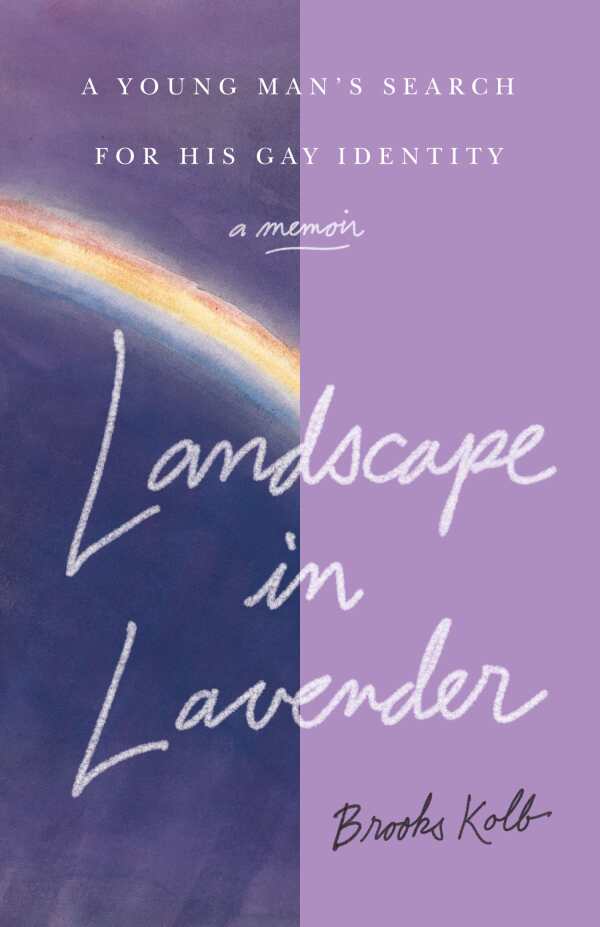
Landscape in Lavender
A Young Man's Search for His Gay Identity
Landscape in Lavender is a moving, meditative memoir about the nonlinear process of coming out to oneself and one’s family.
Brooks Kolb’s LGBTQ+ memoir Landscape in Lavender is about navigating his identity, romance, and career during the mid-to-late twentieth century.
In the mid-1970s and early 1980s, Kolb studied to be a landscape archtitect at the University of Pennsylvania. He also wrestled with being gay against the expectations of his single-minded father. Even after he came out to himself, Kolb spent years trying to date women. Still, as a timid twentysomething, he began to enter the gay dating scene.
This personal meditation on the nonlinear process of coming out to oneself and one’s family is made up of memorable, thoughtful anecdotes. A pattern emerges of Kolb admiring beautiful women and forming close friendships with them while lamenting his lack of sexual interest in women. Also recurrent is Kolb’s attraction to Black men and his desire to understand anti-Black racism, having spent most of his young adulthood in segregated Philadelphia. Indeed, racism complicates his dating life, just as being gay complicates his professional life.
Some of the book’s treatments of racism are oversimplified, though, as with the assertion that Kolb wishes he could wave a wand and make anti-Blackness disappear. Still, the subject is handled with genuine concern: Kolb works to understand how racism affects his neighbors and why his Black classmates would choose to separate themselves from their white peers. The book reckons with the realities of racism, rather than its mere concept, with greater clarity as it progresses.
The complications of a relationship between conservative parents and a queer child are also handled with care. Kolb’s parents are framed as well-meaning, but they still presumed that gay life was too complicated, fraught, and lonely. His father, an architect, had a tunnel-vision desire to see his children follow in his footsteps, and Kolb’s deviations from that path to become a landscape designer also caused friction.
The prose is fluid, accessible, and often beautiful, with strong sensory details and figurative language. For example, Kolb discusses his growing awareness of homophobia and racism: “It was as if both pathologies were floating on the breeze or rushing out with the water every time someone turned on a faucet.”
Moved along by revelatory moments, such as Kolb’s realization that refusing to bring his boyfriend to work events was a form of devaluing their relationship, the book is illuminating. Such realizations also direct the book’s milestone turns, as with Kolb’s first time having sex with a man, whom he became convinced was his soulmate. Discussions of Kolb’s career trajectory are less involving and consume too much of the book’s first half, compromising interest. But after Kolb comes out and his gay identity is centered, the book becomes more evocative.
A moving memoir, Landscape in Lavender tracks the long process of coming out in a racially divided American city.
Reviewed by
Leah Block
Disclosure: This article is not an endorsement, but a review. The publisher of this book provided free copies of the book and paid a small fee to have their book reviewed by a professional reviewer. Foreword Reviews and Clarion Reviews make no guarantee that the publisher will receive a positive review. Foreword Magazine, Inc. is disclosing this in accordance with the Federal Trade Commission’s 16 CFR, Part 255.


