

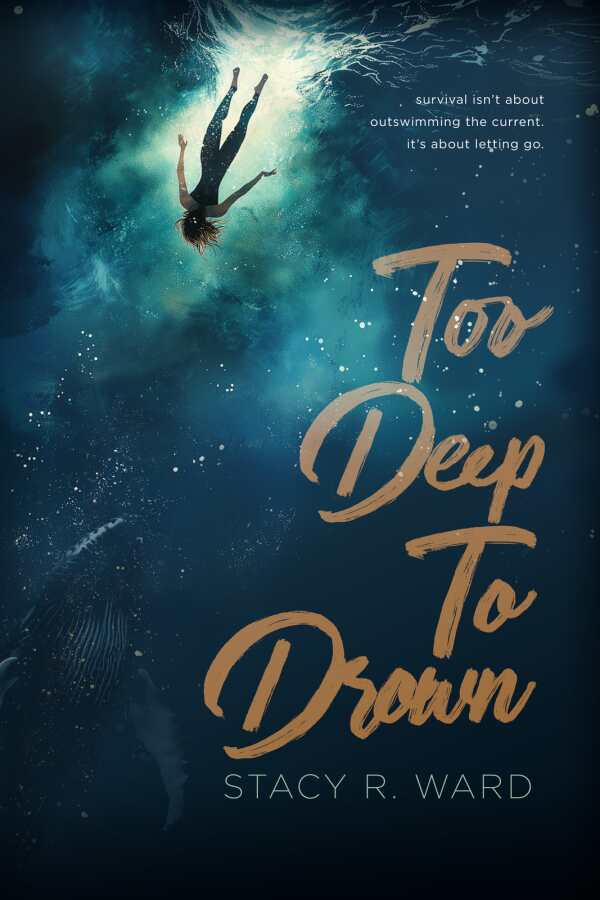
Too Deep to Drown
A resourceful teenager comes into her own while working as an intern on a research vessel in the affecting novel Too Deep to Drown.
In Stacy R. Ward’s aching, ecoconscious novel Too Deep to Drown, a teenager matures while working aboard a marine research vessel.
Seventeen-year-old Meg sought legal emancipation from her mother, an agoraphobic hoarder in Ohio. Now she lives with her Aunt Tessa, the captain of the R/V Sojourner, in San Diego. Hoping to earn a naval engineering scholarship and prove her worth, Meg becomes an intern on the boat, working as a wiper in the engine room during its oceanic pollution survey trip and developing a camaraderie with the crew, among whom she strives to show that she belongs.
The book ably moves between the past, which is covered through child protective services transcripts, and Meg’s present. Meg discloses much about herself, in terms of her resourcefulness, her pain, and her feelings of love and shame toward her mother. Her enthusiasm for her new mechanical work is apparent as she describes the engine room’s generators and the ship’s interiors; her problem-solving on the job is methodical. Youthful and intelligent, she’s equally at home using casual lingo and employing scientific terms.
The book’s secondary characterizations are more impressionistic, though. Her bold Brazilian roommate, Izabel, fosters Meg’s courage; Joe, a college intern, becomes Meg’s romantic interest. Though she seems stern at first, Tessa is fleshed out as competent and supportive.
The story moves at a measured pace that reflects the ship’s itinerary, with thrills introduced via research dives and rare instances of danger. Meg exhibits reckless resolve at times, though she also becomes more aware as the book continues, learning to be more considerate about how her choices impact others. Meg’s growth is further illumined using science as a lens, as with a recurrent metaphor concerning a humpback whale, which also reinforces the book’s themes related to the sea’s mystery and Meg’s hope for healing. Indeed, information about whales folds into her conversations as she learns about the ship’s various projects.
As the book moves toward its conclusion, Meg’s hopes for a future at sea, which she thought would be an antidote to “the overwhelming claustrophobia” of her mother’s home, gain further complexity. Life on the water, she realizes, isn’t easy either, as the ocean teems with beauty and and dangers alike. And while the book’s finale is a bit too tidy, spelling out the novel’s hopeful themes in explicit terms, it is nonetheless affecting.
In the potent novel Too Deep to Drown, a girl contends with her sense of duty toward her mentally ill mother while working to claim a future on the sea.
Reviewed by
Karen Rigby
Disclosure: This article is not an endorsement, but a review. The publisher of this book provided free copies of the book and paid a small fee to have their book reviewed by a professional reviewer. Foreword Reviews and Clarion Reviews make no guarantee that the publisher will receive a positive review. Foreword Magazine, Inc. is disclosing this in accordance with the Federal Trade Commission’s 16 CFR, Part 255.


