

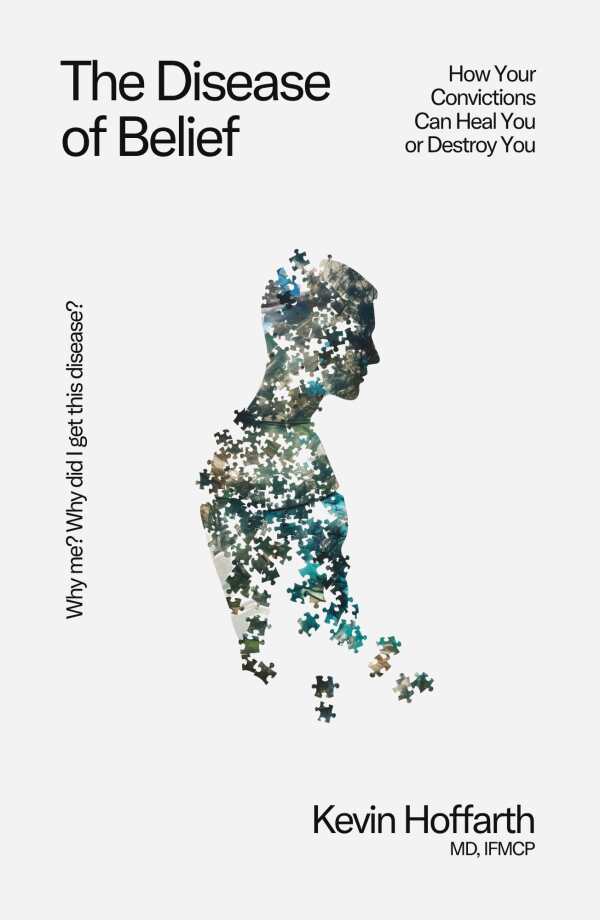
The Disease of Belief
How Your Convictions Can Heal You or Destroy You
Health issues often reflect problems in people’s thought environments, suggests the holistic health guide The Disease of Belief, which encourages looking within to find the root causes of illnesses and physical pain.
Physician Kevin Hoffarth’s corrective health guide The Disease of Belief uses quantum theory and other groundbreaking research to question traditional Western medicine.
Hoffarth draws on his experiences with lower back pain to discuss how physical problems sometimes have psychological roots. Indeed, he discusses how, through functional medicine, an integrated approach, and biological decoding (which locates pain that occurs in possible emotional and other psychological origins) he determined that his problems were rooted in his unresolved conflicts with his father. Using techniques inspired by innovations in science, psychology, and spirituality, he began to pursue holistic healing instead.
Suggesting that catastrophes prove the existence of quantum particles, the book’s chapters often relate moments of awe and wonder. Questions including “Why me?” and “What caused my disease?” appear, followed by assertions that just as science before quantum theory fell short, traditional Western medicine’s reliance on diagnoses based on physical evidence alone also falls short. The book works toward an ending that advocates for the wisdom from within, celebrating communities that build health together.
Some repetition is involved in the book’s recommendations, as with the recommendation to foster “curiosity, awareness, and consciousness of [the] boomerang effect,” represented by the acronym CAB. Indeed, the notion that diseases reflect people’s thought environments proves central, with Hoffarth’s back pain held up as an example: He felt that pain, the book suggests, because he was carrying his father’s heavy legacy. It insists that awareness of such connections is crucial to the healing process, and that ignoring them leads to worsening health. The example of an otherwise healthy woman whose digestive issues are attributed to keeping a secret from her husband is also shared, with the book claiming that those who included awareness in their plans to resolve physical and psychological troubles experienced success.
The book also includes discursions and winding analogies, as where it devotes excess space to explaining adjacent wellness practices, including the uses of psychedelics and Eye Movement Desensitization and Reprocessing (EMDR) therapy, and makes comparisons to life as a game, a school, and a puzzle in the process. Further, the chapters are quite short and end with “rabbit holes” that are underexplained in the text itself. A bevy of topics are introduced and left unexamined, making the text feel rushed and incomplete at times.
A holistic health guide, The Disease of Belief suggests that exploring one’s thoughts and unresolved issues can shore up the body’s ability to heal itself.
Reviewed by
Mari Carlson
Disclosure: This article is not an endorsement, but a review. The publisher of this book provided free copies of the book and paid a small fee to have their book reviewed by a professional reviewer. Foreword Reviews and Clarion Reviews make no guarantee that the publisher will receive a positive review. Foreword Magazine, Inc. is disclosing this in accordance with the Federal Trade Commission’s 16 CFR, Part 255.


