
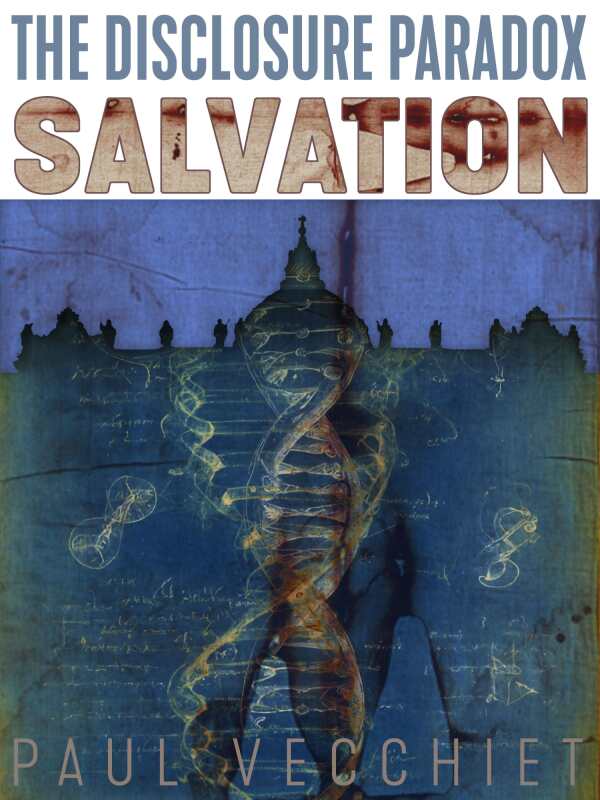
The Disclosure Paradox
Book 2: Salvation
The musing science fiction novel The Disclosure Paradox follows a cosmic conflict involving humans, aliens, and the divine.
In Paul Vecchiet’s intriguing science fiction novel The Disclosure Paradox, a Vatican guard’s disappearance leads to an investigation of the Shroud of Turin.
Robert and Fulvio served together in the Iraq War. Later, Fulvio became a Vatican guard. When Fulvio cuts his long-awaited reunion with Robert short, Robert goes to Rome to find out why. And when the person behind Fulvio’s disappearance learns about Robert’s visit, they attack Robert with chemicals. Robert’s vision of Jesus as he recovers reveals the Shroud of Turin’s importance in Fulvio’s disappearance.
Back in New Mexico, the Acturians, an alien race, return Robert’s friend Mary Ellen’s son, who was abducted by another alien race, the archons. The Shroud of Turin, which is on display during Robert’s Italy visit, links Fulvio’s disappearance with Mary Ellen’s reunion with her son. What follows is a cosmic conflict involving humans, aliens, and the divine that moves at a quickening pace.
Fulvio’s disappearance comes just after the opening abduction scene, setting up immediate intrigue as to what they have to do with one another. As the book toggles between Rome and New Mexico, its storylines converge. In New Mexico, Mary Ellen’s returned son adapts to life among human beings. His bond with his mother is soulful, as is that between Mary Ellen and Robert’s partner, Katrina. The women have telepathic powers with which they help one another and Robert from afar.
People’s conversations about spirituality are a dramatic undercurrent to the book’s events. Robert is an atheist who operates in a deadpan and pragmatic manner, but he changes after his vision of Jesus, becoming more heartfelt and sensitive. He starts to believe in the powers Mary Ellen and Katrina have, too. The person behind Fulvio’s disappearance also evolves, and the book’s secondary characters are amusing, including a make-up artist who helps Robert with costumes to get around the Vatican incognito and playful shroud experts. In comparison, the aliens’ characterizations are scant; they are unchanging across the novel, and their mindsets are underexplored.
The book’s worldbuilding is stultifying because of its excess of descriptions of buildings and other sites, including their intricate floor plans and designs. An abundance of sites named in Rome also bogs down the book’s progression. In contrast, the alien lab and ship are underdescribed. Further, the book ends sans a true sense of finality to its storylines, instead closing with a final verdict on the Shroud of Turin itself.
In the probing science fiction novel The Disclosure Paradox, people learn about the possible connections between humans and other galactic beings.
Reviewed by
Mari Carlson
Disclosure: This article is not an endorsement, but a review. The publisher of this book provided free copies of the book and paid a small fee to have their book reviewed by a professional reviewer. Foreword Reviews and Clarion Reviews make no guarantee that the publisher will receive a positive review. Foreword Magazine, Inc. is disclosing this in accordance with the Federal Trade Commission’s 16 CFR, Part 255.


