

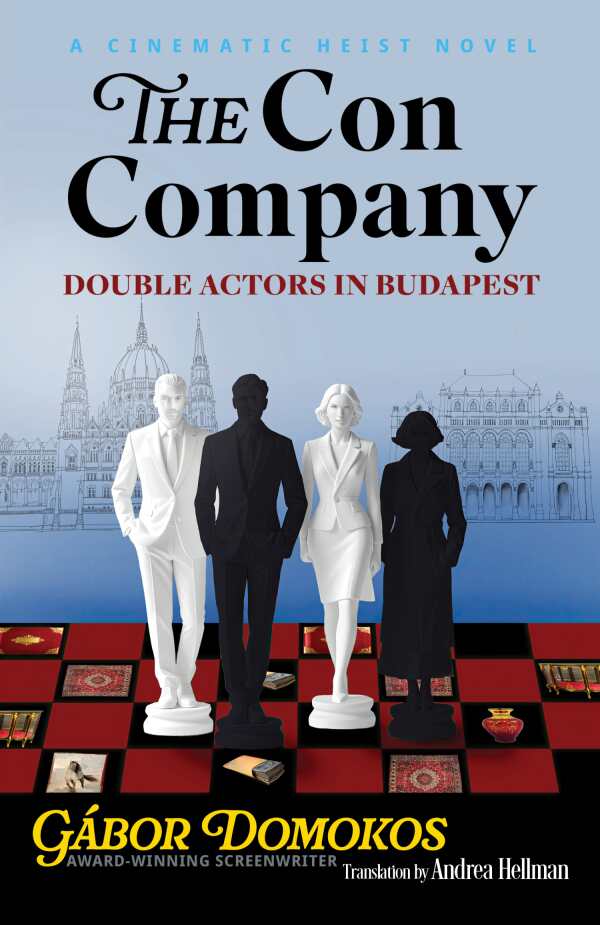
The Con Company
Double Actors in Budapest
A sharp and intricate thriller, The Con Company considers ambition against a backdrop of scheming.
Set in contemporary Budapest, Gábor Domokos’s vivid thriller The Con Company concerns a heist involving a forged manuscript and a diverse crew of con artists.
In Budapest, corruption operates in plain sight. In a public park, Bartha Junior, who is still new to the craft, assists his father in delivering bribe money to a municipal official. This choreographed performance introduces the novel’s central motifs: precision, rehearsal, and the normalization of deceit. Bartha Senior’s favorite refrain, “Everything’s greased,” becomes a thematic touchstone, capturing a worldview wherein corruption eases all transactions and dulls moral friction.
The book’s opening scene functions as a microcosm of the larger narrative. Bartha Junior’s internal evolution is followed; he grows from an uneasy novice to a willing participant in his father’s dealings, and his transformation underscores a broader concern with legacy—not only the inheritance of money or opportunity, but of ethical compromises. Here, corruption is learned behavior, passed from parent to child and embedded in habits and language.
Layered with reversals and shifting allegiances, this cinematic novel is divided into four sections that build on one another well. Each deepens people’s motives, the mechanics of the scheme, and the consequences, which reverberate long after the con is complete. The book’s deliberate progression generates dramatic irony too, with foreshadowing used to intensify suspense. The omniscient narrator moves between perspectives, illuminating people’s competing ambitions and private rationalizations to reveal aspects of their manipulations and moral compromises as the full architecture of the fraud comes into view.
The book blends suspense, dark humor, and psychological elements into its mix. Still, though deception anchors the plot, the pacing varies. Rapid-fire exchanges drive the action forward, while quieter passages focused on introspection expose the anxieties and self-justifications that fuel each person’s choices. Strategic descriptions add texture, mirroring the complexity of the con itself. The interplay between conversations and reflection keeps the tension taut, balancing spectacle with psychological depth.
As the museum heist takes shape, the groundwork laid in the opening acquires new resonance. Each gesture and contingency reinforces the novel’s suggestions that deception is both an art form and a survival strategy. The cast’s ingenuity is undeniable, but so is the cost of their choices.
An entertaining and unsettling thriller, The Con Company is about the pervasiveness of corruption, which is passed between generations as people trade integrity for advantages.
Reviewed by
Xenia Dunford
Disclosure: This article is not an endorsement, but a review. The publisher of this book provided free copies of the book and paid a small fee to have their book reviewed by a professional reviewer. Foreword Reviews and Clarion Reviews make no guarantee that the publisher will receive a positive review. Foreword Magazine, Inc. is disclosing this in accordance with the Federal Trade Commission’s 16 CFR, Part 255.


