

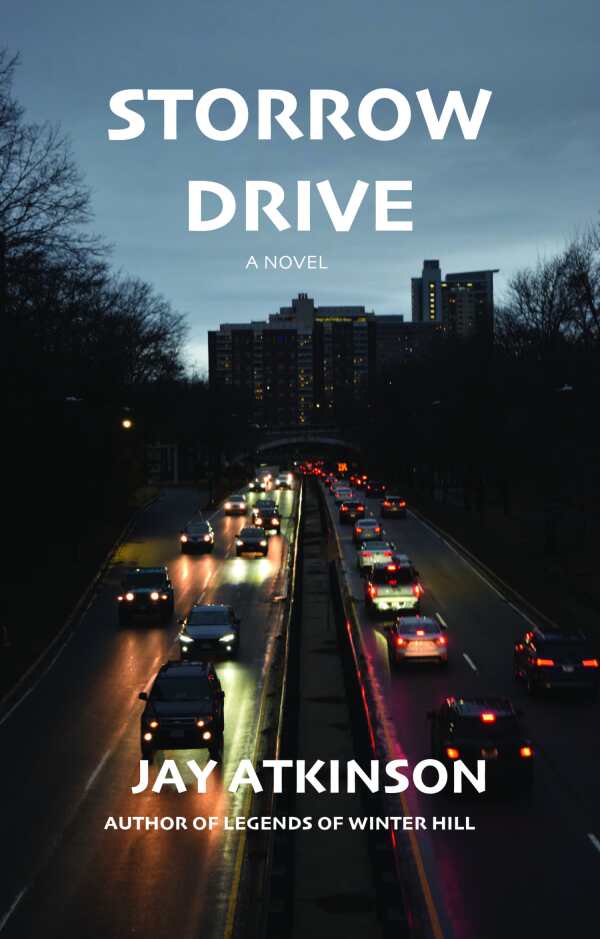
Storrow Drive
Covering interviews, ride-alongs, off-the-record exchanges, and insights into the machinery of law enforcement, Storrow Drive is an involving crime novel.
In Jay Atkinson’s engrossing thriller Storrow Drive, investigative journalism, institutional power, and professional risks intersect during a contemporary manhunt.
Joe is a Boston reporter who cultivates sources across law enforcement and the city’s criminal margins. Facing financial strain and professional pressure, he pursues a sprawling story involving a high-level drug dealer, Marco, whose evasion of capture draws in local police, state troopers, federal agents, and confidential informants.
Rather than framing the hunt in a single dramatic arc, the narrative unfolds through accumulation, covering interviews, ride-alongs, off-the-record exchanges, and insights into the machinery of law enforcement. In these situations, Joe is both an observer and a participant, with access to planning sessions, surveillance operations, and drug busts. Indeed, his journalistic process is the book’s structural backbone.
The book’s investigatory scenes emphasize preparation and uncertainty over spectacle, with tension emerging from incomplete information and competing priorities. The prose, too, favors clarity and restraint. Its sentences are direct and unadorned, with people’s humorous observations carrying the plot’s momentum. Exchanges between officers, informants, and reporters reflect their long-standing relationships, shaped by shared history, skepticism, and professional rivalry. Banter, sarcasm, and coded language suggest trust earned over time, while Joe’s references to sports, film, and art mark him as an older reporter whose cultural shorthand does not always land beyond his inner circle.
The settings are rendered in tactile terms, with mentions of worn police stations lit by fluorescent bulbs, subways feeling packed and restless, and city streets stretching across the winter cold and falling snow. Crime scenes carry the stench of neglect and human decay; informants and suspects are described in physical detail, with references to their sweat-soaked clothing and bodies altered by addiction.
Scenes outside of the active investigations broaden the story’s scope, as with accounts of people’s teaching obligations, romantic entanglements, and daily routines. These elements converge as the danger escalates, with Marco and his associates responding to their exposure through threats and pursuits. The overlap between people’s personal vulnerability and professional duties is central to the book’s ongoing tension. Still, detours inhibit the book’s progression at times, delaying its ultimate payoffs, which arrive via a decisive law enforcement operation that brings the investigation to a head. Indeed, the outcomes underscore the real human cost of proximity to violence and crime.
In the exciting thriller Storrow Drive, a crime reporter uses his access and restraint to construct a layered story.
Reviewed by
Brandon Pawlicki
Disclosure: This article is not an endorsement, but a review. The publisher of this book provided free copies of the book and paid a small fee to have their book reviewed by a professional reviewer. Foreword Reviews and Clarion Reviews make no guarantee that the publisher will receive a positive review. Foreword Magazine, Inc. is disclosing this in accordance with the Federal Trade Commission’s 16 CFR, Part 255.


